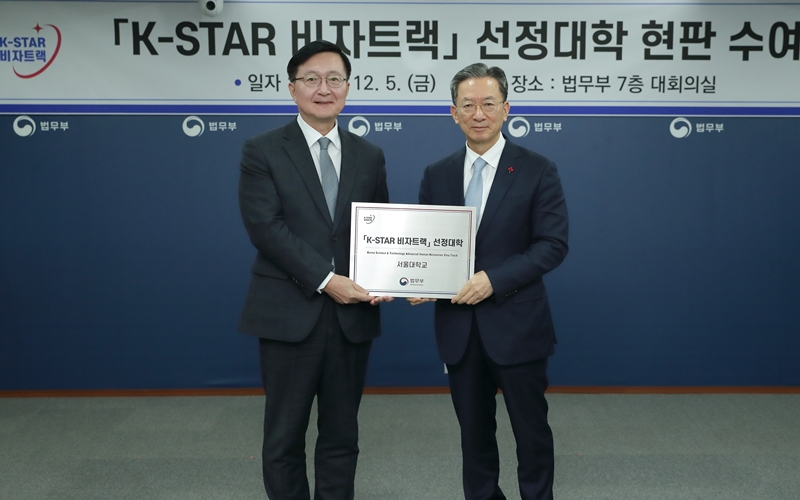
Minister of Justice Jung Sung-ho (right) on Dec. 5 presents a plaque to Seoul National University President Ryu Hong Rim on the designation of the latter's school for the K-Star Visa Track at Government Complex-Gwacheon in Gwacheon, Gyeonggi-do Province. (Ministry of Justice)
By Margareth Theresia
A system will be expanded to more domestic universities to offer longer-term visas to talented graduate students in science and engineering.
The K-star (Korea Science and Technology Advanced Human Resources) Visa Track offers the F-2 (resident) visa immediately to international students with a master's degree or doctorate in science and engineering regardless of job status, with only a recommendation from the applicant's university president needed.
This is expected to raise support for the settlement of outstanding researchers in the country and boost the global competitiveness of domestic research and development.
The Ministry of Justice on Dec. 5 said it held an awards ceremony at Government Complex-Gwacheon in Gwacheon, Gyeonggi-do Province, for plaques and certificates of designation to 32 universities selected for the program.
To prevent high-level researchers from leaving the country, this fast track for permanent residency and naturalization for outstanding scientists and engineers was launched in January 2023 at universities specializing in science and engineering. Thus outstanding foreign scientists and engineers with a master's or doctorate can get the F-2 simply with a recommendation from their university presidents and without needing a job.
K-star's main benefit is the halving of the period required to acquire permanent residency from six years to three and support for citizenship through naturalization when certain research results are met.
At the time of the system's launch, only master's and doctoral students from five science and engineering schools like the Korea Advanced Institute of Science and Technology (KAIST), University of Science and Technology (UST), and Daegu Gyeongbuk Institute of Science and Technology (DGIST) were eligible for the track.
From next month, however, 27 universities will join the program including Seoul National, Yonsei, Korea and Kyung Hee. All of the additions are deemed world-class research-centric schools under the Ministry of Education's program BK (Brain Korea) 21 Four, which eyes development of next-generation researchers and world-class leaders through stronger research and education at outstanding graduate schools in the country.
Minister of Justice Jung Sung-ho said, "Universities and the government will form a close cooperative system so that top talent who will create the future of the Republic of Korea's science and technology can settle here to achieve high-quality research results.
margareth@korea.kr