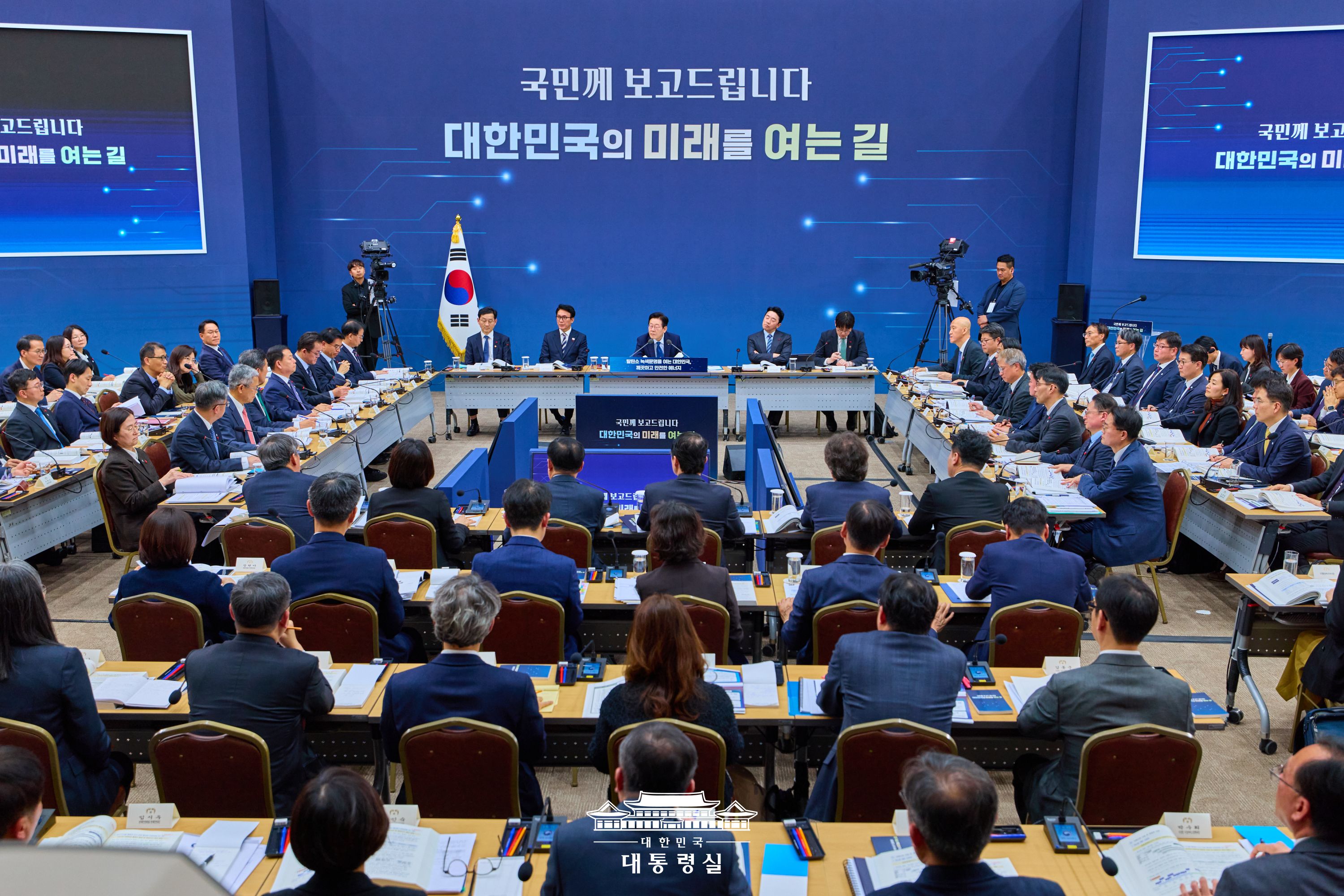
President Lee Jae Myung on Dec. 17 chairs a briefing on the joint 2026 business plan of the Ministry of Climate, Energy and Environment and the Nuclear Safety and Security Commission at the Government Sejong Convention Center in Sejong. (Office of the President)
By Xu Aiying
The Ministry of Climate, Energy and Environment will launch a stable basis for running a power system centered on renewable energy to supply 100 gigawatts of such energy by 2030.
At a briefing on the 2026 business plans of government ministries chaired by President Lee Jae Myung at the Government Sejong Convention Center in Sejong, the ministry on Dec. 17 announced two core strategies: a green transformation to create a carbon-free civilization and sustainable national environment where nature and humans coexist.
The foundation for achieving making progress toward a green country will come through responsible operation of 2030 Nationally Determined Contributions (NDC).
For this, the government's full capacity will go into achieving the objective of supplying 100 gigawatts of renewable energy by 2030. The revision of related laws and enactment of other legislation seek to improve rules on solar power distance to promote the energy source and expand its distribution.
For wind power, the aim is to supply 12 gigawatts on land and 25 offshore by 2035. Regulations will undergo streamlining to allow the use of wind data from the Korea Meteorological Administration instead of wind gauging equipment in getting power generation permits. A comprehensive pan-government support system will also provide key support for permits and licensing.
In addition, support will go to the development and verification of next-generation technologies such as tandem solar modules and ultra-large turbines of 20 megawatts or more. Efforts will also seek the early commercial application of such know-how to secure a leading role on international markets.
A planned energy highway will meet the era of renewable energy. Other plans are the setup of an intelligent power grid using artificial intelligence, deployment of 2.3 gigawatts of energy storage devices by 2029 and activation of virtual power plants to raise acceptance of renewable energy.
The ministry will leverage the implementation of NDCs as an opportunity to achieve major advances in industry and the economy. To expedite early commercial use of new carbon-neutral know-how, the focus will go toward developing green technologies like clean power, fuel and infrastructure.
Innovative unicorns companies will qualify for initial funding and startup consulting, as well as open innovation programs and demonstration equipment.
Another goal is a no-plastic, circular economy free from mining or disposal. Next year will see the debut of a certification system for renewable raw materials and promotion of joint certification with major economies abroad to lower the burden of obtaining international certification for exporters.
xuaiy@korea.kr