- 한국어
- English
- 日本語
- 中文
- العربية
- Español
- Français
- Deutsch
- Pусский
- Tiếng Việt
- Indonesian
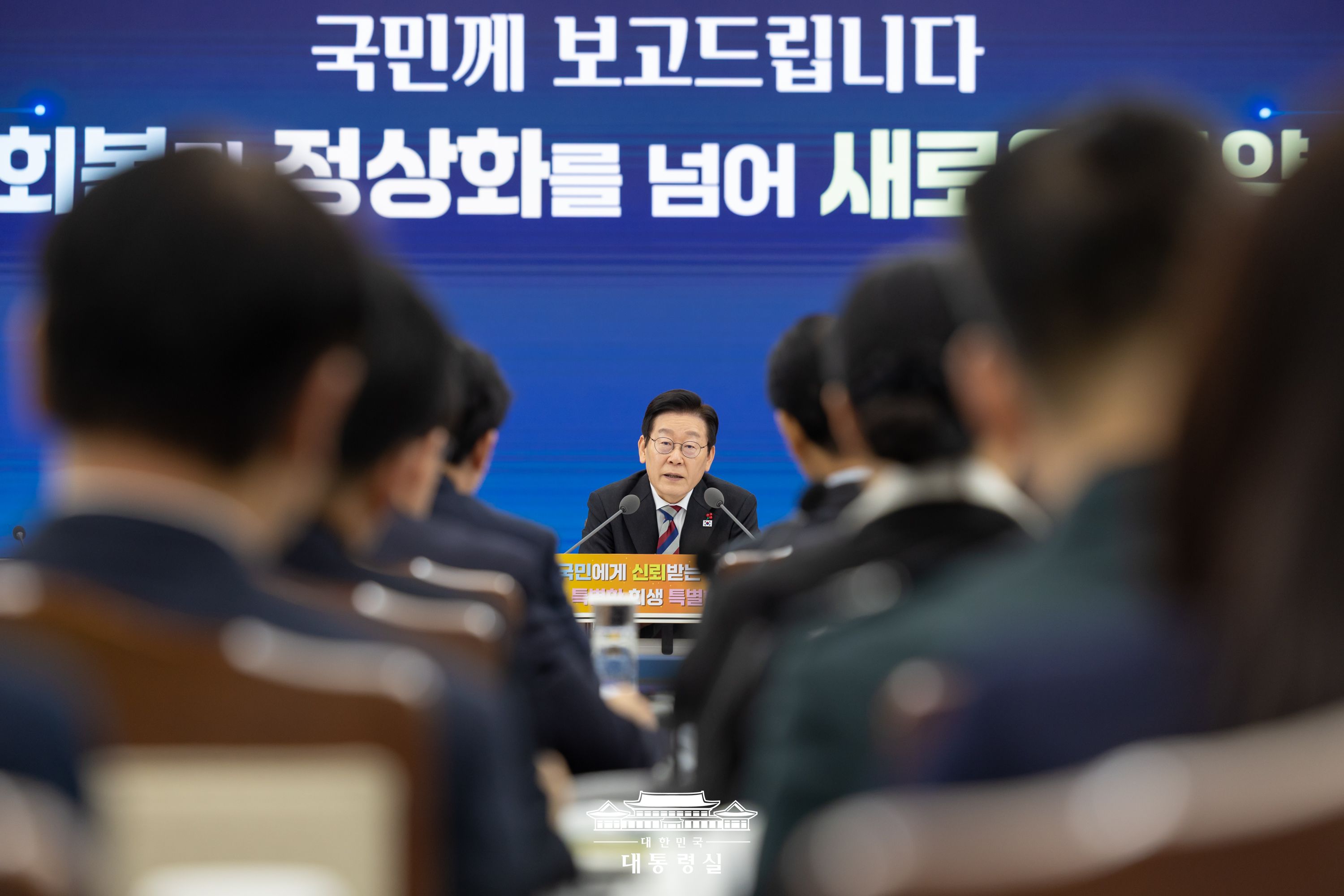
President Lee Jae Myung on Dec. 18 speaks at the livestreamed presentation of the Ministry of National Defense's 2026 business plan at ministry headquarters in Seoul's Yongsan-gu District. (Office of the President)
By Jeon Misun
The country's military innovation is focused on the advancement of the three-axis defense system and development of 500,000 war drones, two measures expected to greatly raise the armed forces' independent deterrence and future warfare capabilities.
The Ministry of National Defense on Dec. 18 announced this under a plan to foster a "cutting-edge and strong: military in a livestreamed presentation of its 2026 business plan chaired by President Lee Jae Myung at ministry headquarters in Seoul's Yongsan-gu District.
The three-axis system, the military's core strategy, consists of the "kill chain" (preemptive attack) strategy, Korea Air and Missile Defense, and Korea Massive Punishment and Retaliation to counter North Korea's nuclear and missile threats.
The 2026 ministry budget for streamlining the system reached KRW 8.8 trillion, up 21.3% from this year.
Thus the deployment of reconnaissance satellites, Aegis destroyers and high-powered missiles into service will be expedited. The plan is to reinforce power by securing additional key assets including KF-21 fighter jets, Cheongung-II missiles and C-130H military transport aircraft.
The expansion of unmanned forces to prepare for future battlefields also drew attention. The ministry seeks to develop 500,000 military drones using artificial intelligence and advanced science and technology, along with the manned-unmanned teaming system.
This will form an education and training environment where all service members can get drone flight skills and related qualifications.
Civilian technology verification and combat simulation will receive a boost from the tentatively named Korea Drone Combat Competition. Through these efforts, unmanned forces for high-risk missions will be expanded such as attack drones and medium loitering munitions (suicide drones).
In addition, the event focused on reform of the military system, better service conditions, restructuring of intelligence agencies and domestic construction of nuclear-powered submarines. Other topics included the transfer of wartime operational control from the U.S. to Korea, restoration of the September 19 Comprehensive Military Agreement with North Korea and creation of conditions for inter-Korean dialogue.
msjeon22@korea.kr