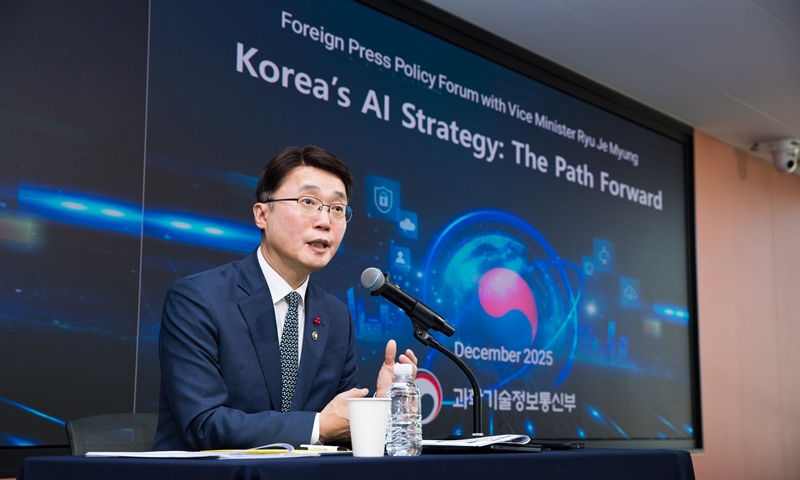
Second Vice Minister of Science and ICT Ryu Je Myung on Jan. 5 explains the government's main initiatives in artificial intelligence this year at a policy briefing for foreign reporters at the Korea Press Center in Seoul's Jung-gu District. (Ministry of Science and ICT)
By Margareth Theresia
A newly released blueprint for national artificial intelligence (AI) strategy seeks to make the country one of the world's top three AI powers.
The plan is to boost the AI budget this year to KRW 10 trillion, more than triple that of last year, and stimulate up to KRW 30 trillion in investment from the public and private sectors to make a decisive move in the global competition for technological hegemony.
The Ministry of Science and ICT announced this last month at a policy briefing for foreign media in Seoul on a government-wide AI strategy. This focused on the ministry's role as a control tower and the promotion of the minister's position to deputy prime minister under a plan to go beyond technological development to cover infrastructure, finance and human resources.
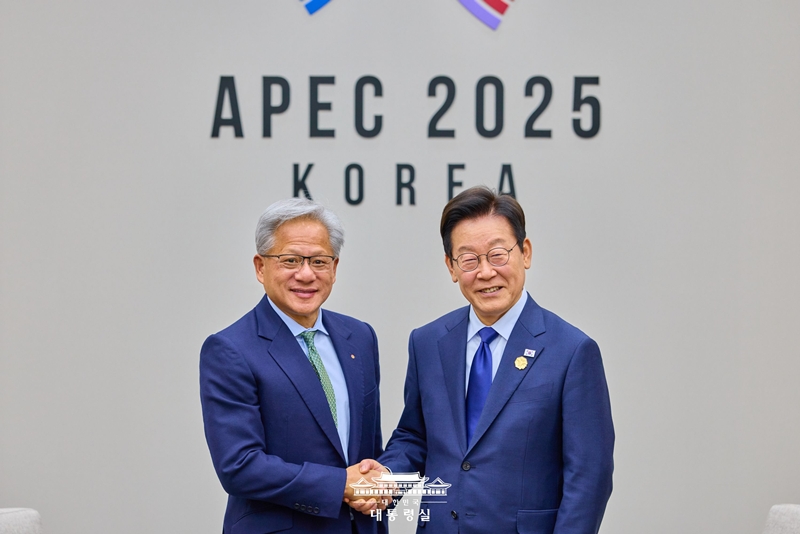
President Lee Jae Myung (right) on Oct. 31, 2025, shakes hands with Nvidia founder and CEO Jensen Huang at Gyeongju Hwabaek International Convention Center in Gyeongju, Gyeongsangbuk-do Province, where the Asia-Pacific Economic Cooperation forum was held. (Cheong Wa Dae)
The top priority is construction of large-scale computing infrastructure dubbed the "AI highway." For this, the ministry will secure 260,000 graphics processing units of world-class quality for supply to domestic companies, startups and think tanks to greatly enhance their research and development (R&D) capabilities.
To secure sufficient funding, an aggressive leverage strategy will see the injection of KRW 10 trillion and attraction of KRW 30 trillion in private capital through a national growth fund.
Data infrastructure will undergo upgrades at the national level. A national data platform will connect public and private data while data spaces for medicine, science and industry will expand the basis to develop AI services.
Another priority is to create an environment to allow world-class AI talent to conduct research, entrepreneurship and industrial activities. The government aims to attract outstanding human resources from abroad, support leading researchers and develop convergence specialists in industrial sectors.
To secure the technological lead beyond artificial general intelligence, proactive investment is going into next-generation sectors such as physical AI, technology based on Korean-style national processing units and quantum AI, with KRW 160 billion this year alone to go into R&D of physical AI. An ongoing project seeks to raise the performance of domestic AI-based semiconductors.
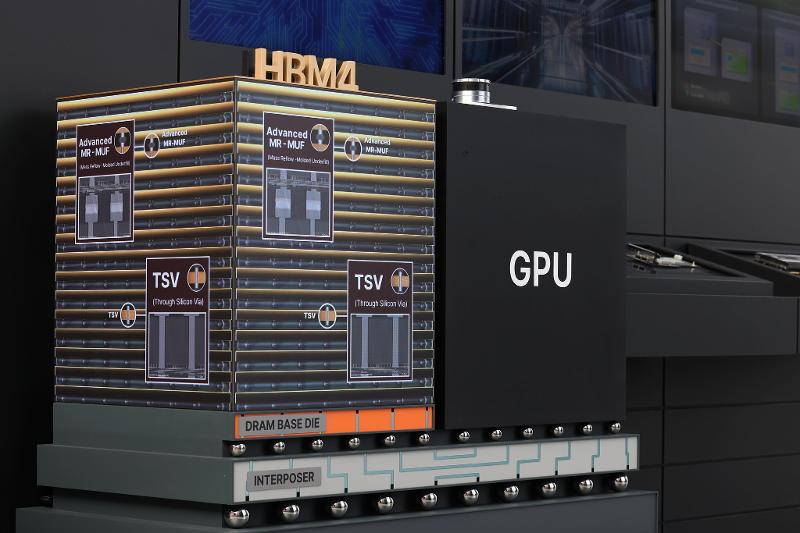
A next-generation high-bandwidth memory is displayed on Oct. 29, 2025, at the SK Group booth at the K-Tech Showcase in Gyeongju, Gyeongsangbuk-do Province. (Park Dae Jin)
Beyond simple software AI, the AI Transformation initiative aims to have all sectors such as manufacturing, health care, welfare, employment and regional industries adopt AI. Key projects include the AX-Sprint 300, which targets 300 manufacturing companies; development of AI innovation hubs in Gwangju, Daegu, and the provinces of Jeollabuk-do and Gyeongsangnam-do; and stimulation of the AI transition in public services such as taxation, health care and welfare.
A program for developing 10 major AI projects for the people's livelihood will focus on ensuring that technical advances directly affect daily life, while institutional reforms such as the enactment of the Basic AI Act on the safety and transparency of AI will be sped up.
Externally, the country is leading a global AI initiative agreed on last year at the Asia-Pacific Economic Cooperation forum in Gyeongju, Gyeongsangbuk-do Province. Seoul expressed its intent to launch a joint AI R&D center in the Asia-Pacific region and cooperate with global organizations like the World Bank Group to set global standards for "responsible AI."
"Korea is a country strong in both manufacturing base and information and communication technology," a ministry official said. "We will combine the capacities of the government and private sector to secure a clear advantage in the global AI race."
margareth@korea.kr