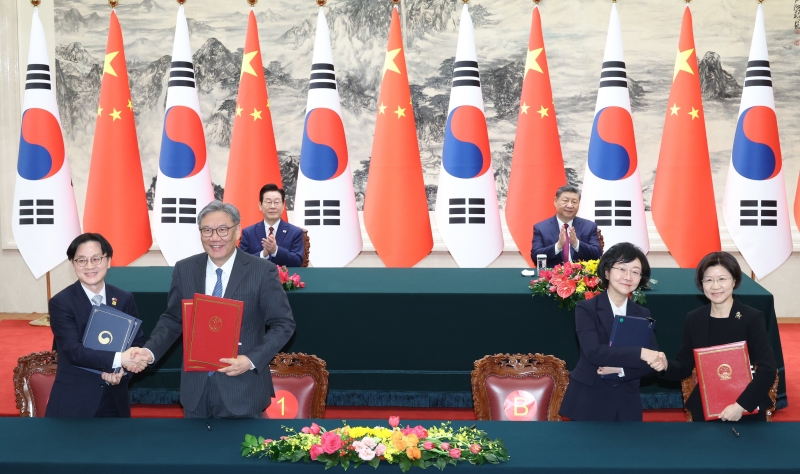
Minister of Trade, Industry and Resources Kim Jung-Kwan (far left) and Chinese Minister of Commerce Wang Wentao (second from left) on Jan. 5 shake hands after signing bilateral agreements on trade cooperation dialogue, while Minister of Food and Drug Safety Oh Yu-Kyoung (second from right) and Sun Meijun (far right), director general of the General Administration of Customs of China, do the same after concluding deals on food safety ties at the Great Hall of the People in Beijing, with President Lee Jae Myung (third from left in back) and Chinese President Xi Jinping applauding in the background. (Yonhap News)
By Kim Hyelin
Korea and China will hold regular meetings between their trade ministers and expand practical cooperation to sectors like digital technology and protection for intellectual property rights.
Following the Jan. 5 summit between President Lee Jae Myung and Chinese President Xi Jinping, both sides concluded 14 memorandums of understanding (MOUs) between government branches and institutions.
President Lee's spokesperson Kang Yu-jung that day said in a written briefing, "We signed an MOU on setting up dialogue on trade cooperation to hold regular talks between the trade ministers of both countries and another on raising cooperation between industrial complexes to stimulate investment between them and reinforce industrial and supply chain collaboration."
Thus the two sides will set up a permanent and consistent intergovernmental communication that covers not only trade, investment and supply chains but also multilateral cooperation including with third countries. Seoul will host the first such talks in the first half of the year.
One MOU covered the expansion of cooperation in small and medium enterprises (SMEs) and innovation to boost cooperation in SMEs to include venture companies, startups and innovation. Another promoted stronger ties in digital economy.
For the environment, they also signed an MOU to expand the scope of environmental cooperation from atmospheric issues to climate change, and another guaranteed the protection of children's rights and promoting of their welfare amid the challenges of low birth rates and aging societies.
An agreement on hygiene for the export of wild seafood expanded the scope of Korean exports of such food, and another on food safety cooperation was expected to boost the conditions for Korean corporate entry into the Chinese market.
One MOU covered stronger cooperation in the protection of intellectual property rights and another on mutual cooperation to safeguard such rights at borders sought to boost the competitiveness of Korean companies advancing to China.
On the occasion of the summit, Korea agreed to donate a pair of stone lion statues to China. These artifacts are part of Chinese cultural heritage purchased in the 1930s by Korean art collector Kansong Chun Hyungpil (1906-62) in Japan and will be returned to China following his wishes.
The presidential office of Cheong Wa Dae said, "This donation of the stone lion statues will help foster friendly ties between the people of Korea and China."
kimhyelin211@korea.kr