- 한국어
- English
- 日本語
- 中文
- العربية
- Español
- Français
- Deutsch
- Pусский
- Tiếng Việt
- Indonesian
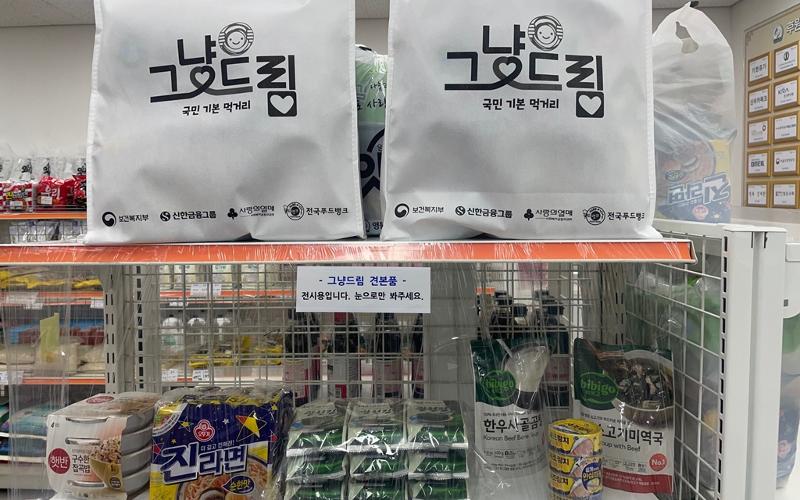
"Just Dream" packages are displayed on Jan. 28 at the first branch of Yeongdeungpo Love Sharing Food Market in Seoul's Yeongdeungpo-gu District. (Kim Seon Ah)
By Kim Seon Ah
"Identifying vulnerable groups is the crux of the project."
This is how Choi Jeong-hoon, deputy director of the Korea Council on Social Welfare based in Seoul's Yeongdeungpo-gu District, summarized the "Just Dream" project.
On the surface, this might seem like a warehouse where anyone can freely take food and daily necessities. Yet its purpose goes beyond mere provision of goods; the goal is recognition of food insecurity as a signal of crisis and connection with those previously overlooked by the social welfare system.
Public welfare is based on an application-based system in which the beneficiaries must verify their income and eligibility. At-risk households in welfare blind spots, however, are generally unable to overcome this obstacle due to lack of information and psychological pressure like stigma.
The "Just Dream" initiative of the Ministry of Health and Welfare reverses this process by omitting complicated review and verification procedures. Recipients can simply visit a center and take food and three to five daily necessities.
Anyone struggling financially can just leave their names and contact information on their first visit to receive immediate support based on a policy shift prioritizing verification of poverty to universal accessibility.
The true value of the program gets clearer from the second visit. Repeat visitors can fill out a consultation form on their basic living conditions such as income level and housing type and ownership. This process provides important administrative data by showing who the beneficiaries are and their frequency of visits, indicating the depth of a household's crisis.
If practical difficulties are seen during this process, recipients receive regular food market services or customized welfare support. Those unable to get assistance because of lack of awareness of available programs can access the administrative network through this structure.
"Accessibility has greatly improved since anyone can use the program without restriction," Choi said. "Thus we've created a channel to practically identify vulnerable groups."
The results are reflected in the metrics. Launched last year on Dec. 1 at 56 locations nationwide, the pilot project was expanded to about 70 within two weeks. Last month, the ministry confirmed the initiative's efficiency and finalized plans to turn it into a full program this year and raise the number of centers to 150.
sofiakim218@korea.kr