Korea's model of public administration is seeing rising global prominence. The Ministry of the Interior and Safety last month presented benchmarks of public sector advancement to diplomatic delegations from 93 countries, promoting the potential of Hallyu (Korean Wave) in public administration. This series covers five innovative examples like disaster management, smart agriculture, forest restoration and construction of administrative cities.
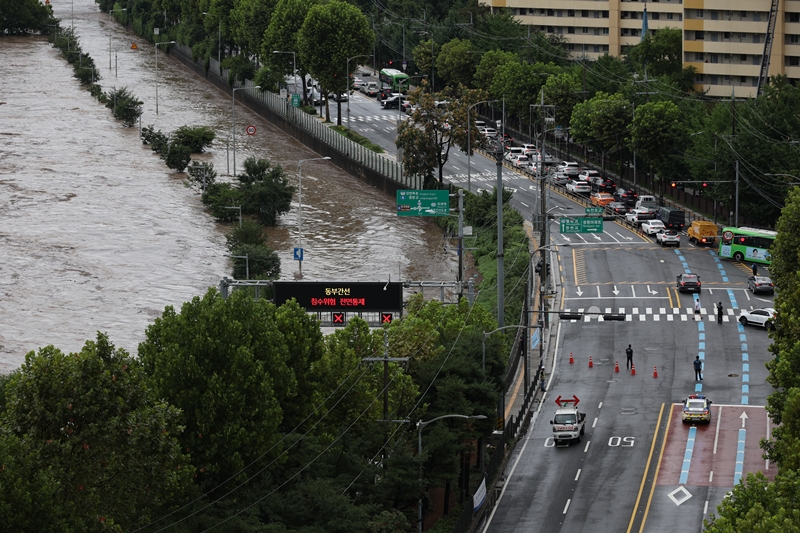
Heavy rains on Aug. 13, 2025, for Jungnangcheon Stream in Seoul's Nowon-gu District blocks traffic on the Dongbu Expressway, causing the release of a flood warning. (Yonhap News)
By Margareth Theresia
The use of artificial intelligence (AI) to raise the national flood response system is speeding up the digital transformation of disaster management.
With the occurrence of unpredictable torrential rains rising due to climate change, public authorities are forming an intelligent safety network to provide real-time guidance in areas at risk of road flooding.
Moist from East Asia enters Korea in the summer, causing a prolonged rainfall period called jangma (monsoon season). Typically lasting from June to late July, this weather phenomenon can cause the concentration of downpours in select regions.
If typhoons strike, the risk of flooding in rivers and cities shoots up.
To prepare for these risks, the Ministry of Science and ICT and the Ministry of Climate, Energy and Environment have adopted the AI Flood Forecasting System based on a digital platform.
This system automatically analyzes data on rainfall and water levels every 10 minutes. If warning signals are detected, it verifies a physical model and decides whether to issue a special advisory.
The system relays the AI-provided data to forecasters so that they can make final decisions.
On-site response capacity has also seen major advances. The Ministry of Science and ICT has teamed up with navigation companies to provide voice and pop-up alerts to drivers entering areas under special advisory or dam discharge zones.
In a break from the conventional method of using TV and text messages, this approach connects real-time disaster alerts to media used in daily life.
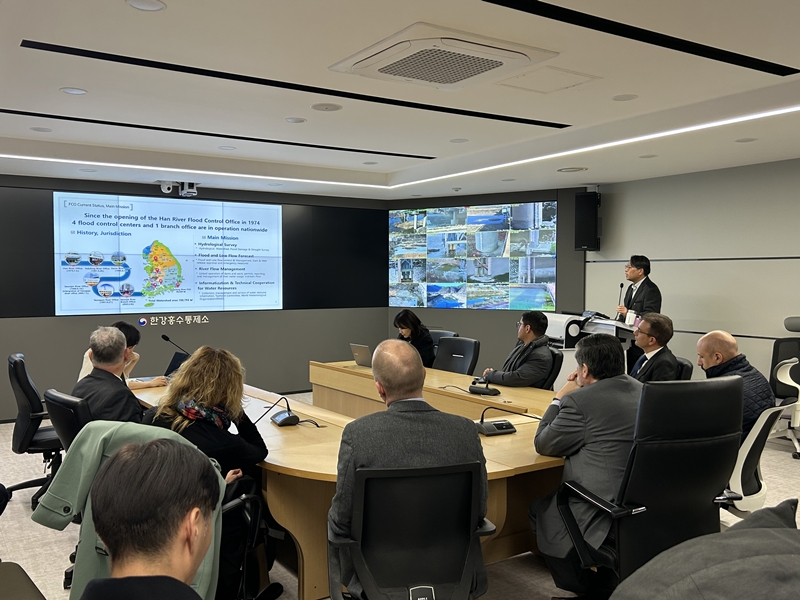
Diplomatic delegations from 93 countries including the European Union, China and Japan on Dec. 14, 2025, watch a demonstration of the AI-based flood prediction and forecasting system at the Hangang River Flood Control Center in Seoul's Seocho-gu District (Margareth Theresia)
Due to the repeated flooding of underpasses and roads at lower elevations by short-term torrential rains, a real-time alert service for flood risk was added in July 2024 to six navigation apps including Naver Map and Kakao Map.
Last year, the scope of data provided was expanded to "critical flood data," or the level immediately before river overflow, and a monitoring network keeps a tight watch on 933 locations nationwide.
The Ministry of Science and ICT will expand the scope of the system's application next year from data on landslides to other disaster criteria like ground subsidence and flood-prone areas.
"Collaboration between the public and private sectors in data release and reservation was launched during the COVID-19 pandemic, and this served as the cornerstone for innovation of disaster response systems," the ministry said. "We will keep striving toward a further advanced digital system for disaster response to protect public safety."
margareth@korea.kr
![[Public admire-stration] ① Detecting potential](/upload/content/image/38ceae8af2704a64b95c13822897ed16_20251210100934.jpg)