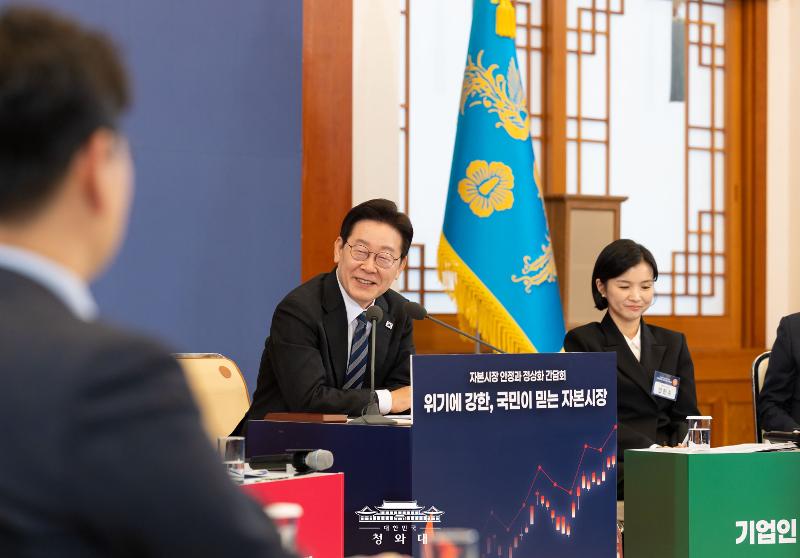
President Lee Jae Myung (middle) on March 18 chairs a meeting on the stabilization and normalization of the capital market. (Cheong Wa Dae) )
By Kim Seon Ah
The country's top financial watchdog is pursuing financial market stability while simultaneously trying to improve the capital market's fundamentals amid external jitters like geopolitical risks originating from the Middle East.
The plan is to take short-term measures to suppress market uncertainty while pursuing structural reform focused on trust, shareholder protection, innovation and accessibility.
Financial Services Commission (FSC) Chairman Lee Eog-weon on March 18 announced these measures at a meeting chaired by President Lee Jae Myung on the stabilization and improvement of the fundamental structure of the capital market.
The first task is to greatly boost the capability to respond to unfair trading. The number of personnel on a joint response team for stock price manipulation will be raised, and authority to access telecommunication records and investigation powers initiated by special judicial police officers from the Financial Supervisory Service will be introduced.
The pursuit of legal amendments will seek to allow confiscation of investment principal in cases of insider trading and fraudulent or illegal transactions. Market surveillance will be raised by scrapping the cap on incentives for whistleblowers and paying a reward of up to 30% of the illicit gains.
The acceleration of the market exits of failing and underperforming businesses includes stronger requirements for delisting and an intensive management period until June next year. The stimulation of mergers and acquisitions will seek to induce natural downsizing.
Boards of directors must review and announce the fairness of purchase prices from the perspective of general shareholders. Duplicate listings of subsidiaries will be strictly regulated under the approach of "prohibition in principle, permission by exception" to prevent the erosion of minority shareholder value.
A new "naming and shaming" approach for undervalued companies will indicate this in stock names. To encourage responsible investment by institutional investors, external inspections and disclosure systems on compliance with the stewardship code, or a guide for institutional investors to fulfill their fiduciary duties by monitoring and engaging with investee companies, will be adopted.
The scope of application will go beyond corporate governance to cover the overall range of environmental, social and governance including environmental and social issues.
Market restructuring conducted in parallel will support innovative companies. The secondary stock market KOSDAQ will be divided into premium and standard tiers under a promotion and demotion system, and the scope of companies eligible for technology-based listing benefits will be expanded to those in artificial intelligence, space and energy.
To expand the supply of venture capital, more than KRW 30 trillion will be disbursed this year through the National Growth Fund and over KRW 20 trillion in new public funding by 2028.
With the goal of inclusion in the MSCI (Morgan Stanley Capital International) Developed Markets Index, the attraction of foreign investment will be expedited through a 24-hour foreign exchange market, more English-language disclosures and improvement of dividend procedures.
The setup of infrastructure for the issuance, distribution and settlement will prepare for the launch next year of the security token offering system.
A government source said, "We will resolve the Korea Discount by stabilizing the market, restoring confidence in the capital market and building an innovation ecosystem."
sofiakim218@korea.kr