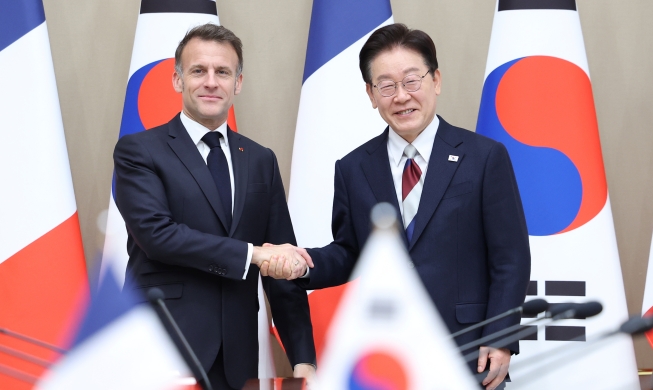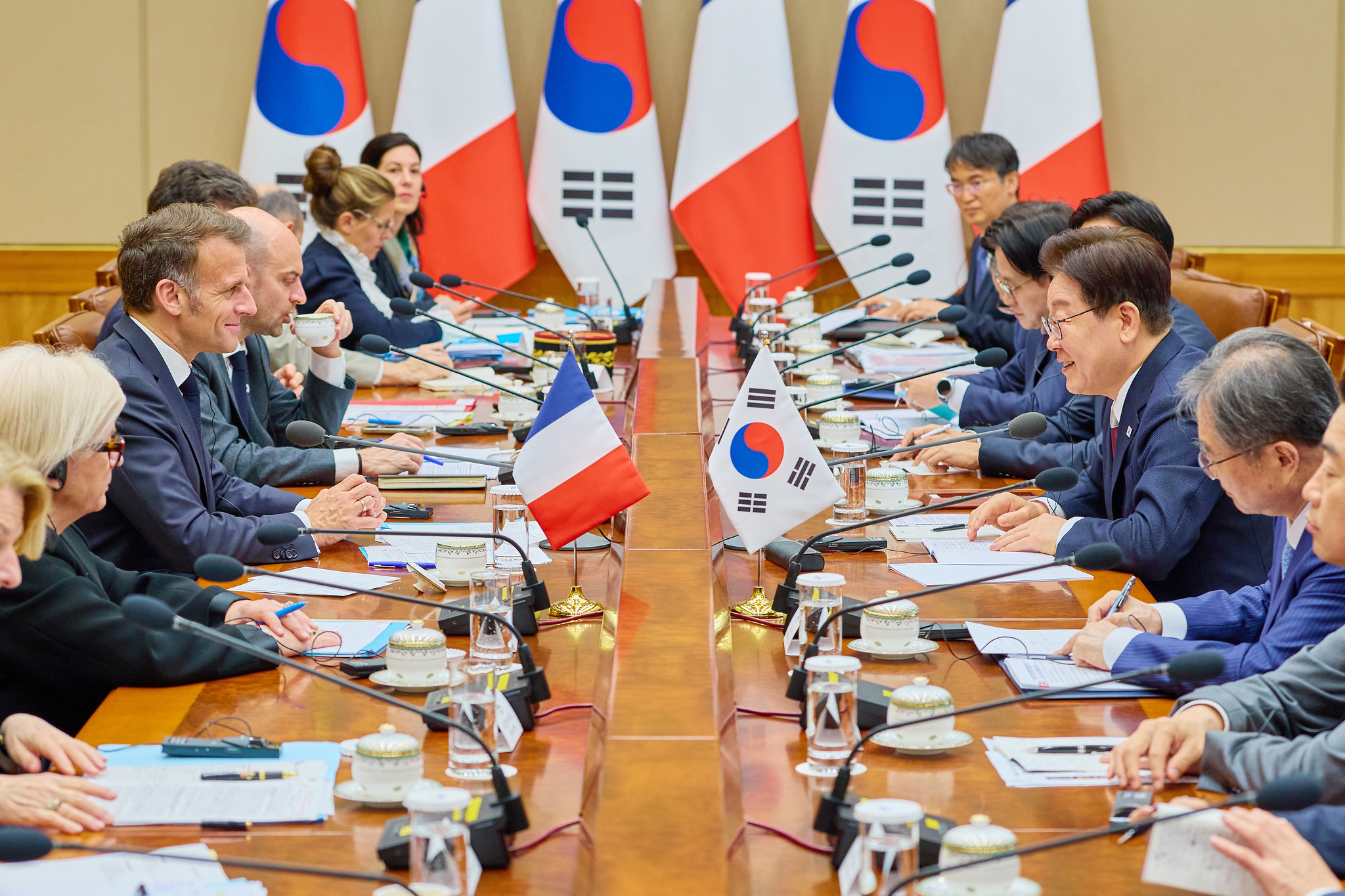
President Lee Jae Myung (third from right) on April 3 speaks to French President Emmanuel Macron at their extended summit at Cheong Wa Dae in Seoul. (Cheong Wa Dae)
By Charles Audouin
The state visit to Korea by French President Emmanuel Macron has fueled a rush to boost bilateral cooperation in a wider range of sectors.
Both sides have agreed on amendments to three agreements, signed 11 memorandums of understanding (MOU) and letters of intent for cooperation, and adopted a joint statement on the direction of future cooperation.
To mark the 140th anniversary of bilateral relations this year, both sides first pledged to raise cultural cooperation focusing on celebration of the diplomatic milestone.
The National Library of Korea will revise its 2011 MOU with the National Library of France to expand exchanges of experts, cooperation in cultural projects and sharing of literary resources.
In cinema, the expansion of exchanges such as joint production workshops will be based on a sisterhood agreement signed in September last year between the Korean Film Council and CNC (French National Centre for Cinema).
Korea has been invited to co-chair in September the Cinema & Moving Image Summit in France.
At their April 3 summit held at Cheong Wa Dae in Seoul, President Lee Jae Myung and President Macron agreed on the need to revise a 1965 bilateral agreement on culture and technical cooperation.
French Minister of Culture Catherine Pegard said, "This amendment will serve as an important institutional foundation to stimulate substantive cooperation in cultural industries that both countries are strong in like film, music, webtoons, e-sports, books and fashion."
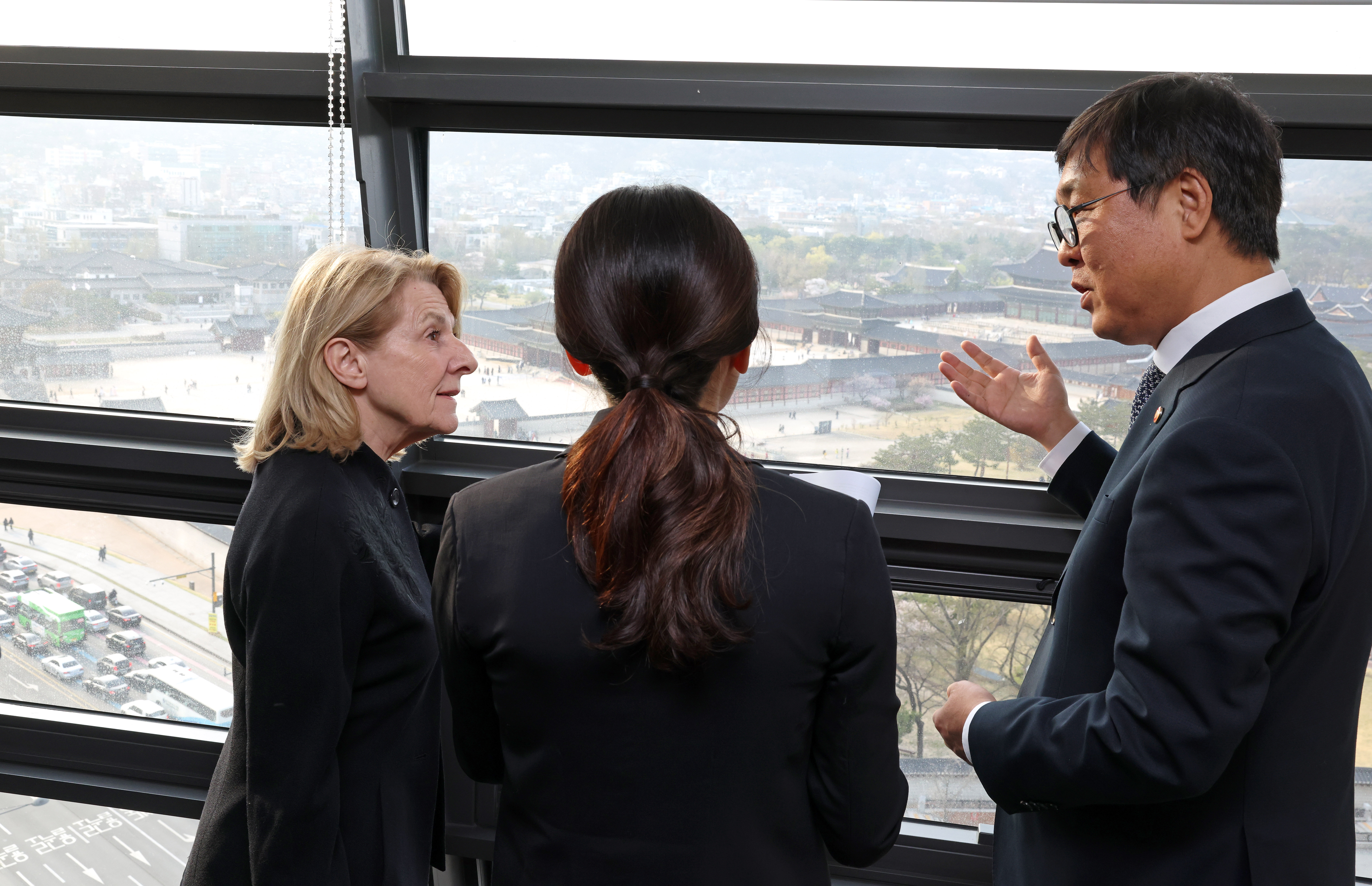
Minister of Culture, Sports and Tourism Chae Hwi-young (right) on April 3 describes Gwanghwamun Gate and Gyeongbokgung Palace to French Minister of Culture Catherine Pegard before their meeting at the compound of the Presidential Committee on Popular Cultural Exchange in Seoul's Jongno-gu District. (Heo Man-jin from Ministry of Culture, Sports and Tourism)
Both countries will expand people-to-people exchanges. From the second half of the year, youth from Korea and France will be sent to each other's country to work as assistant teachers of their respective languages.
Such teachers in France will assist in middle and high school classes. France designated Korean an elective foreign language for both regular schools and an elective topic for the college entrance exam, with about 1,800 people last year learning Korean in the nation.
Cooperation in core minerals will see reinforcement. Cooperation within multilateral frameworks such as the Forum for Strategic Resource Cooperation and Pax Silica will be upgraded to the bilateral level.
The two sides will also seek institutional cooperation, joint project development, capacity building for sustainable mining management, and collaboration in research and education.
Another joint goal is to secure future growth engines. Both countries signed letters of intent for cooperation in three sectors: artificial intelligence, semiconductors and quantum technology.
Also expected to see a boost are policy sharing, bigger exchanges between the government and private sectors, and cooperation in research and innovation.
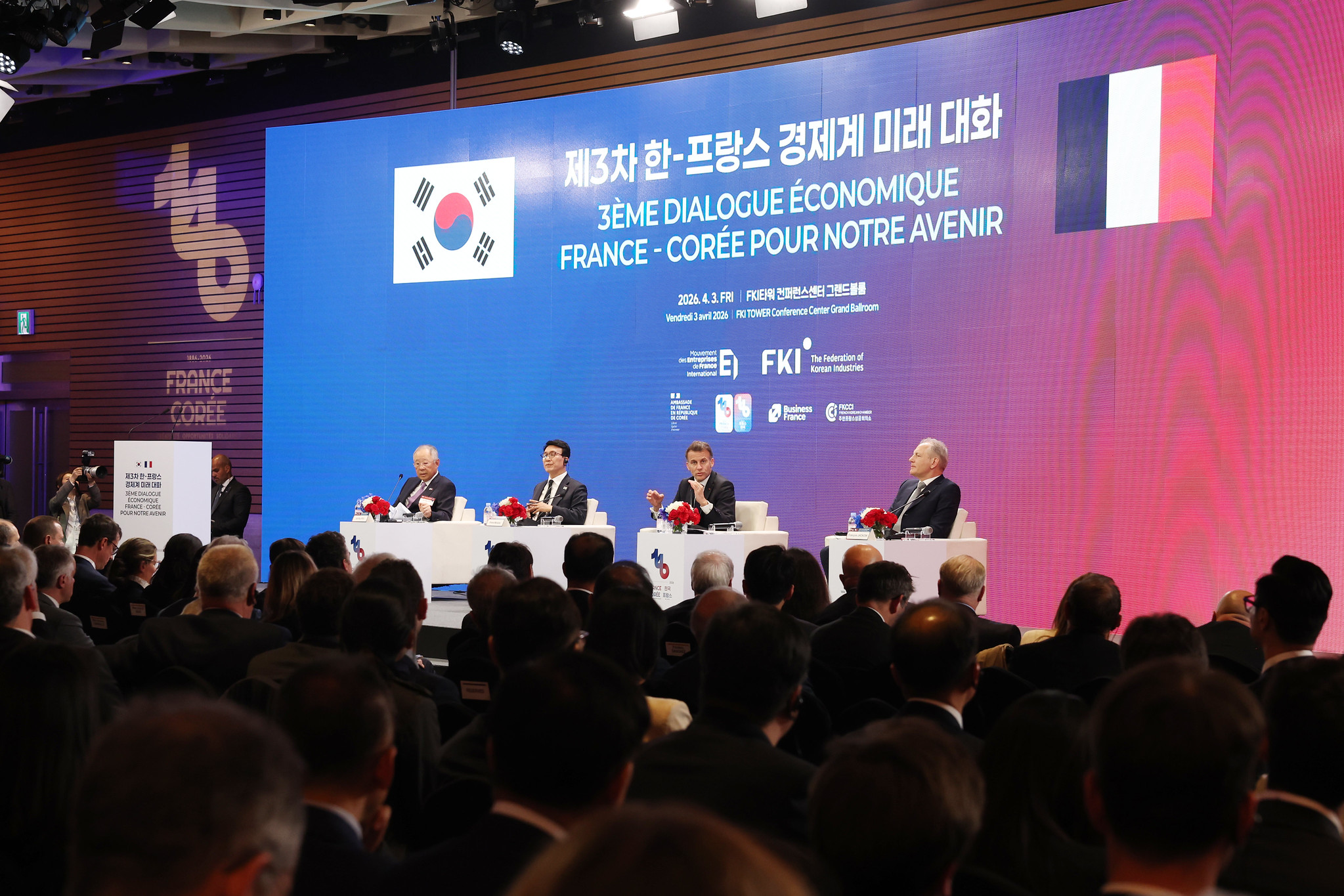
The third Korea-France Business Dialogue on the Future on April 3 is held at FKI Tower in Seoul's Yeongdeungpo-gu District. From left on stage are Korea Economic Association Chairman Jin Ryu, Prime Minister Kim Min-seok, French President Emmanuel Macron and Air Liquide Chairman Francois Jacobs. (Lee Jeongwoo)
Key domestic research entities like the Asia-Pacific Centre for Theoretical Physics, Korea Advanced Institute of Science and Technology (KAIST), Seoul National University and Korea University will expand research exchanges through cooperation with CNRS (French National Centre for Scientific Research).
KAIST and Quandela, a French quantum computing company, agreed to boost cooperation in quantum hardware manufacturing and set up supply chains for materials, parts and equipment. This year, Quandela will enter the Korean market and pursue joint research projects with KAIST.
The National Research Foundation of Korea and ANR (French National Agency for Research) will expand a joint research project launched last year and continue it through next year.
Seoul and Paris have worked together in science and technology since signing a bilateral agreement in 1981 on related cooperation. In 2018, a university alliance in science and technology formed by each country broadened the scope of student exchanges.
The two sides will also reinforce cooperation in honoring veterans affairs, including honoring those who served during the Korean War. During the conflict, France sent 3,421 soldiers from its army and navy.
This year also marks the 75th anniversary of the war's Battle of Jipyeong-ri in Yangpyeong-gun County, Gyeonggi-do Province, where a French battalion achieved a major victory.
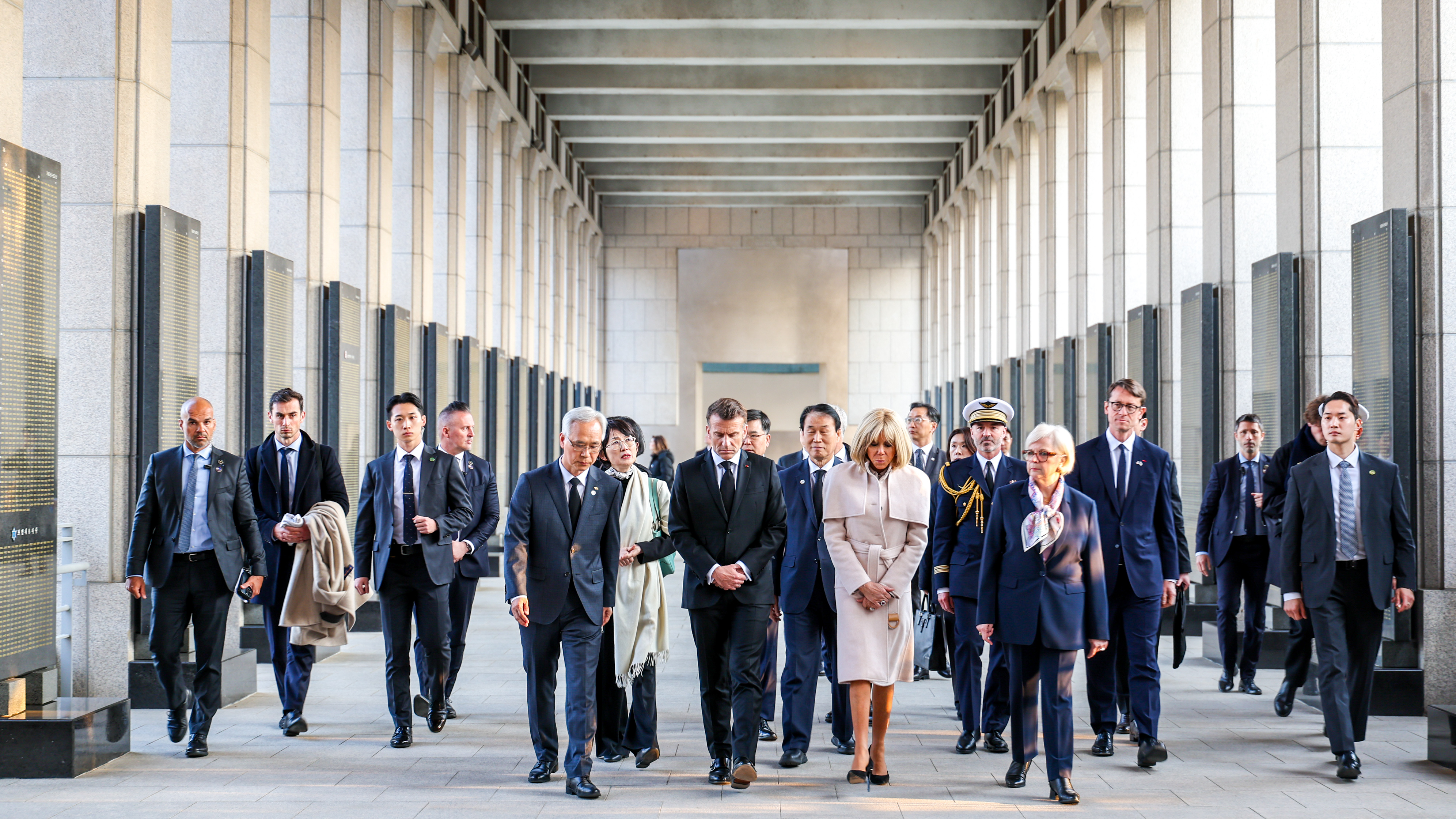
French President Emmanuel Macron (center) and first lady Brigitte Macron on the afternoon of April 2 walk at the Memorial for Fallen Soldiers of the Korean War at the War Memorial of Korea in Seoul's Yongsan-gu District along with Minister of Patriots and Veterans Affairs Kwon Oh-eul (next to President Macron). (Ministry of Minister of Patriots and Veterans Affairs)
caudouin@korea.kr