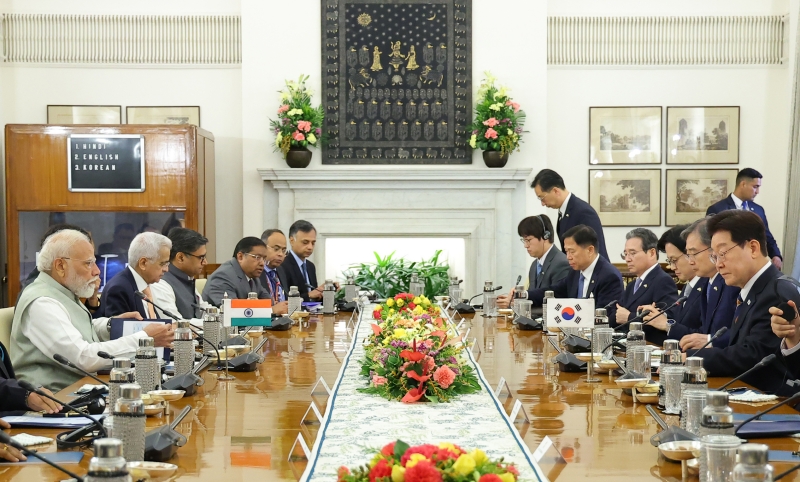
President Lee Jae Myung (right) and Indian Prime Minister Narendra Modi (left) on April 20 attend an extended summit at Hyderabad House in New Delhi.
By Kim Hyelin
Photos = Yonhap News
President Lee Jae Myung and Indian Prime Minister Narendra Modi on April 20 agreed to upgrade their economic cooperation framework to double bilateral trade to USD 50 billion by 2030.
They said this at their summit held at Hyderabad House in New Delhi during President Lee's state visit to the South Asian country.
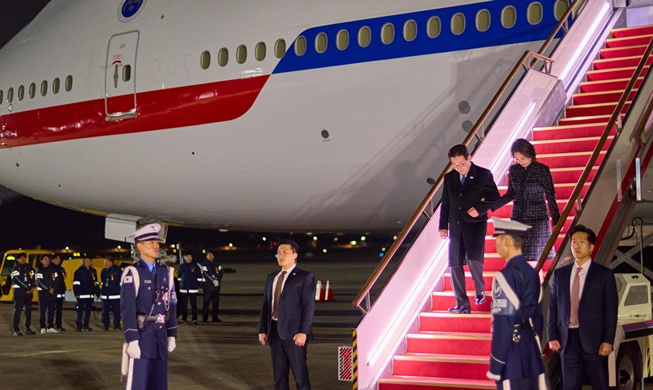
President Lee, the first Korean leader to make a state visit to India in eight years, also agreed to boost bilateral relations, which had remained stagnant since being upgraded to a "special strategic partnership" in 2015.
The summit proceeded in small-group and expanded sessions, with the former scheduled for 40 minutes but lasting for over an hour due to heated discussions.
Right after the talks, both sides announced their signing of 15 memorandums of understanding and adoption of three supplementary documents: the Joint Strategic Vision for ROK (Republic of Korea)-India Special Strategic Partnership (2026-30); Comprehensive Framework for Partnership in Shipbuilding, Shipping and Maritime Logistics; Joint Statement on Cooperation in Sustainability; and Joint Statement on Energy Resource Security.
They also agreed to resume negotiations to improve their Comprehensive Economic Partnership Agreement to meet their bilateral trade target of USD 50 billion.
The crux of economic cooperation lies in the strategic sectors shipbuilding, artificial intelligence (AI), semiconductors and clean energy.
Prime Minister Modi announced the launch of a Korea desk headed by his office and asked Cheong Wa Dae to set up a task force specifically for economic cooperation with India.
Both sides also agreed to form the Korea-India Industrial Cooperation Committee, a ministerial-level economic cooperation platform, to systematically raise cooperation in strategic sectors like critical minerals and nuclear power. They also signed a Framework for a Korea-India Digital Bridge to facilitate collaboration in AI, semiconductors and data governance.
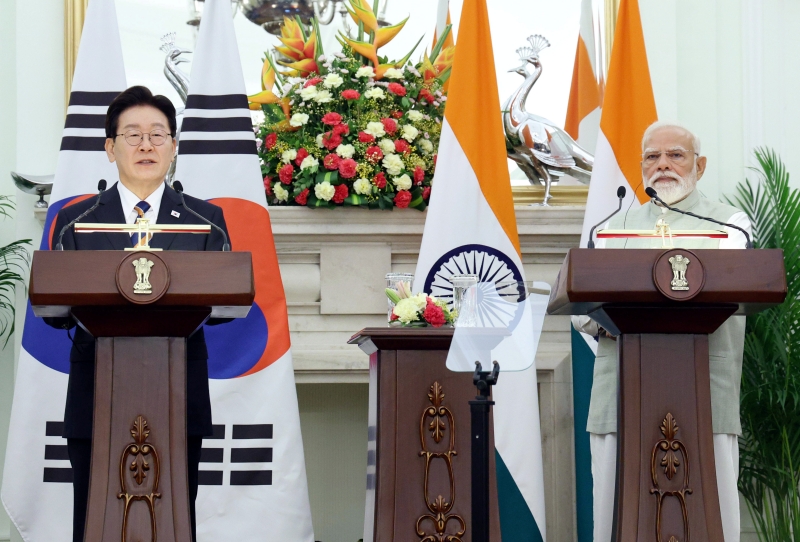
President Lee Jae Myung (left) and Indian Prime Minister Narendra Modi on April 20 release a joint statement at Hyderabad House in New Delhi.
Amid the constant flux in global politics affected by the war in the Middle East, both leaders discussed cooperation to ensure a stable supply of core raw materials like naphtha and energy.
Prime Minister Modi pledged to boost bilateral cooperation in core technologies and supply chains and resume dialogue on economic security, while President Lee asked India to play a constructive role in his administration's efforts to build peace on the Korean Peninsula.
President Lee said bilateral ties remain stagnant as just 12,000 Korean residents and about 670 Korean companies are in India despite its huge population and gross domestic product. Through this summit, he said, both sides should work together at a totally different level including private exchanges and economic and security cooperation.
Both sides decided to open a Korea Center in Mumbai, India's No. 2 city, as a venue for cultural cooperation where K-pop and Bollywood can meet.
Prime Minister Modi also responded positively to President Lee's invitation to visit Seoul.
Cheong Wa Dae hailed President Lee's visit as creating new momentum for cooperation with the rapidly growing India, providing an opportunity for Seoul to fully display its "Global South diplomacy."
President Lee on April 21 flew to Vietnam on another state visit after wrapping up his schedule in India.
kimhyelin211@korea.kr