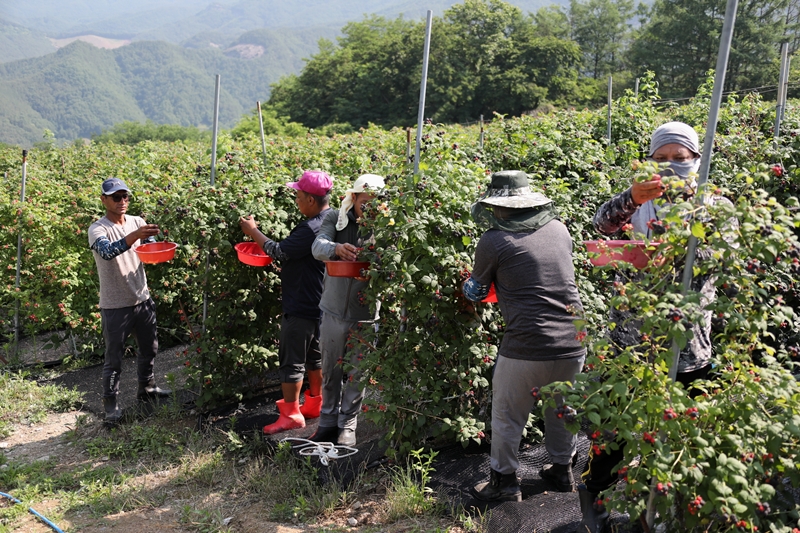
The Ministry of Justice on May 11 announced its launch from May 18 of an employment exception for small business owners located in depopulated areas to stimulate regional economies. Shown are foreign workers harvesting bokbunja (black raspberries) at a farm in Muju-gun County, Jeollabuk-do Province. (Muju County)
By Margareth Theresia
Small business owners and agricultural companies in regions facing population decline from May 18 can hire more foreign workers under a region-specific program.
The Ministry of Justice on May 11 announced a new employment exception for small entrepreneurs to ease labor shortages in depopulated areas and stimulate regional economies.
The exception allows small businesses and agricultural companies in such regions to hire one foreign worker with the F-2-R (regional talent) visa if requirements are met.
The F-2-R system had allowed businesses employing domestic workers to hire foreign labor, but faced limits in regions at risk of depopulation given the difficulty of recruiting natives in such areas.
For this reason, the Korea Immigration Service under the ministry will enable small business owners and agricultural companies that meet the requirements to hire one worker on that visa even if they have no domestic staff. This reflects the reality of labor shortages in areas that are losing residents.
The exception will apply to small businesses and agricultural companies suffering chronic labor shortages, namely manufacturing, wholesale and retail, and restaurants, in 89 depopulated areas including the counties of Muju-gun, Jeollabuk-do Province, and Hoengseong-gun, Gangwon-do Province.
For a more stable employment environment, comprehensive criteria such as business operations of three years or more and annual sales of at least KRW 100 million will apply.
"We expect the exception to help resolve labor shortages, one of the biggest challenges facing regional small business owners," Minister of Justice Jung Sung-ho said. "We will keep pursuing immigration and migration policies that reflect voices from the field and help stimulate regional economies and balanced national development."
margareth@korea.kr