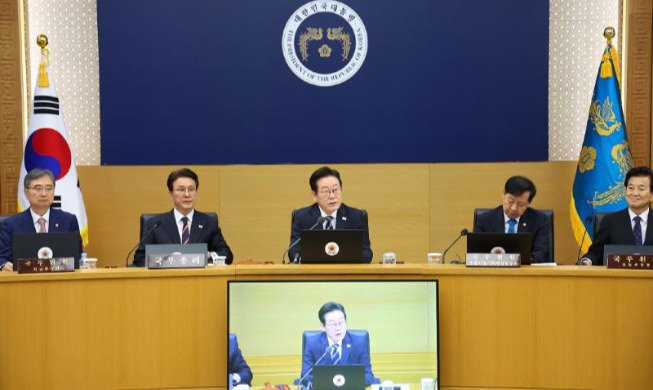
The administration of President Lee Jae Myung marks its first anniversary in early June. Since its launch on June 4, 2025, it has laid the groundwork for change across sectors under the national vision "A nation where the people rule, a Republic of Korea where everyone is happy." To mark this occasion, Korea.net reflects on the government's major achievements in five installments, starting with the diplomatic and security moves that led to "pragmatic diplomacy centered on national interests" and a "Korean Peninsula policy of peaceful coexistence and prosperity."
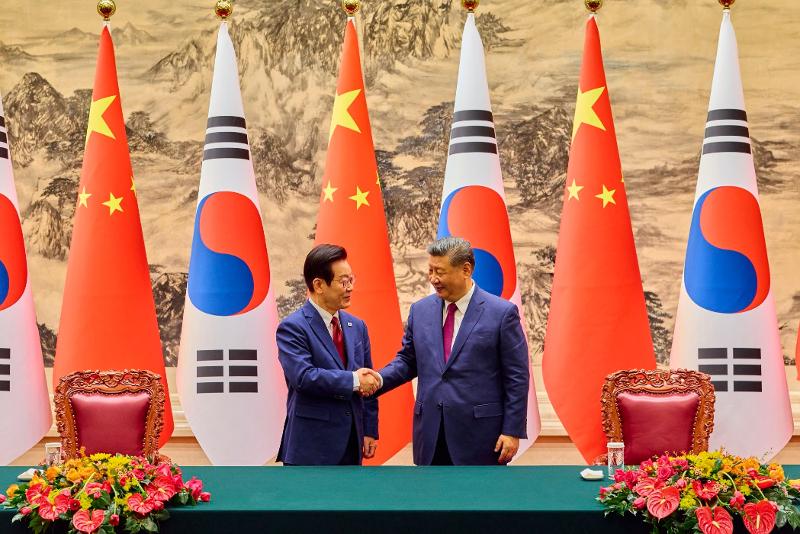
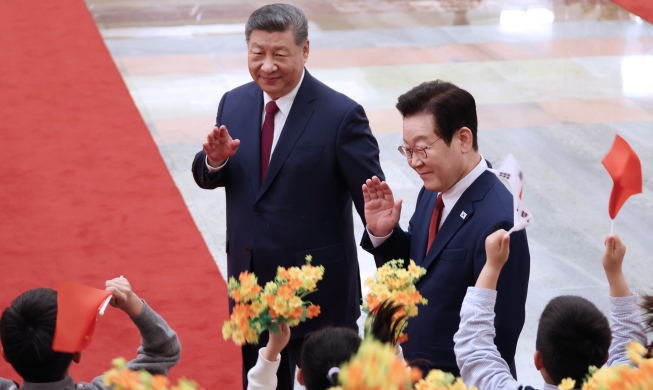
President Lee Jae Myung (left) and Chinese President Xi Jinping on Jan. 5 shake hands at the Great Hall of the People in Beijing. (President Lee's Facebook account)
By Yoon Sojung
Pragmatic diplomacy toward the world
"The No. 1 principle of state administration for the people's sovereignty government lies exclusively in the lives of the people. Our direction is realistic pragmatism free from ideology, factionalism and political strife."
President Lee Jae Myung said this in January in a speech at his New Year's news conference at Cheong Wa Dae. This was his first statement to reporters at the time, reflecting his active diplomacy.
Immediately after his inauguration on June 4, 2025, President Lee started the first of nine overseas trips, starting with the G7 summit of the world's top economies in Canada on June 16 that year.
The most tangible outcome of the Lee administration's first year in diplomacy was restoration of relations with China. The turning point was the Asia-Pacific Economic Cooperation (APEC) forum in Gyeongju, Gyeongsangbuk-do Province, last year from Oct. 31 to Nov. 1. President Lee and Chinese President Xi Jinping, who made his first state visit to Korea in 11 years, in their summit officially declared their commitment to restoring ties.
From this point, Seoul and Beijing signed a bilateral currency swap agreement worth KRW 70 trillion and accelerated talks on services and investment under their free trade agreement (FTA).
Taking advantage of President Lee's state visit to China in January, both sides reached a comprehensive agreement on horizontal mutually beneficial cooperation in economy related to the people's livelihood, peace on the Korean Peninsula, and expansion of cultural and content exchanges.
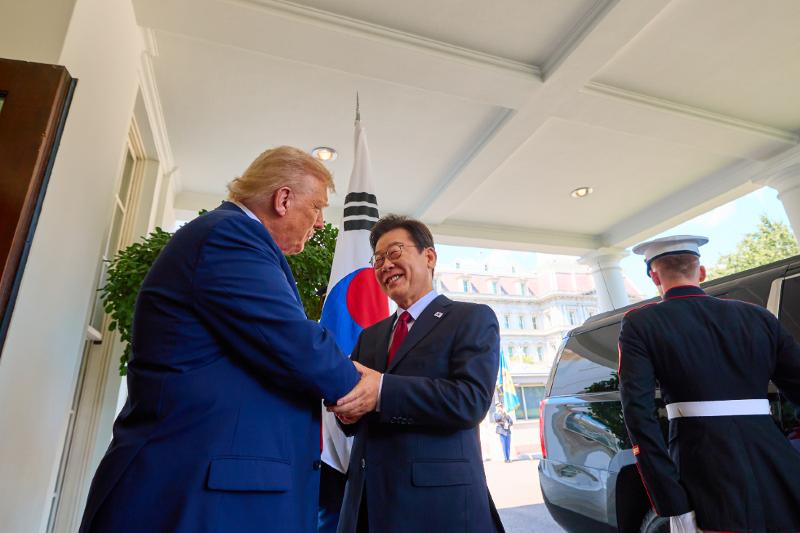
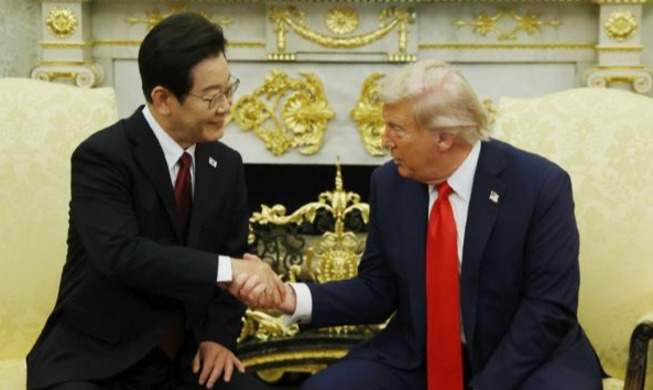
President Lee Jae Myung (second from left) on Aug. 25, 2025, is welcomed by U.S. President Donald Trump right after arriving at the White House in Washington. (Yonhap News)
Cooperation with the U.S. also entered a new era. Seoul bolstered the bilateral security and high-tech alliance by securing equal practical benefits in the economy and national security with the second Trump administration, which championed a policy of "America First."
In the bilateral summit on the sidelines of the Gyeongju APEC, Korea secured American support for the right to build its own nuclear submarines and conduct uranium enrichment. This effectively laid the groundwork to raise Seoul's security capabilities as a core pillar of Northeast Asian security.
Dubbing itself a "globally responsible nation," the Lee administration has consistently dismissed domestic demands for nuclear armament to counter the nuclear threat from North Korea. Experts call nuclear submarines the best means to maximize powerful conventional deterrence as a non-nuclear military option.
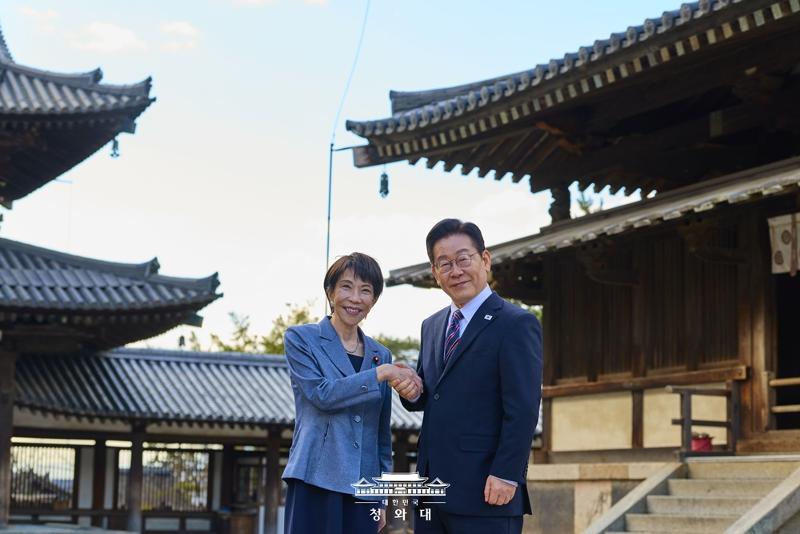
President Lee Jae Myung (right) and Japanese Prime Minister Sanae Takaichi on Jan. 14 pose for photos at Horyuji Temple, a leading cultural heritage site in Ikaruga of Japan's Nara Prefecture. (Cheong Wa Dae)
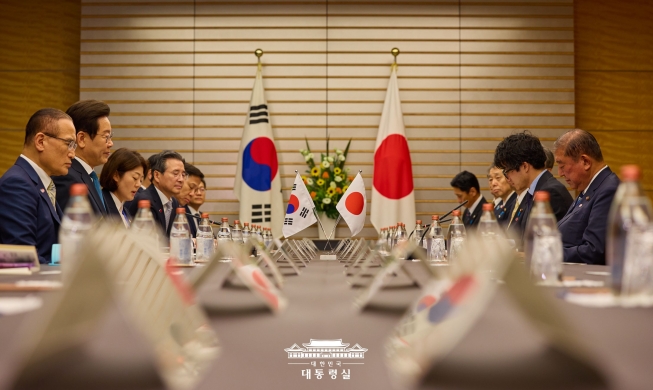
With Japan, the Lee administration used unprecedented "shuttle diplomacy" to boost ties. After holding his first summit in June last year with then Japanese Prime Minister Shigeru Ishiba on the sidelines of the G7 meeting in Canada, President Lee chose Japan instead of the U.S. as his second overseas destination.
This was the first time for a Korean president to visit Japan before the U.S., reflecting a face of pragmatism that placed national interests above all else without being bound by the precedent of prioritizing the bilateral alliance with Washington.
In a bilateral summit in August last year in Tokyo, Korea and Japan agreed to fully uphold the joint Kim Dae-jung-Obuchi Declaration on a New Japan-Republic of Korea Partnership toward the Twenty-first Century in 1998. The statement also contains Japan's pledge to fully recognize the positions of successive cabinets on historical awareness.
This major achievement came on the 80th anniversary of Korea's liberation from Japanese rule and the 60th year of normalized bilateral relations. Both sides have since met often including at the APEC forum last year and President Lee's visit to Japan in January.
Including talks with Prime Minister Sanae Takaichi, who from May 19-20 visited Andong, Gyeongsangbuk-do Province, both sides have held six summits since the Lee administration took office.
Both sides are also strengthening cooperation in energy and supply chains.
Peace and prosperity on the Korean Peninsula
The Lee administration has boldly broken away from the outdated practice of ideological confrontation and instead, its policy toward the Korean Peninsula is centered on peaceful coexistence and pragmatic risk management.
The essence of this policy is embedded in what President Lee said in his Liberation Day speech last year on Aug. 15: "More important than winning a fight and more important than winning without a fight is building a country where fighting is unnecessary – that is, creating peace."
Seoul took bold measures to restore strained inter-Korean ties to a state of reconciliation and cooperation. Just eight days after taking office, the Lee administration on June 12 last year took the first step toward this goal by blocking the scattering of anti-North Korea leaflets and suspending loudspeaker broadcasts.
In his Liberation Day speech last year, President Lee said, "We have defined ties between South and North Korea as a special relationship that involves pursuing peaceful unification while respecting and recognizing one another's system."
"We affirm our respect for the North’s current system, aver that we will not pursue any form of unification by absorption."
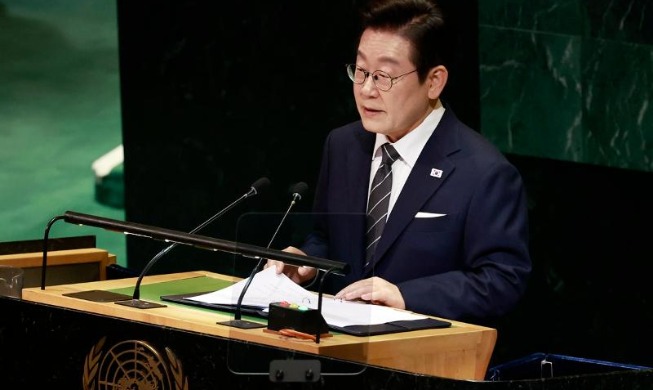
About a month later, President Lee told the United Nations General Assembly, "The Republic of Korea will end the Cold War on the Korean Peninsula through the E.N.D. (Exchange, Normalization and Denuclearization) Initiative and fulfill its responsibility and role to contribute to world peace and prosperity."
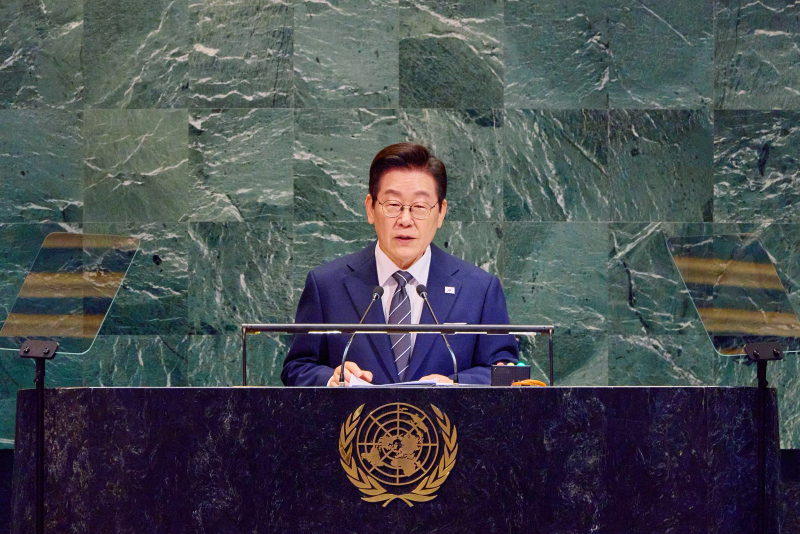
President Lee Jae Myung on Sept. 23, 2025, gives a keynote speech at the United Nations General Assembly in New York. (Cheong Wa Dae)
To resume inter-Korean dialogue, the Lee administration has taken concrete action. In December last year, President Lee officially proposed to North Korea the restoration of inter-Korean communication channels, saying "reviving inter-Korean dialogue, which has been suspended for seven years, is the starting point for a new inter-Korean relationship of peaceful coexistence."
At his news conference in January, he expressed his intent to restore the September 19 Military Agreement of 2018 between both Koreas. The Ministry of Unification in Seoul in February accordingly announced its proactive efforts to restore the no-fly zone established under the accord.
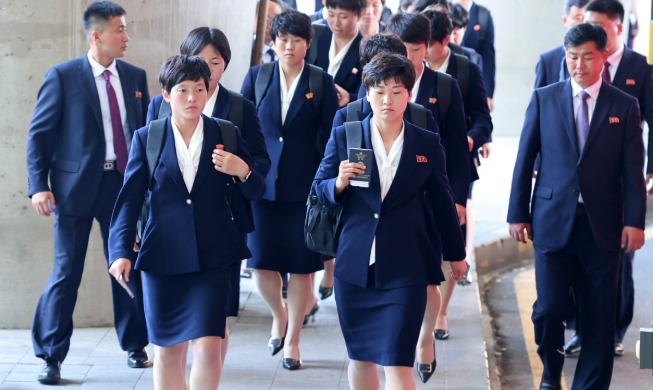
President Lee's efforts have also revived private exchanges between the two Koreas. The 39-member Naegohyang Women's FC, a pro North Korean soccer team, on May 17 arrived at Incheon International Airport as the North's first sports squad since 2018 to play a game in South Korea.
This also held enormous significance under Seoul's policy of "mutually beneficial inter-Korean exchange and cooperation that resonate with the public."
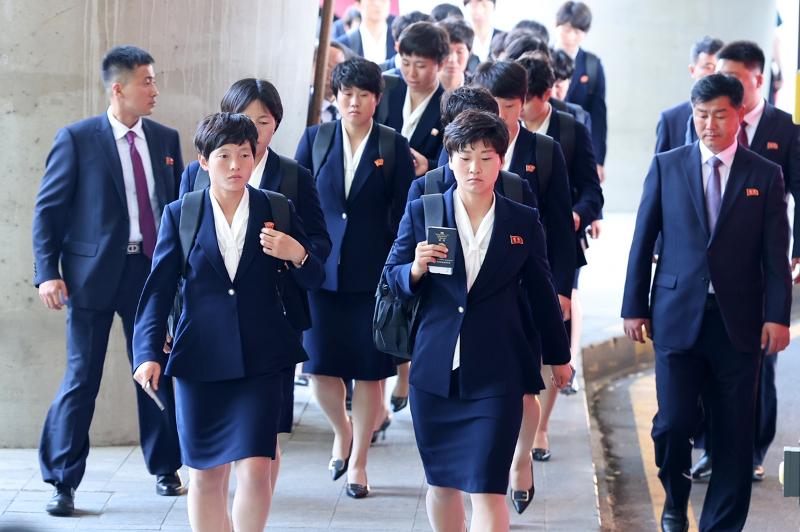
The North Korean pro soccer team Naegohyang Women's FC on May 17 heads for a bus after arriving at Terminal 1 of Incheon International Airport. The squad on May 20 defeated the host Suwon FC Women of South Korea, 2-1, in the semifinals of the Asian Football Confederation Women's Champions League. (Yonhap News)
Foreign media also gave positive reviews of President Lee's pragmatic diplomatic approach. The Diplomat, a foreign affairs magazine, in a March 6 column titled "Lee Jae-myung, a New Type of President, Supported by the Korean People" cited his "policy consistency, transactional diplomacy, radical communication and a servant-leader philosophy" as factors contributing to his popularity.
The op-ed highlighted how President Lee, who had no prior diplomatic experience, prioritized national interests and secured an agreement with President Trump on Seoul's bid to build its own nuclear submarines. "By framing the agreement within the context of transactional burden-sharing, Lee achieved a breakthrough that had eluded his predecessors for decades, proving an ability to navigate the 'America First' landscape," it added.
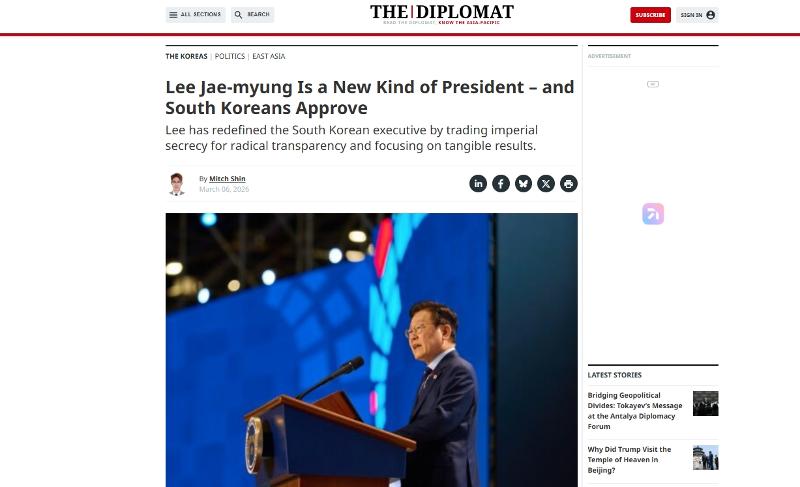
The Diplomat, a foreign affairs magazine, in the op-ed titled "Lee Jae-myung, a New Type of President, Supported by the Korean People" on March 6 cited his "policy consistency, transactional diplomacy, radical communication and a servant-leader philosophy" as factors behind his popularity. (Screen capture from Diplomat site)
arete@korea.kr