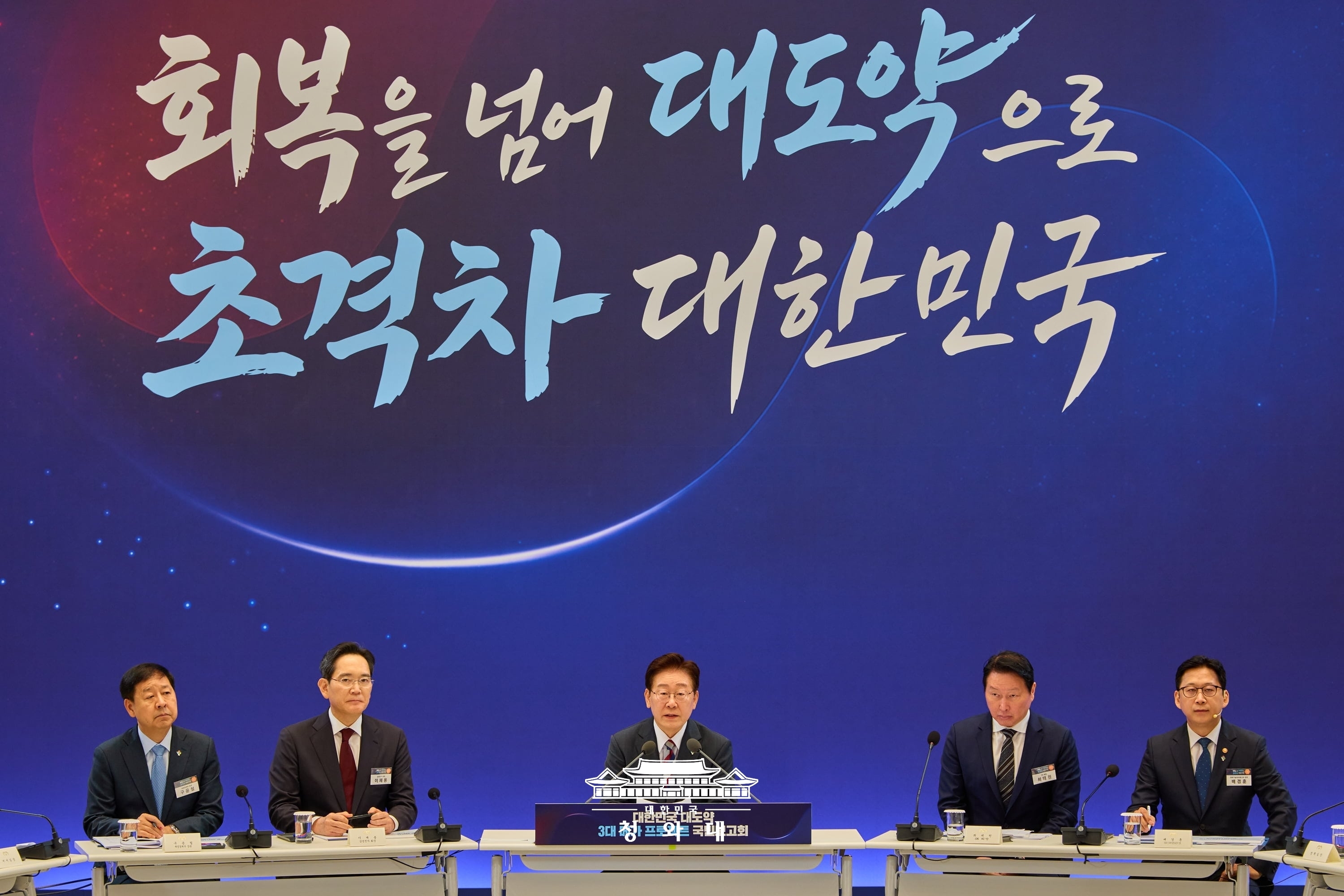
President Lee Jae Myung on June 29 speaks at a public briefing on three mega-projects for the country to achieve "a great leap forward" at Cheong Wa Dae in Seoul. From left are Deputy Prime Minister and Minister of Finance and Economy Koo Yun Cheol, Samsung Electronics Chairman Lee Jae-yong, President Lee, SK Group Chairman Chey Tae-won, and Deputy Prime Minister and Minister of Science and ICT Bae Kyunghoon. (Cheong Wa Dae)
By Margareth Theresia
President Lee Jae Myung has announced plans for three mega-projects at a cost of KRW 1,558 trillion to transform three provincial regions into hubs for cutting-edge industries.
In a public briefing to the nation at Cheong Wa Dae on June 29, he said, "I will make the second year of my administration the one in which we start to build an irreplaceable Republic of Korea, one that no other country in the world can substitute for," adding, "The most critical task is to take a leap forward as a Republic of Korea with a 'super-gap' competitive edge."
The briefing also announced public-private investment in three major sectors -- semiconductors, physical artificial intelligence (AI) and AI data centers -- as well as measures to expand infrastructure such as power supply and site selection.
Spanning Gwangju and the provinces of Jeollabuk-do and Jeollanam-do, the Honam region was designated the site for the country's second production base for semiconductors following the Seoul metropolitan area. To this end, investment of KRW 800 trillion will go into building four memory fabs.
The Yeongnam region -- spanning Busan, Daegu, Ulsan, and the provinces of Gyeongsangbuk-do and Gyeongsangnam-do -- will be an innovation hub for materials, components and equipment to set up a robust supply chain for upstream and downstream sectors.
The administration will devote all its efforts to preemptively capture promising markets through comprehensive support that includes expedited permits, site acquisition, and essential infrastructure such as power and water supplies.
In physical AI, the plan is to maximize synergies between domestic core manufacturing industries in which Korea holds a competitive edge and robotics. Calling the next three years a critical window for securing global leadership, the administration presented a concrete roadmap to make the country the world's top physical AI power by 2030 through bold fiscal investment and the introduction of unprecedented regulatory sandboxes.
In AI data centers, the core infrastructure that drives AI, leading domestic companies such as SK, GS and Naver are taking part in large numbers and collectively invested KRW 550 trillion. Through a public-private partnership, a large-scale cluster of such centers with a combined capacity of 8.4 gigawatts in the first phase will be set up in the provinces to foster balanced regional development.
Prioritizing the use of homegrown AI chipsets and software solutions at such centers will seek to boost the self-reliance of the domestic AI ecosystem and raise its global competitiveness.
"We will mobilize all government capacities to ensure that bold corporate investments bear the fruit of greater growth," President Lee said. "We will achieve a 'Korean-style AI Industrial Revolution' led by regions without fail and expand it worldwide."
margareth@korea.kr