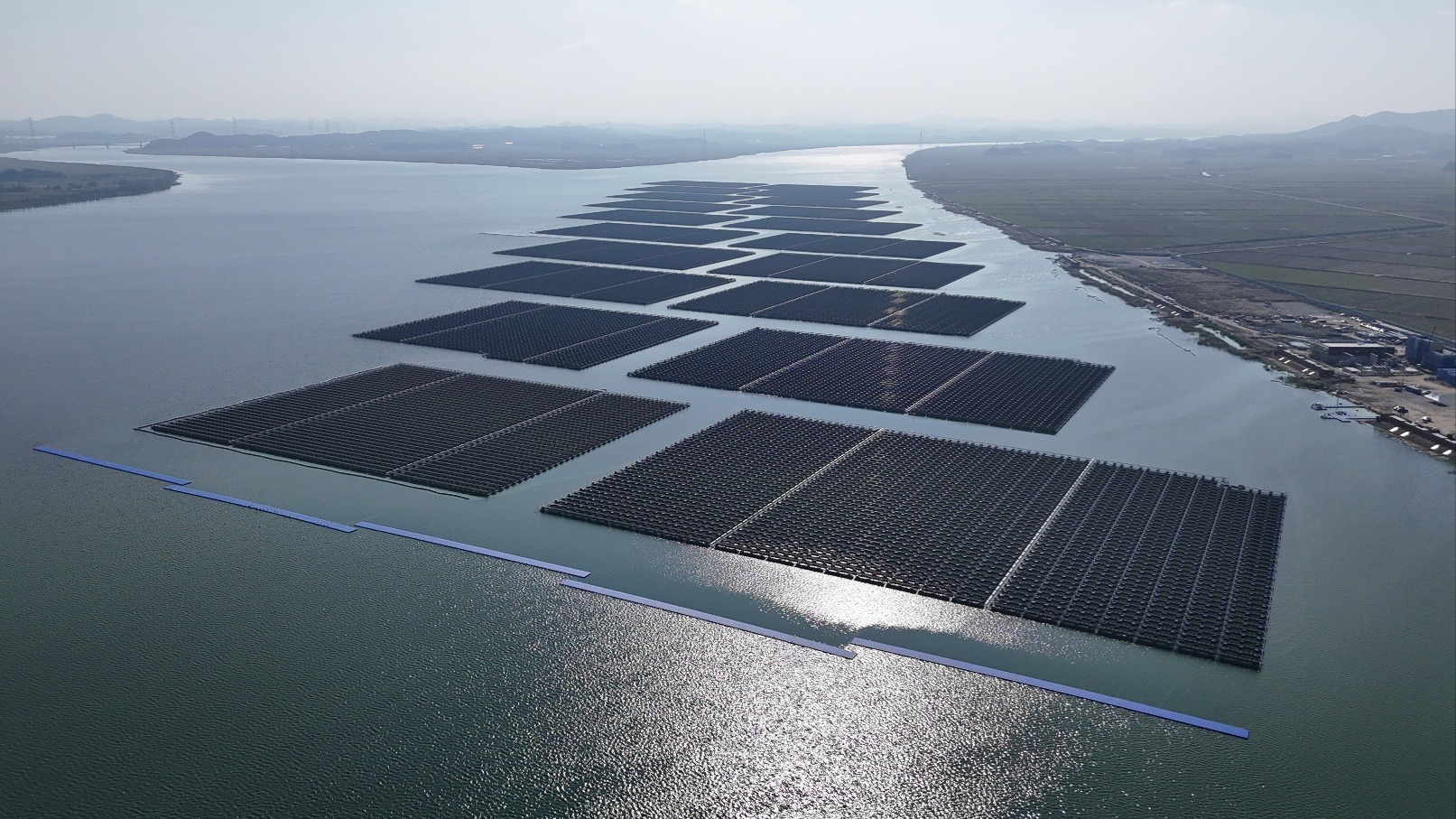
The Ministry of Climate, Energy and Environment on Sept. 29 announced a plan for power grid innovation at a Cabinet meeting to redesign the power grid system to enable renewable energy capacity of over 100 gigawatts by 2030. Shown is an aerial view of the floating solar power plant at Daeho Lake in Seosan, Chungcheongnam-do Province. (Korea-East Power)
By Charles Audouin
The Ministry of Climate, Energy and Environment on Sept. 29 announced a plan for power grid innovation at a Cabinet meeting to redesign the power grid system to raise renewable energy capacity to over 100 gigawatts (GW) by 2030.
This is expected to raise the country's ability to host renewable energy by 2030 from 119 GW to 171 GW for tranmission and from 84 GW to 110 GW for distribution.
The crux of the plan is to raise the capacity to connect renewable energy sources by utilizing energy storage systems (ESS). The launch of "flexible connection," which temporarily curtails solar power generation when output exceeds capacity, will boost solar power volume linkable to distribution lines from 14 megawatts (MW) to 16 MW and to substations from 50 MW to 60 MW.
This will allow the southwestern Honam region, which spans Gwangju and the two Jeolla-do provinces, to take in 2.6 GW more of solar power without the need for more power grid infrastructure.
A system allowing utilities to build facilities with a capacity greater than their connection limit and regulate output using ESS is also set for launch next year after a pilot program.
The criteria for reviewing grid connections will also undergo revision. New facilities for renewable energy now take priority over coal and liquefied natural gas power plants in grid connection selection.
This is expected to allow an additional 20 GW of renewable energy by 2030 in Yeongnam, the southeastern region covering Busan, Daegu, Ulsan and the two Gyeongsang-do provinces, and Gangwon-do Province, where thermal power plants are concentrated.
"The timely construction of power grids is urgently needed to ensure stable power supply for megaprojects such as semiconductor industrial complexes," the ministry said. "We must expand power grid infrastructure to transmit electricity from power generation sites to areas of demand."
caudouin@korea.kr