- 한국어
- English
- 日本語
- 中文
- العربية
- Español
- Français
- Deutsch
- Pусский
- Tiếng Việt
- Indonesian
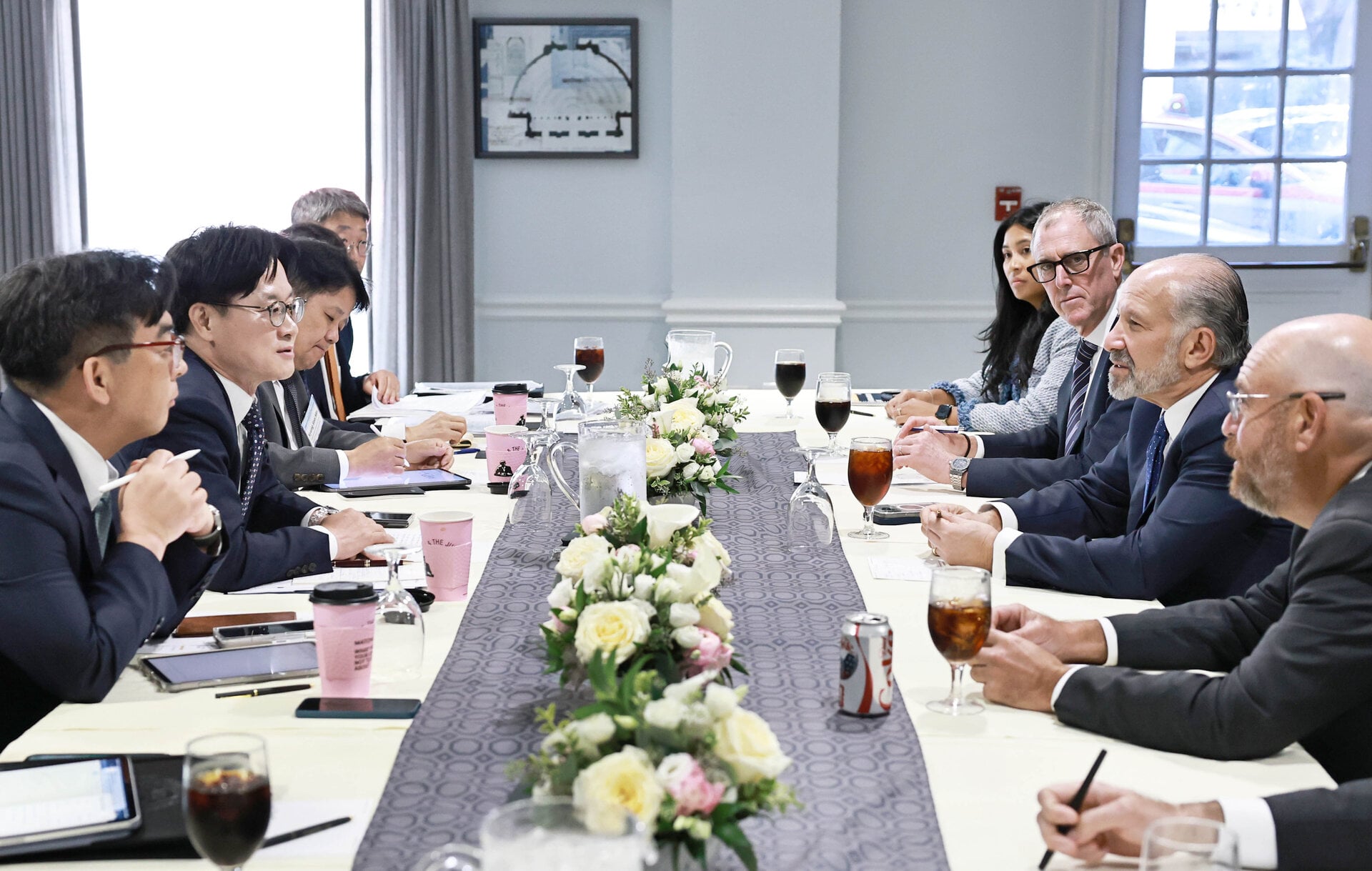
The Korean and U.S. governments on Oct. 1 announced plans to promote three strategic investment projects under a bilateral memorandum of understanding. Shown is Minister of Trade, Industry and Resources Kim Jung-Kwan (second on left) on July 23 attending talks with U.S. Secretary of Commerce Howard Lutnick (second on right)in Washington. (Ministry of Trade, Industry and Resources)
By Xu Aiying
Korea and the U.S. have selected the Texas Gas Combined-Cycle Power Generation Project (Project Star) as the first of three strategic investment between both sides for promotion.
The two governments on Oct. 1 announced plans to promote the ventures under a bilateral memorandum of understanding covering Project Star, the building of nuclear reactors (Project Power) and construction of a liquefied natural gas (LNG) pipeline in Alaska (Project North).
The two countries reached a broad agreement on setting up eight large-scale nuclear plants in the U.S., though specific details remain pending. For Project North, they will begin reviewing whether to move forward.
They also finalized the project in Encinal, Texas, to build and run a gas-fired combined-cycle power plant at a combined cost of USD 22.3 billion and capacity of 6,472 megawatts. The facility will supply electricity directly to nearby artificial intelligence (AI) data centers.
The first phase of commercial operations is slated to begin in 2029, with the plant expected to be fully operational by 2032.
The project leaders are Related Companies, the world's No. 9 real estate developer, and NextEra Energy, the top power generation and operations company in the U.S. and Lewis Energy Group, the fifth-largest LNG supplier in Texas, will provide infrastructure including the site, natural gas and water.
The project will also seek to expand the participation of competitive Korean companies across the business cycle including power generation equipment, design and construction, and long-term operations and maintenance.
Through this venture, the two countries are expected to jointly take on growing demand for electricity in the U.S. due to the expansion of AI data centers, while creating a new model for economic security cooperation in strategic sectors such as AI and energy infrastructure.
xuaiy@korea.kr