- 한국어
- English
- 日本語
- 中文
- العربية
- Español
- Français
- Deutsch
- Pусский
- Tiếng Việt
- Indonesian
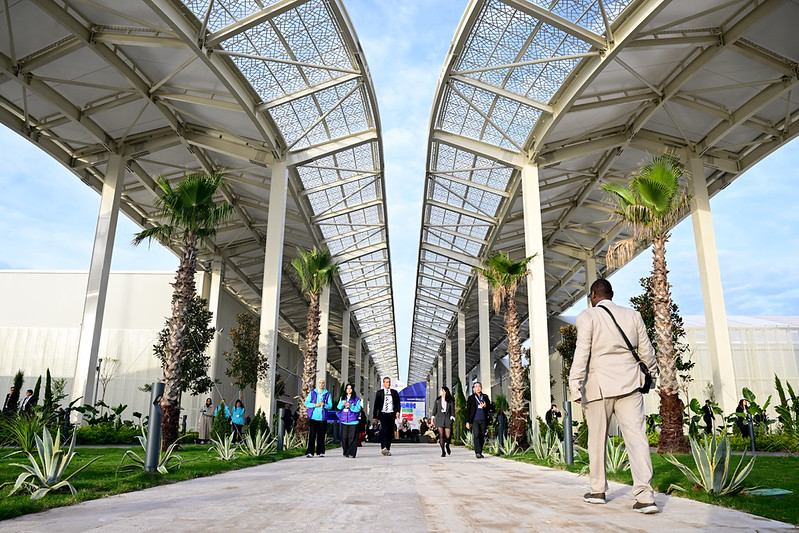
Korea has joined the Carbon Market Coalition, a global initiative whose members include the European Union and China to promote cooperation in carbon markets. Shown are participants at this year's Conference of the Parties (COP31) to the United Nations Framework Convention on Climate Change in Antalya, Turkiye. (COP31's official website)
By Oh Jung Eun
Korea has joined the Open Coalition on Compliance Carbon Markets, aka the Carbon Market Alliance, a global initiative that promotes cooperation in carbon markets with members such as the European Union (EU) and China.
Minister of Climate, Energy and Environment Kim Sunghwan on Nov. 16 announced Korea's membership at a high-level meeting of the coalition on the sidelines of the Conference of the Parties (COP31) to the United Nations Framework Convention on Climate Change in Antalya, Turkiye (Turkey).
The coalition is a voluntary cooperation initiative proposed by Brazil at COP30 last year and launched in May this year, led by major carbon market operators such as the EU and China. Korea is the 13th member country.
Members share their experiences in running compliance carbon markets like trading systems for greenhouse gas emissions and promote mutual understanding and cooperation in areas such as measurement, reporting and verification, carbon accounting and the use of high-quality offset mechanisms.
"Korea in 2015 became the first country in East Asia to launch a national emissions trading system, which it has operated since and covers over 70% of our greenhouse gas emissions," Minister Kim said in announcing Korea's membership.
"We will share with other coalition members our system for emission measurement, reporting and verification in a manufacturing-centric industrial economy, as well as our experience in designing and operating such markets and implementing offset mechanisms under the emissions trading system."
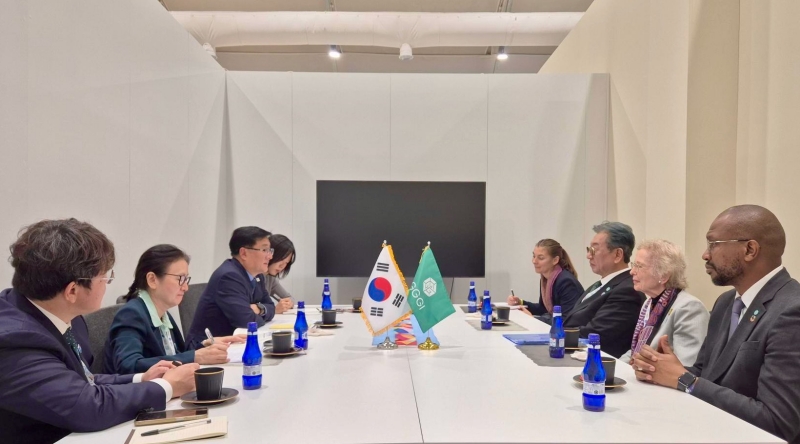
The Ministry of Climate, Energy and Environment on Nov. 16 amended its memorandum of understanding on green growth cooperation with the Seoul-based Global Green Growth Institute (GGGI) on the sidelines of COP31 in Antalya, Turkiye (Turkey). Shown is Minister Kim Seonghwan (third from left) speaking in a meeting with senior GGGI officials including Secretary-General Kim Sang-Hyup (third from right). (GGGI)
In addition, the Ministry of Climate, Energy and Environment on Nov. 16 amended its memorandum of understanding (MOU) on green growth cooperation with the Seoul-based Global Green Growth Institute (GGGI) on the sidelines of COP31.
Launched in 2012, the institute is an international organization led by Korea that supports developing countries in devising green growth strategies, identifying green investment opportunities, mobilizing funds and building institutional capacity.
Under the revised MOU, the two sides will expand their cooperation beyond green growth development and climate adaptation projects, reduction of greenhouse gas emissions and capacity building to include energy transition, the circular economy, management of sustainable water resources and global carbon markets.
They will also strengthen capacity to engage carbon markets abroad by supporting the implementation of Article 6.2 of the Paris Agreement, as well as help developing economies formulate green growth plans and expand public and private investment in green sectors.
cloveroh@korea.kr
