The administration of President Lee Jae Myung marks its first anniversary in early June. Since its launch on June 4, 2025, it has laid the groundwork for change across sectors under the national vision "A nation where the people rule, a Republic of Korea where everyone is happy." To mark this occasion, Korea.net looks at the government's key achievements in five installments. This second part of the series is on economic growth led by artificial intelligence, the semiconductor boom and financial innovation.
Photos = Cheong Wa Dae
The economy over the past year has faced intense uncertainty both at home and abroad due to the impeachment of a president, tariff negotiations with the U.S., the weak domestic currency and supply chain disruptions.
Despite this multifaceted crisis, artificial intelligence (AI), semiconductors and the main stock market KOSPI have emerged as the undisputed drivers of economic growth.
Over the last 12 months, President Lee Jae Myung has made AI and chips the cornerstones of the national growth strategy. Leveraging both industries as momentum, his administration has sped up the transition of the industrial structure and overhaul of the capital market.
Accordingly, the economy has recovered faster than expected, leading major institutions and global investment banks to raise their forecasts for economic growth in 2026.
At the heart of this economic surge is the semiconductor supercycle. Rising global investment in AI has seen demand for AI chips like high-bandwidth memory (HBM) skyrocket, leading to simultaneous growth of exports and facility investment.
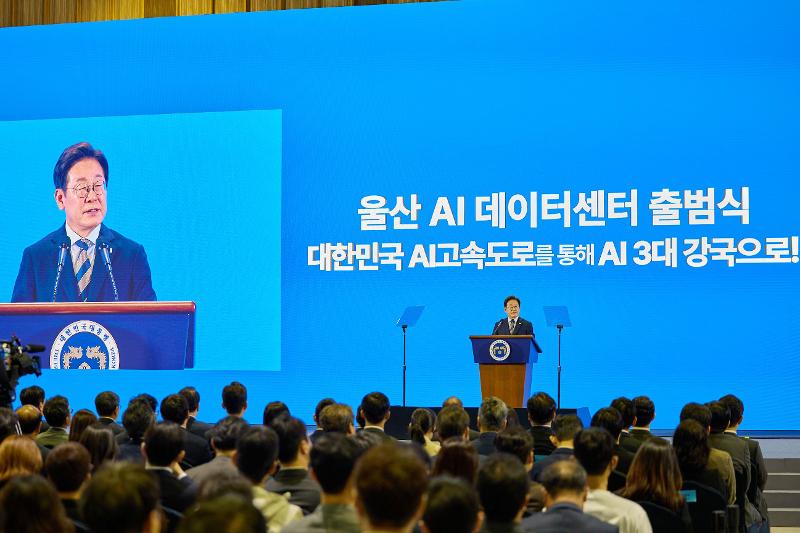
President Lee Jae Myung on June 20, 2025, gives a congratulatory speech at the launching ceremony for Ulsan AI Data Center, saying, "Through bold tax incentives and regulatory innovation, we will build a highway for the AI era to lead to the success of Korea's massive AI transformation."
In the first quarter of this year, the economy grew 1.7% from the previous quarter, the highest in 5 1/2 years, and the current account surplus set a record-high USD 73.8 billion. Export volume also jumped from eighth to fifth in the world.
The Lee administration pushed for the Semiconductor Special Act to boost industrial competitiveness through the creation of a chip cluster, providing tax support and expanding personnel training.
Efforts to make Korea one of the world's top three AI powers were also accelerated. Seoul proactively secured graphic processing unit infrastructure, overhauled AI laws and regulations, and built a tight-knit system of private-public cooperation.
The administration's launch of the Independent AI Foundation Model project seeks to create a Korean-style mega-AI and expand AI transition and data utilization in manufacturing and medicine (M.AX). It also promoted the creation of the National Growth Fund worth over KRW 100 trillion to support major transformation across all industries.
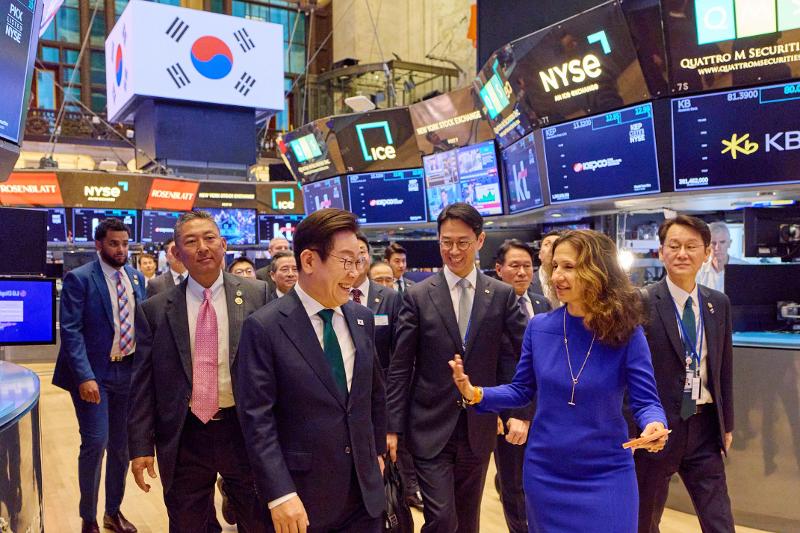
President Lee Jae Myung (left in front) on Sept. 25, 2025, attended the Korea Investment Summit at the New York Stock Exchange to explain the directions of Korea's capital market policy and his commitment to reform.
The stock market has seen the most drastic changes over the past year.
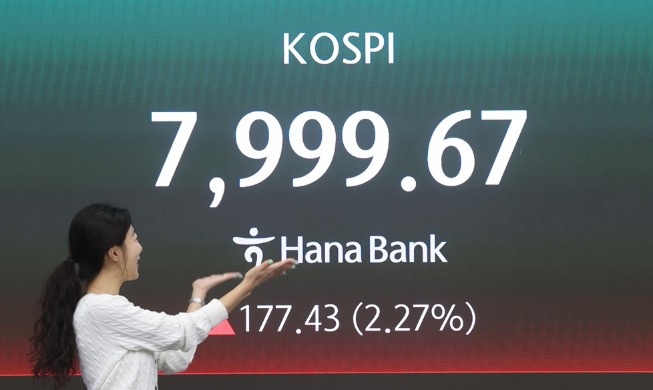
In his election campaign, President Lee pledged to usher in the era of "KOSPI 5,000," referring to the main stock market KOSPI. The index was around 2,770 when he assumed office but hit 8,000 on May 26 for the first time in history thanks to semiconductor recovery and optimism over AI's growth.
Efforts to streamline the basic structure of the capital market are also considered a growth driver.
The amendment to the Commercial Act sought to decisively introduce measures such as strengthening the fiduciary duties of directors to shareholders, expanding cumulative voting and implementing a treasury stock cancellation system. Other shareholder-friendly moves included separate taxation of dividend income to tackle the "Korea discount," a phenomenon in which the stocks of domestic companies are valued lower than those of their counterparts abroad.
Foreign capital inflows have risen after Korea's inclusion in the World Government Bond Index. Major credit rating agencies have kept the country's sovereign credit rating at a stable level, something that buttressed market confidence.
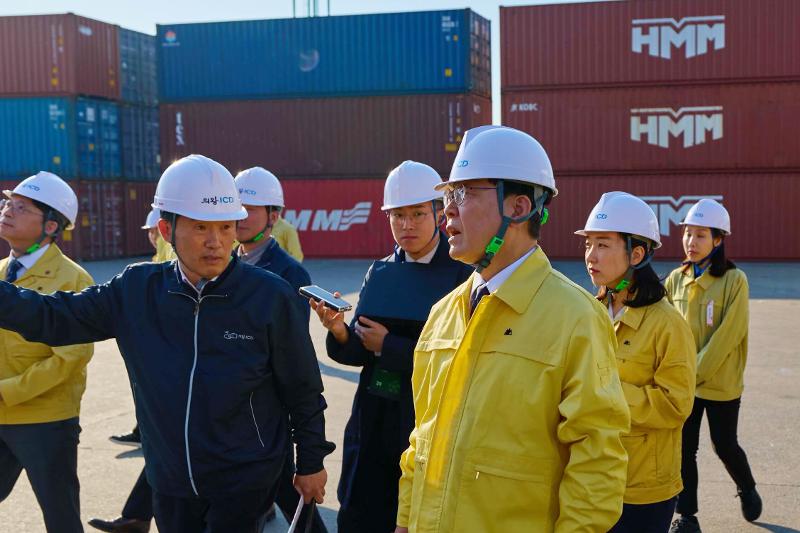
President Lee Jae Myung (right in front) on April 8 visits a logistics hub in Gyeonggi-do Province and listens to worker opinions on the transportation industry.
The administration also produced results from its expansionary fiscal policy eyeing economic stimulation and stabilization of the people's livelihoods.
To stimulate consumption, a supplementary budget worth KRW 31.6 trillion was passed in July last year and spending stimulus measures followed like consumption coupons. This year, the National Assembly on April 10 passed the bill on a supplementary budget of KRW 26.2 trillion in 29 days to alleviate the public's pain from higher oil prices, tightening the reins on the response to the shock of fuel inflation.
Measures to stabilize prices were conducted in parallel. The administration slashed fuel taxes and capped petroleum prices to help absorb the shock of soaring global oil prices. This led to consumer inflation remaining in the 2% range, a relatively stable level compared to those of leading economies.
The streamlining of energy policy sought to respond to changes in industrial structure. Given surging electricity demand due to the spread of AI, the construction of two large-scale nuclear power plants received the green light as well as the promotion of an energy highway to connect power grids.
In addition, the expansion of renewable energy was linked with the K-RE100 policy, a Korean-style system for sourcing all of a company's electricity from renewable energy sources. This led to the simultaneous pursuit of two goals: industrial competitiveness and transition to carbon neutrality.
In its first year, the Lee administration has achieved palpable economic results despite internal and external shocks. The semiconductor supercycle and AI transformation are apparently not just temporary phenomena and instead have emerged as new and sustainable drivers of economic growth.
kgh89@korea.kr
![[President Lee: Year 1] ① Nat'l interests over ideology in diplomacy](/upload/content/image/789fb9184e1c4a5096d9e74f23feb58b_20260520132603.jpg)