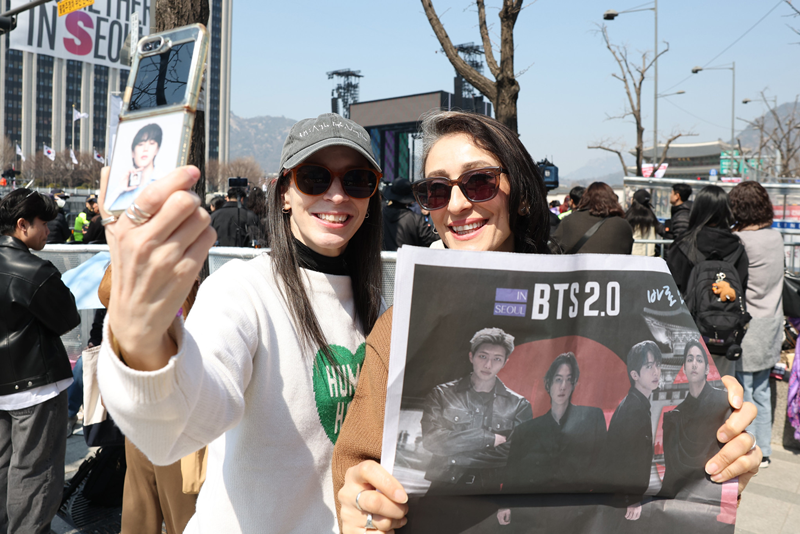
The growing global status and influence of Korean content have helped boost the world's interest in and demand for Korean consumer goods like food and cosmetics, a report released on Nov. 12 by the Institute for International Trade at the Korea International Trade Association said. Shown are two tourists in March taking photos at Gwanghwamun Square in Seoul's Jongno-gu District around the time of a performance by BTS marking the release of the group's fifth studio album "Arirang." (Lee Jeongwoo)
By Yoon Sojung
The global boom in Hallyu (Korean Wave) content such as K-pop and K-dramas is driving international interest in and demand for domestic consumer goods, an analysis says.
This is according to a report on the effects of Korean content on consumer goods exports released on Nov. 12 by the Institute for International Trade of the Korea International Trade Association (KITA).
The report reviewed the magnitude and timing of effects on the export of five key items -- agri-food products, household goods, cosmetics, fashion and apparel, and pharmaceuticals -- if the consumption of Hallyu content, based on YouTube Music's Global Top 20 for K-pop and Netflix's top 10 list in viewing hours for K-dramas, rise 10% above baseline levels.
The analysis covered the five-year period from July 2021 to June 2026 across four countries representing a region: Germany, Mexico, Japan and Vietnam.
In quantitative terms, the report said the success of Korean content raises the export figures of consumer goods. This effect was concentrated a three-month window starting from the month a work gains popularity, and is most accelerated in categories such as living goods and cosmetics, which typically have shorter delivery lead times following an order.
The timing of this impact and the specific items affected varied by country, depending on factors such as income level and cultural context.
In Mexico, a 10% increase in K-pop's popularity fueled 1.7% growth in cosmetics exports in the same month, followed by rises of 1.6% three months later and 1.3% six months later. In Vietnam, a 10% jump led to 0.7% growth in the export of cosmetics and 0.5% in household goods.
In Japan and Germany, the impact was concentrated within the first three months. Korean cosmetics rule the Japanese market for imported cosmetics, accounting for 33.4% in the first half of this year, making the potential for further export growth was limited.
Exports of agricultural, fishery and food products, however, went up 0.4% three months after a K-drama became a hit, with the report suggesting that repeated exposure of products in these productions and growing interest in Korean consumer culture gradually translating into exports through purchases and expanded distribution.
Cosmetics exports to Germany rose 1.6%–1.7% in a month when a K-pop act achieved success, while K-dramas contributed a 1.6% boost after a two-month lag.
"We need customized export strategies linking Korean content with domestic consumer goods, with the market characteristics of each country and the timing of export responses across product categories in mind," senior KITA researcher Lee Kwan Jae said.
"We need to concentrate sales events and online campaigns in regions immediately following the success of a piece of content, in addition to follow-up marketing to ensure that initial interest turns into sustained export growth."
arete@korea.kr