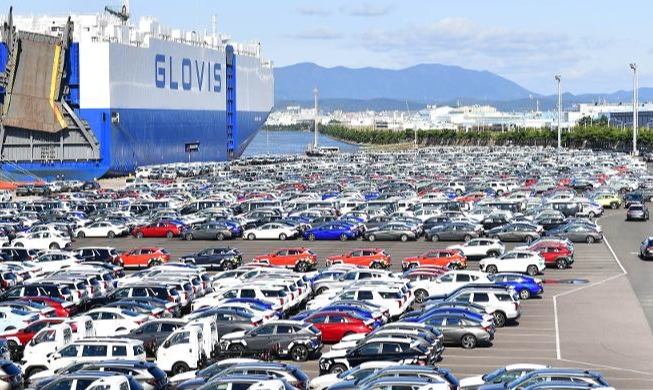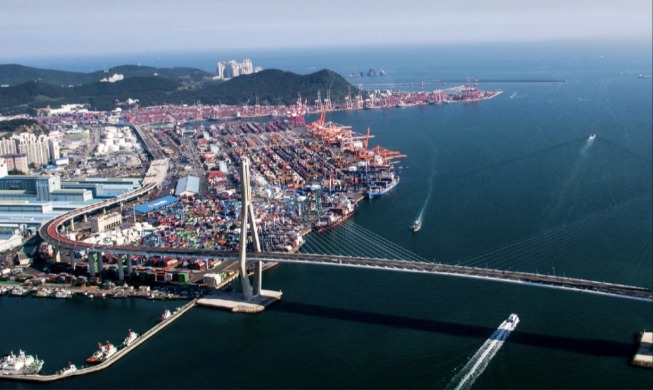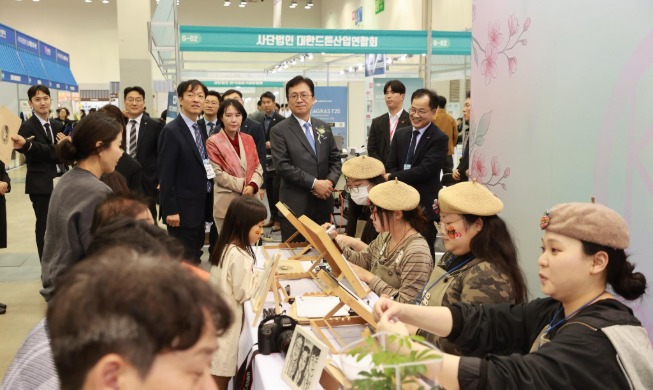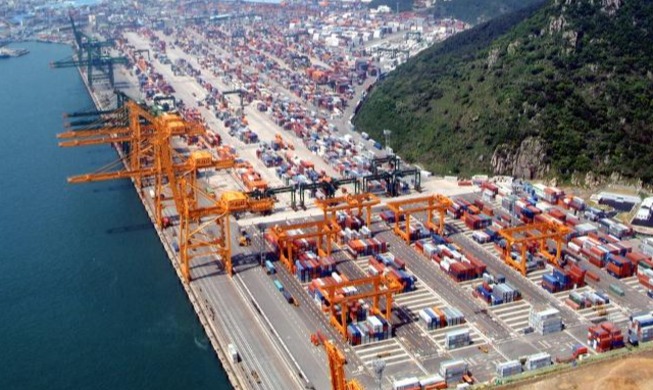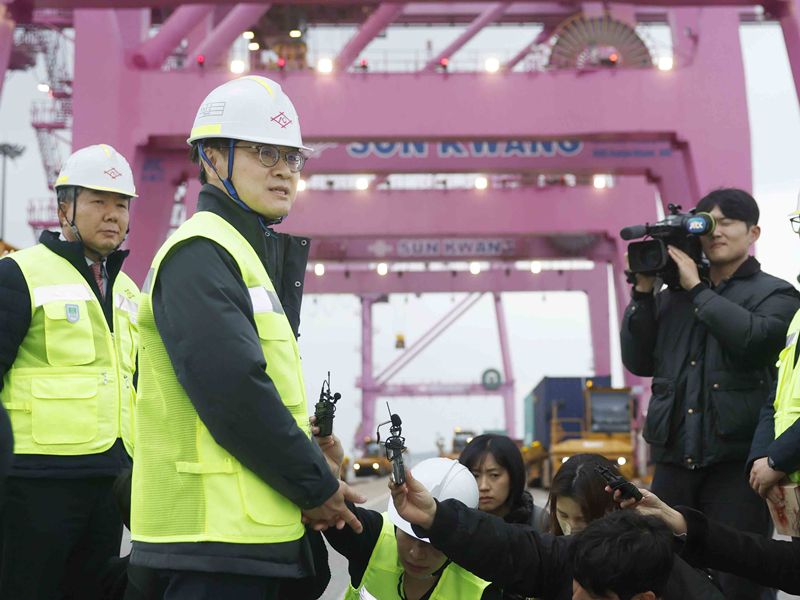
Minister of Trade, Industry and Resources Kim Jung-Kwan on Nov. 17 visits Sun Kwang New Container Terminal at Incheon New Port in Incheon's Yeonsu-gu District. There, he thanked port and logistics personnel for helping the economy's export performance this year. (Ministry of Trade, Industry and Resources)
By Lee Ji Yae
Korea is the fourth country to achieve USD 1 trillion in annual exports.
The Ministry of Trade, Industry and Resources on Nov. 19 cited preliminary data in saying exports this year surpassed USD 1 trillion that day as of 2:09 p.m.
The milestone came just a year after the country broke USD 700 billion in exports. Korea thus joined Germany, the U.S. and China in the trillion-dollar export club.
Export volume saw a 10,000-fold increase over 62 years since breaking the USD 100 million mark in 1964, despite the nation having a smaller population and economy and fewer natural resources than the three other countries on the list. Per a comparison of population and nominal gross domestic product at the time each of the four reached the milestone, Korea had the smallest economy and population.
The achievement came despite challenging external conditions like the spread of protectionism and slowing growth of global trade.
The types of leading exports have also shifted from labor-intensive goods to high-tech, high-value-added products. When exports first broke USD 10 billion in 1977, the country's leading exports included fish, timber and clothing, but this year's top performers are semiconductors, computers, petroleum products and passenger vehicles.
This shift reflects the transformation of the export sector from labor-intensive sectors to advanced manufacturing thanks to continuous technological innovation and industrial upgrading.
A leading driver of this year's growth is higher investment in artificial intelligence (AI) by global tech giants. Rising demand fueled by AI investment has greatly pushed up the prices of DRAM and NAND flash memory chips, boosting overseas sales of chips and computer products.
While core export items such as petroleum products, ships and displays maintained solid performance, emerging consumer goods like cosmetics, agricultural and fishery products, and pharmaceuticals recorded record highs.
Markets also got more diversified, with exports rising in seven of Korea's top nine destinations. Significant growth was seen not only in traditional markets like the U.S. (77%), China (88%) and member states of the Association of Southeast Asian Nations (69%), but also in emerging markets such as India (38%) and Latin America (10%).
Exports by small and medium and middle market enterprises also set record highs, signaling a shift away from a traditional reliance on large corporations to reflect a broader and more inclusive export base.
To maintain export growth into next year, the plan is raise the competitiveness of core industries like semiconductors, cars and shipbuilding by integrating AI into manufacturing processes and fostering emerging industries such as biotechnology and robotics. Stronger trade cooperation will also seek to help domestic companies expand exports within a stable environment.
"Korea has reached the historic milestone of USD 1 trillion in annual exports, just the fourth country to do so," Minister of Trade, Industry and Resources Kim Jung-Kwan said.
"This remarkable achievement was thanks to our companies that compete fiercely abroad, business executives and workers who quietly work at production sites, and everyone else who helps contribute to our export success."
ljyhwa@korea.kr