Busan in July hosts the 48th session of the UNESCO World Heritage Committee. To mark this occasion, Korea.net introduces six of the country's 12 tentative candidates for World Heritage status.
By Margareth Theresia
Photos = Lee Jeongwoo
Video = Park Dae Jin
When the Joseon Dynasty was founded in 1392 by King Taejo, the capital was relocated from Gaegyeong (now Gaeseong, North Korea) to Hanyang (present-day Seoul). The new site was a basin nestled between Bukhansan Mountain and the Hangang River, a strategic location surrounded by mountains and the river.
The kingdom built a fortress along the ridges of Bukhansan in the north, Namsan Mountain in the south, Naksan Mountain in the east and Inwangsan Mountain in the west to clearly define the boundaries and shape of the capital.
With the founding of Joseon in 1392, the capital was moved from Gaegyeong to Hanyang. Hanyang, chosen by King Taejo Yi Seong-gye, was located in a basin between Bukhansan Mountain and the Hangang River. It was a strategic location, blessed with a natural harmony of mountains and rivers. Joseon established the boundaries and shape of its capital by building a fortress along the ridges of Bukaksan Mountain, Namsan Mountain, Naksan Mountain, and Inwangsan Mountain.
The Capital Fortifications of Hanyang, a candidate for UNESCO World Heritage designation, covers the defensive system built on mountainous terrain. Construction of this network began in 1396 and ended with Bukhansanseong Fortress in 1711. The addition of Tangchundaesong Fortress connected the two forts, forming a massive link covering 37.7 km.
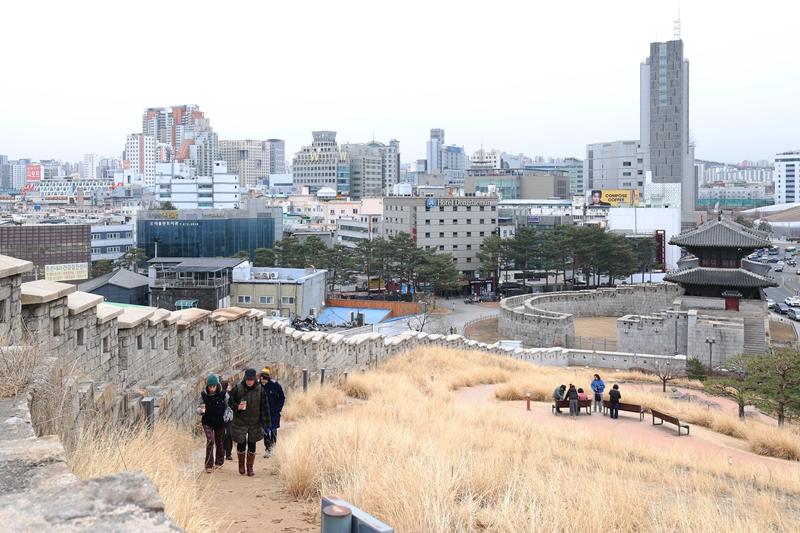
Hanyangdoseong (Seoul City Wall) Fortress, which was built in the 14th century to defend the capital of the Joseon Dynasty (1392-1910), is today a historical landmark in Seoul and a popular attraction for domestic and foreign tourists. Shown are visitors to the Naksan Mountain section of the structure. .
Hanyangdoseong: surrounding capital's administration and life
Hanyangdoseong (Seoul City Wall) Fortress, which defined the boundaries of the Joseon capital and defended against external invasions, was first built in the late 14th century and underwent major renovations in the 15th. The initial earth walls built on flat ground were later reconstructed with stones, greatly reinforcing the facility's defensive structures.
Measuring a combined 18.6 km long with 12.8 km in its original form or restored, the fortress has well-preserved towers and walls to provide a glimpse into the architectural know-how and urban culture in the Joseon capital.
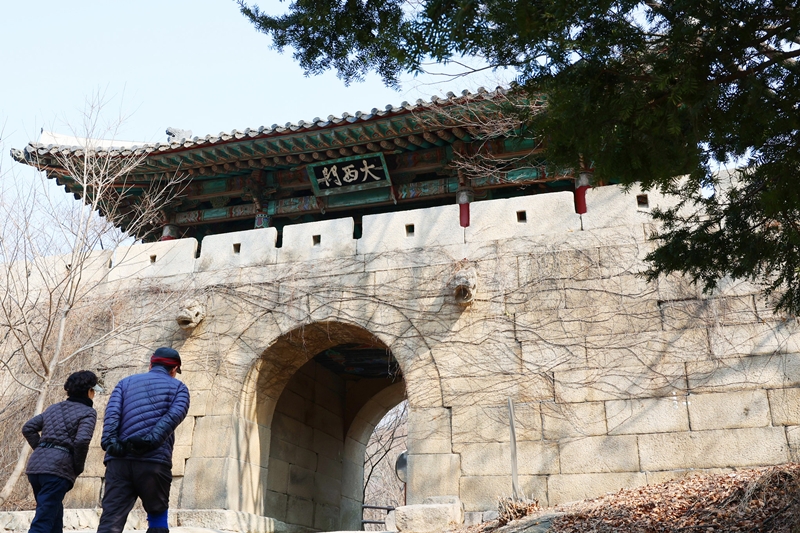
History and daily life intersect at Daeseomun Gate of Bukhansanseong Fortress in Goyang, Gyeonggi-do Province. This gate has the lowest altitude of the structure's 16 and was used by residents as a passageway. Today, this tourist landmark is frequented by locals and foreign tourists and leads to a popular hiking trail.
Bukhansanseong: stronghold in case of emergency
Built north of the capital, Bukhansanseong Fortress was used as a key stronghold in case of emergency. Connecting the rugged peaks of Bukhansan Mountain, the structure stretches 11.6 km and its internal area covers 5.3 square km.
As the capital's defense grew in importance with the Imjin Waeran, the Japanese invasion of the Korean Peninsula from 1592-98, and Byeongja Horan, Qing China's invasion of the peninsula from 1636-37, the original parts of the fortress built with soil were rebuilt with stone in the early 18th century, achieving its present-day majesty.
Within the fortress were military facilities such as a temporary palace and a military supply warehouse. The installation of 99 wells, 26 small reservoirs and eight storage venues prepared for prolonged warfare.
The systematic structure of this fortress allowed the king and the people to enter and defend the capital in case of emergency.
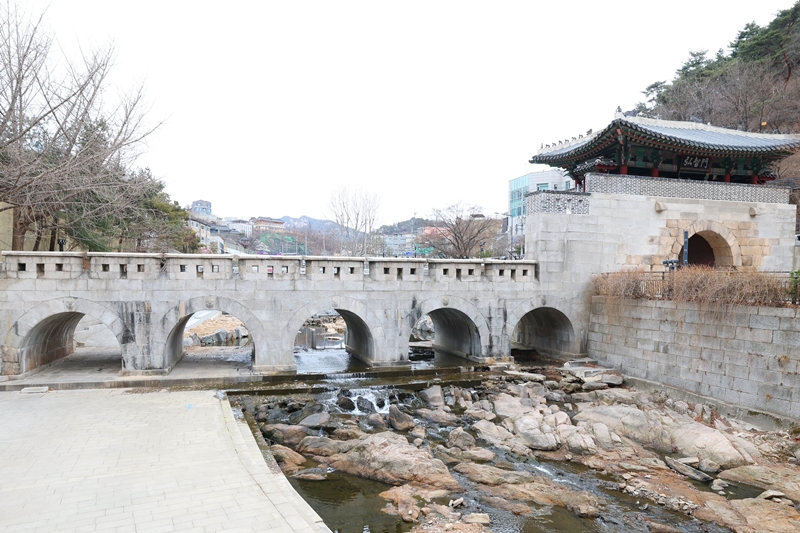
This is Hongjimun Gate of Tangchundaeseong Fortress in Seoul's Jongno-gu District. This gate and the five-arch floodgate Ogansumun collapsed in 1921 due to a flood but were restored in 1977 through a restoration project.
Tangchundaeseong: connected fortress completing defense system
Tangchundaeseong Fortress was a connecting wall built between Hanyangdoseong and Bukhansanseong along the ridge from Inwangsan Mountain to Bukhansan Mountain. Around 4 km long, Tangchundaeseong was designed to repel enemy attacks and allow residents to evacuate to Bukhansanseong.
Tangchundaeseong boosted the western defensive line and was a route for military supplies and troops between Hanyangdoseong and Bukhansanseong. When defense of the capital proved difficult, Tangchundaeseong was a strategic link for the royal court and people to relocate to Bukhansanseong.
This completed the capital's defense in the late Joseon period as a distinctive, three-dimensional fortification system that organically integrated the capital on the plains, fortresses in the mountains and the axis linking them.
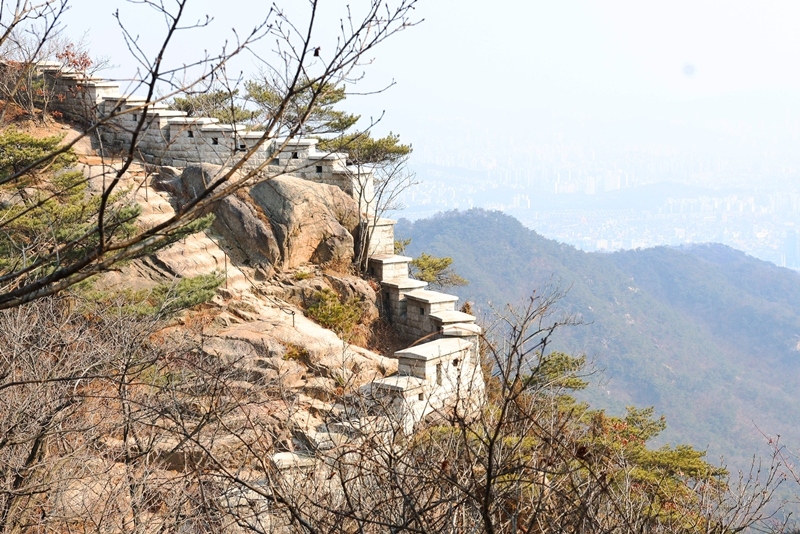
Seoul landscape as seen from Bukhansanseong Fortress
Cultural heritage accumulated over time
The Capital Fortifications of Hanyang are not a single, isolated structure completed at a specific time but a defensive system built in stages from the late 14th to early 18th century. Stones of varying shapes remain throughout the walls, reflecting the fortification techniques and urgency of the time.
The structures have high value in creatively passing on the Northeast Asian tradition of maximizing the use of mountainous terrain to build fortresses in valleys and reflects the development of capital defense on the Korean Peninsula.
margareth@korea.kr
![[World Heritage candidates] ① Busan: refugee hub of Korean War](/upload/content/image/2013b0a594b344268b6e4bca4795ad63_20260121105424.jpg)