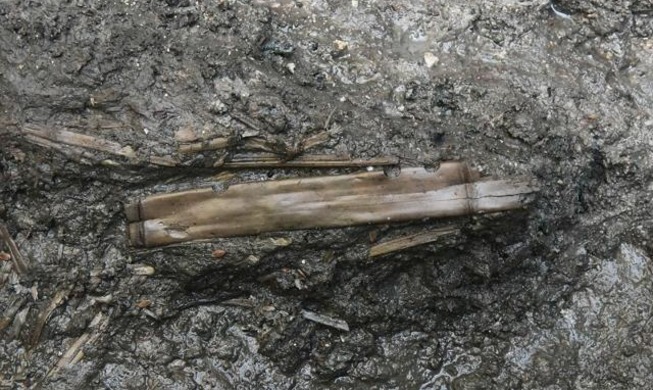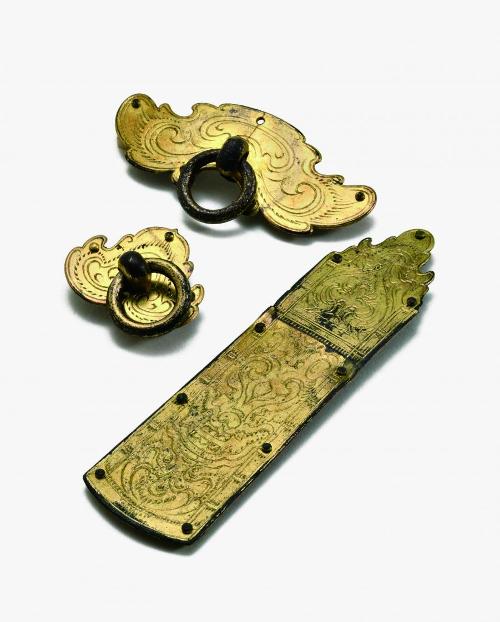
Three gilt-bronze belt ornaments in the artistic style of the ancient Baekje Kingdom (18 B.C.- A.D. 660) have been discovered in the Suzu Senninzuka Tumulus in Fuji, a city in Shizuoka Prefecture, Japan. (Fuji)
By Yoo Yeon Gyeong
Gilt-bronze belt ornaments from the ancient Baekje Kingdom (18 B.C.- A.D. 660) have been discovered at a burial mound complex in Shizuoka Prefecture, Japan.
Fuji, a city in the prefecture, on May 7 announced completed conservation treatment for three such ornaments related to Baekje after they were unearthed at the burial mound Suzu Senninzuka Kofun. Discovered there in 2024, the artifacts were confirmed as high-quality ornaments from Baekje dating back to the late sixth to early seventh centuries.
The artifacts discovered comprised one gold ornament attached to the end of a belt and two decorative plates with circular rings all made of gilded bronze, with intricate gold plating over copper. The belt end ornament had delicately engraved images of phoenixes and dragons, showing the essence of Baekje art over the period.
As the first Baekje-style gold belt ornaments found in good condition in Japan, these valuable artifacts are proof of exchanges between the ruling classes of the ancient Korean Peninsula and the Japanese archipelago.
dusrud21@korea.kr