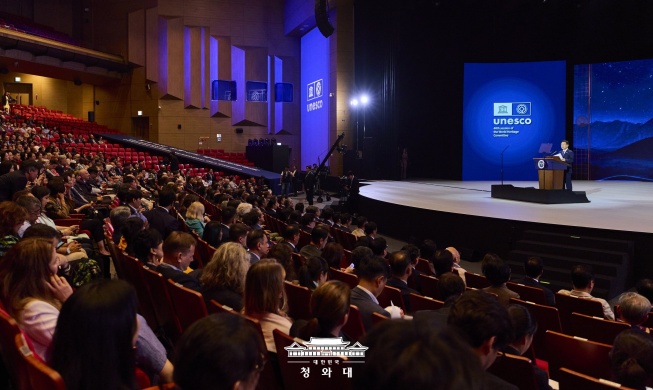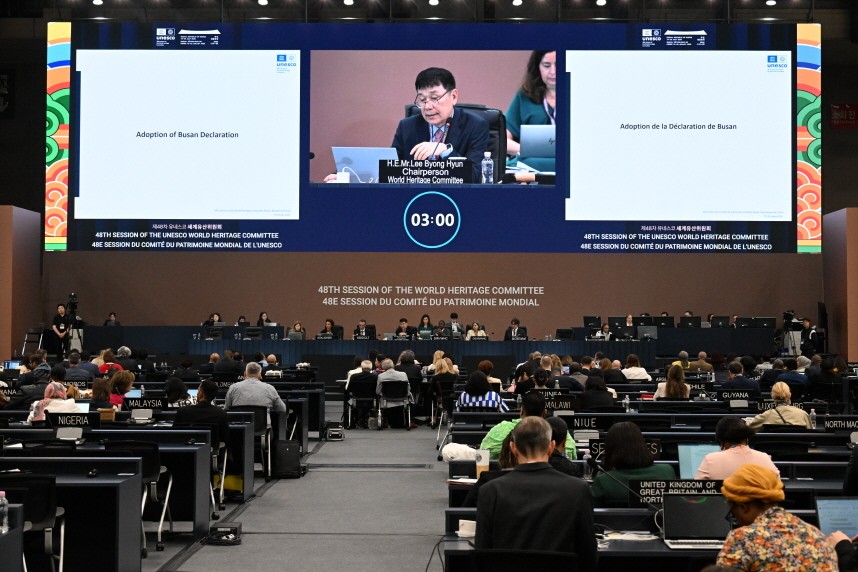
Lee Byong-hyun, chair of this year's UNESCO World Heritage Committee, on July 20 adopts the Busan Declaration on World Heritage at the plenary session of the committee's annual session held at the convention center BEXCO in Busan's Haeundae-gu District. (Korea Heritage Service)
By Margareth Theresia
This year's session of the UNESCO World Heritage Committee on July 20 unanimously adopted the Busan Declaration on World Heritage for the protection of such heritage.
The Korea Heritage Service (KHS) and the Ministry of Foreign Affairs said the declaration was finalized at the committee's first plenary session that day at the convention center BEXCO in Busan's Haeundae-gu District.
The declaration was drafted under the leadership of Korea, the chair country, with the participation of experts from the committee's 21 member states and three advisory bodies: the International Centre for the Study of the Preservation and Restoration of Cultural Property, International Council on Monuments and Sites, and International Union for Conservation of Nature.
The adoption followed consultations and final coordination among member states that started in April.
The declaration outlined collaboration measures to jointly take on the complex challenges facing World Heritage like armed conflict, climate change and development pressure. It also proposed adding "collaboration" to the list of the five Strategic Objectives of the World Heritage Convention.
In a first for the field, the declaration put up digital transformation and its accompanying responsibilities for public discussion.
It also stressed "inclusive interpretation," or the responsible interpretation and explanation of each site's value based on professional expertise for systematic preservation and management, as well as the principle of "shared responsibility" in World Heritage management.
The declaration included as key agenda the need for continuous capacity building of site managers in each country, recognition of the close interdependence between cultural and natural heritage, and promotion of an integrated approach to conservation and management.
The KHS will promote follow-up initiatives to raise its global leadership in the field of World Heritage while raising solidarity among not only states parties but also World Heritage experts and site managers.
margareth@korea.kr