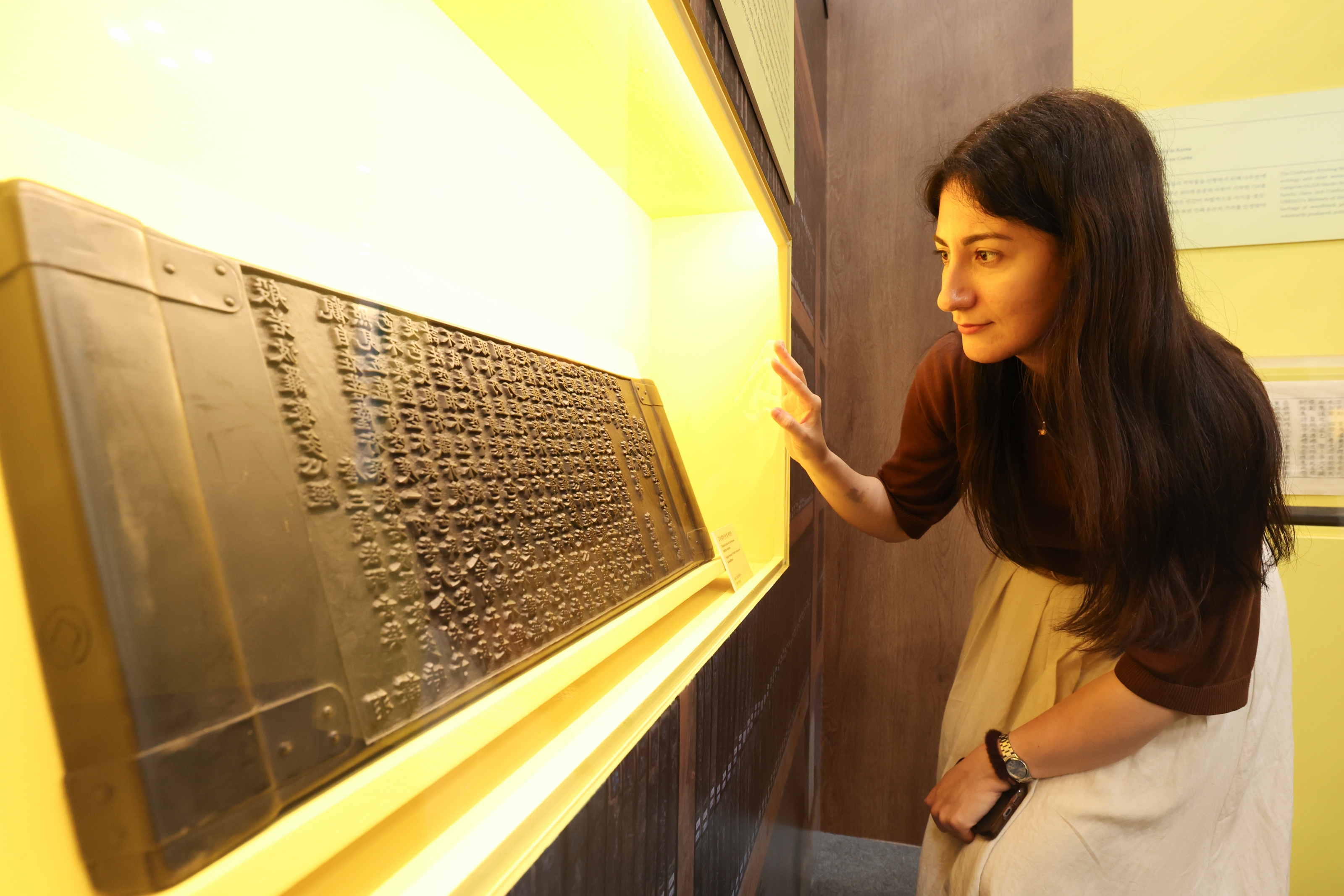
A visitor on July 23 looks at a display of the Tripitaka Koreana, a collection of Buddhist texts, at K-Heritage House located at Exhibition Center 1 of the convention complex BEXCO in Busan's Haeundae-gu District.
By Margareth Theresia
Photos = Park Dae Jin
A long line of visitors on July 23 formed at the entrance to K-Heritage House at Exhibition Center 1 of the convention complex BEXCO in Busan's Haeundae-gu District.
The exhibition spaces K-Heritage Promotion Hall and Heritage: Timeless Time drew the most attention among the many exhibition and interactive booths there. Through media art and interactive content, both venues showcased courses for touring domestic and World Heritage sites nationwide.
Large screens and projector images filling the space transformed heritage from static displays into living and moving stories. They showed cultural heritage, which can often feel difficult to understand, in a more fun and engaging manner.
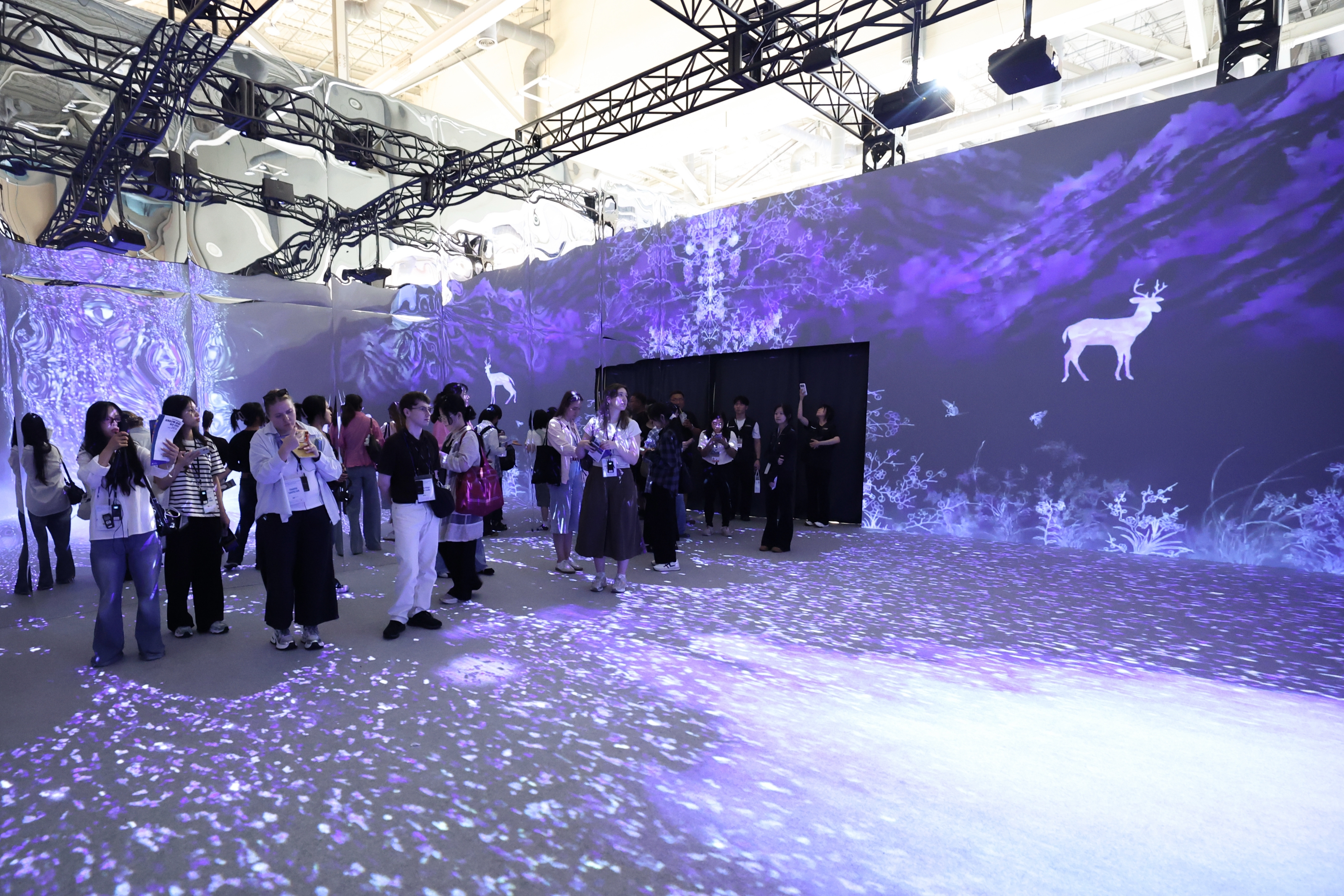
Media art on July 23 features natural landscapes at K-Heritage House at Exhibition Center 1 of the convention complex BEXCO in Busan's Haeundae-gu District.
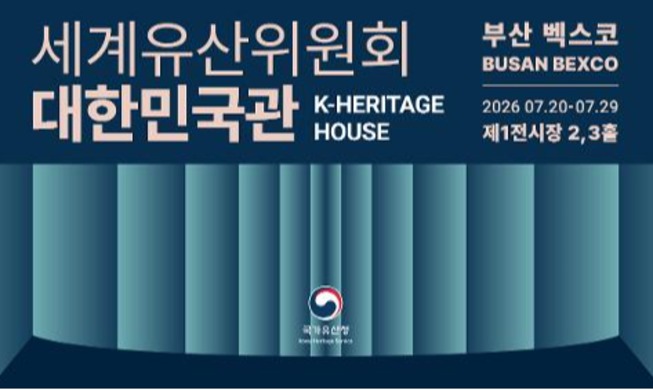
K-Heritage House, the official exhibition hall of host country Korea for the 48th annual session of the UNESCO World Heritage Committee, opened on July 20. In a space about twice the size of a soccer field, 35 organizations including public agencies, local governments, religious organizations and social foundations run 45 exhibition and interactive booths.
The pavilion is a highlight of the session showing Korea's World Heritage, Intangible Cultural Heritage of Humanity and Memory of the World in one place. In addition to exhibitions featuring national heritage policy and results of international cooperation, the facility hosts performing arts, interactive programs and food to diversify the heritage experiences for domestic and foreign visitors.
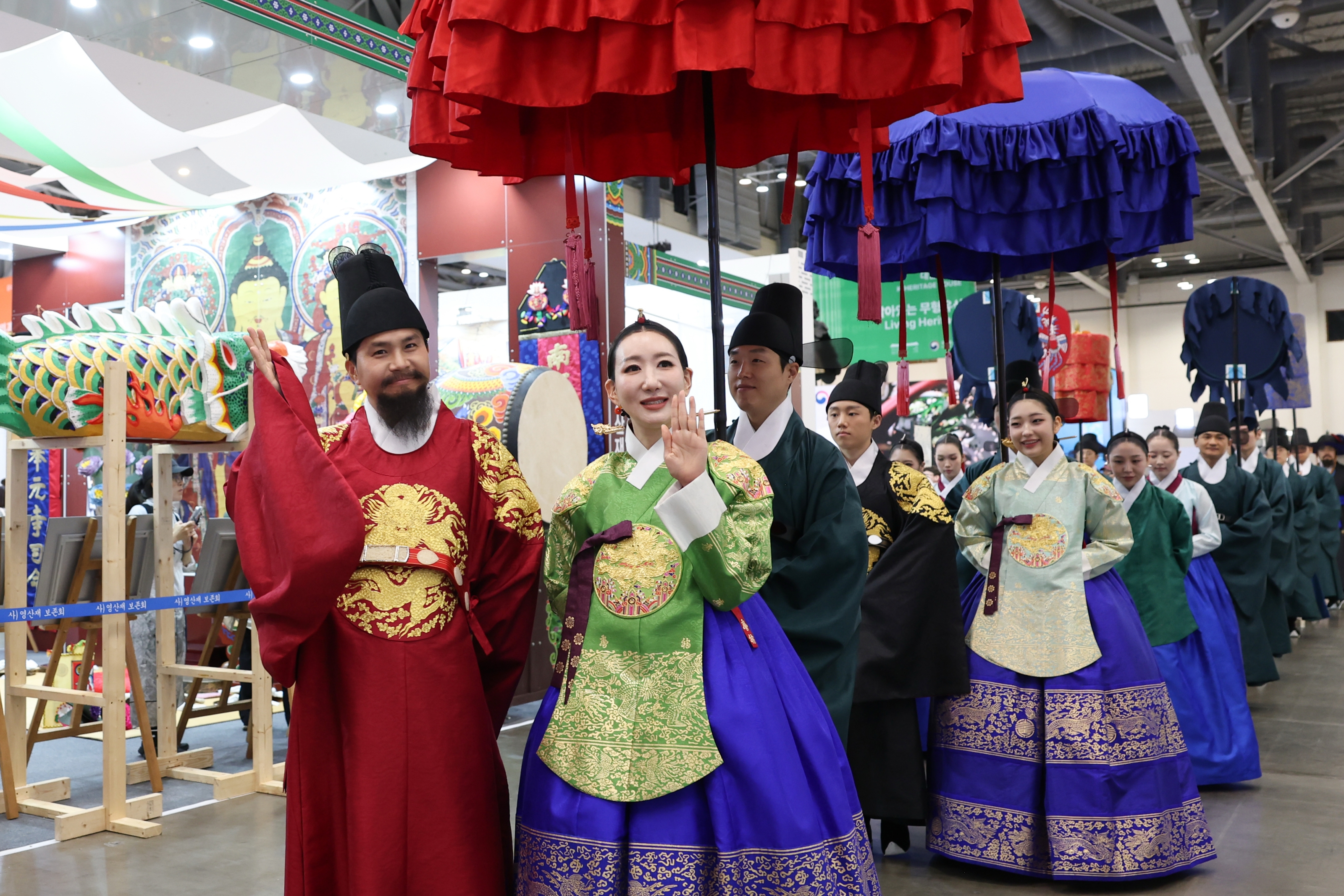
"Royal Stroll," a reenactment of a royal procession from the Joseon Dynasty (1392-1910), on July 23 goes through K-Heritage House at Exhibition Center 1 of the convention complex BEXCO in Busan.
Interactive spaces are set up throughout the venue. The hall of the Korean Studies Institute has plaques hanging on World Heritage sites and allow visitors to make their own plaques and try calligraphy.
Especially popular are halls displaying UNESCO-designated treasures like that for gaetbol (getbol), or long-stretching tidal flats, and domestic seafood and another for the tradition of making jang (fermented sauce) and Korean food.
The events include performing arts as well as exhibitions and interactive programs. K-Heritage House's main stage features 38 traditional performances including demonstrations of Yeongsanjae, a 49-day Buddhist memorial service for the deceased; Suryukjae, a Buddhist water and land ceremony to guide deceased souls; Cheoyongmu (mask court dance); Bukcheong Saja Noreum, a traditional lion mask dance from Bukcheong-gun County, Hamgyeongnam-do Province, in present-day North Korea; and Dongnae hakchum (crane dance).
Bringing a royal touch to the venue are "The Royal Guard Duty," which features gatekeepers dressed in traditional attire, and "Royal Stroll," a reenactment of a royal procession from the Joseon Dynasty.
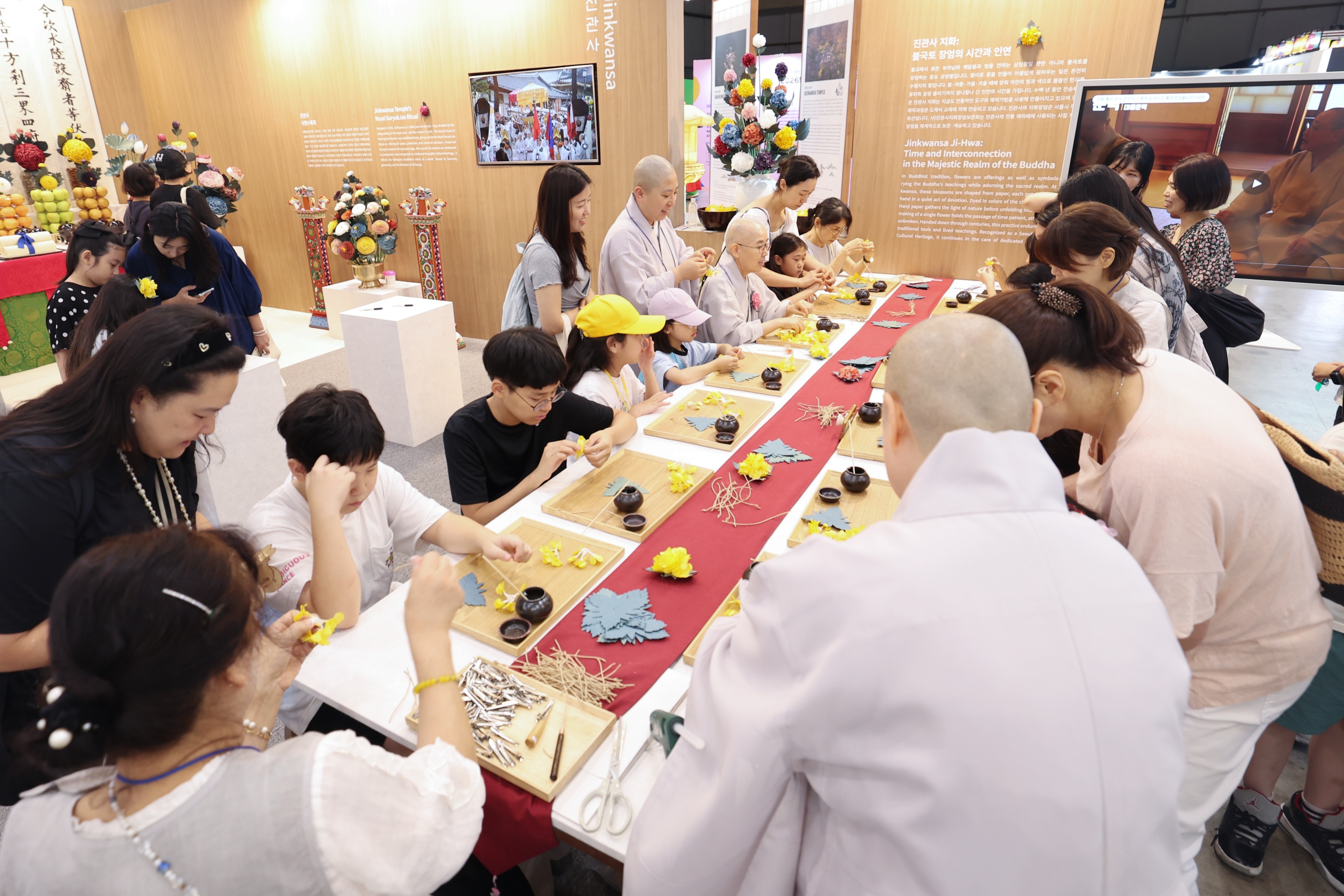
A workshop on July 23 teaches visitors to make jihwa (traditional paper flower) at the Jingwansa Temple booth of K-Heritage House at the convention complex BEXCO in Busan.
K-Heritage House drew an enthusiastic response from foreign visitors. "I came here because I wanted to truly understand Korea's national heritage and share it with other foreigners," said Iuliia Mogylko-Song, an expat from Ukraine. "I hope more foreigners can discover the diverse aspects of Korean culture beyond K-pop."
Adam Hugo Shen Louis, an international student from France, picked the media art there as his favorite. "I've seen many exhibitions in Seoul but the ones here in Busan are on another level," he said, giving a thumbs up. "The works using projectors were unique and truly impressive."
margareth@korea.kr