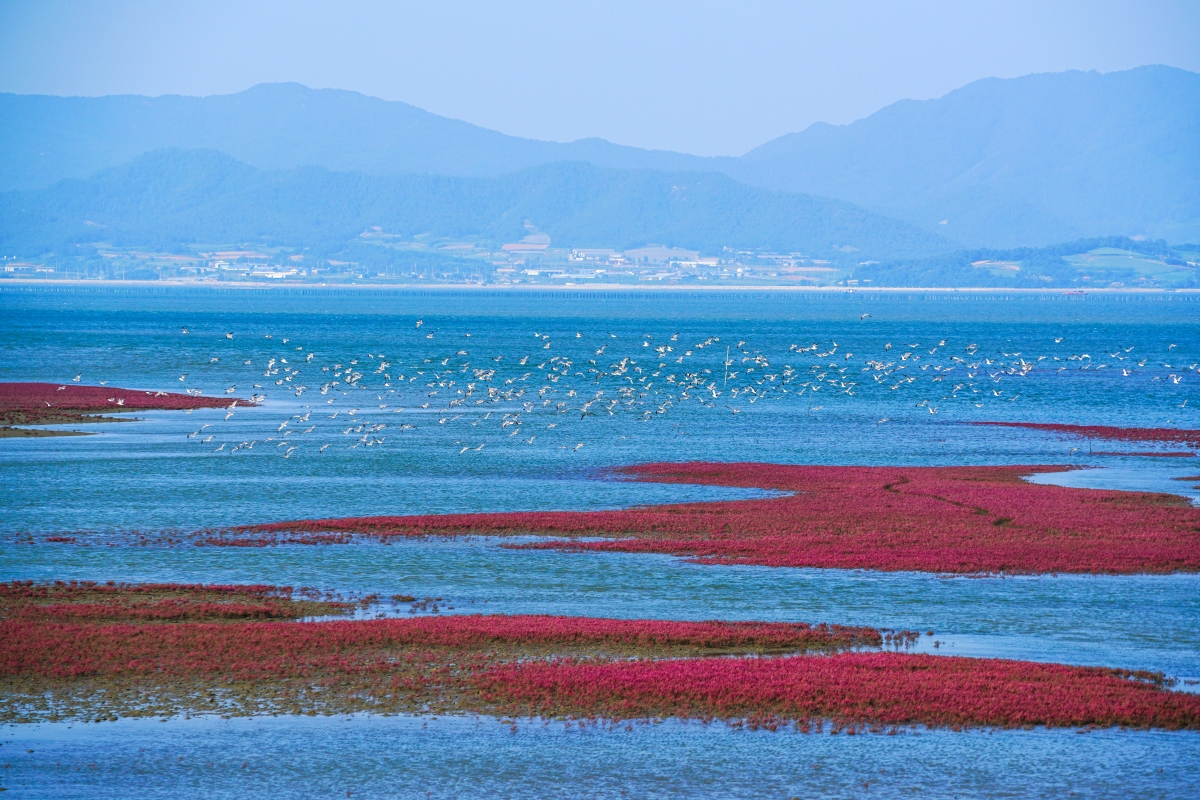
The UNESCO World Heritage Committee on July 25 designated four more gaetbol (tidal flats) in approving "Getbol, Korean Tidal Flats Phase II." Shown is one of the four, Hamhaeman Bay, in Muan-gun County, Jeollanam-do Province. (Korean Tidal Flats World Heritage Inscription Promotion Team)
By Margareth Theresia
Four gaetbol (tidal flats) in the provinces of Chungcheongnam-do and Jeollanam-do have been added to domestic sites registered as UNESCO World Heritage.
A meeting of the annual session of the UNESCO World Heritage Committee in Busan on July 25 made the final decision to approve the second-phase expansion of "Getbol, Korean Tidal Flats" at the convention center BEXCO in Haeundae-gu District.
With complex coastlines and vast tidal ranges, the gaetbol have diverse habitats that are home to 1,429 identified species in the areas of the expansion.
The four tidal flats are in Yeosu, the counties of Goheung-gun and Muan-gun in Jeollanam-do, and Seosan, Chungcheongnam-do. "Getbol, Korean Tidal Flats" were registered as World Heritage in 2021.
The committee also adopted a major modification that expands the boundaries of the inscribed sites.
As a result, the country's tidal flats were expanded to a serial property spanning nine local governments and six components: Boseong–Suncheon–Yeosu–Goheung; Sinan–Muan Tandoman Bay and Muan Hamhaeman Bay in Jeollanam-do; Gochang in Jeollabuk-do Province; and Seocheon-gun County and Seosan in Chungcheongnam-do.
In addition, 2,454 species of flora and fauna were identified throughout the areas included in the Phase II expansion.
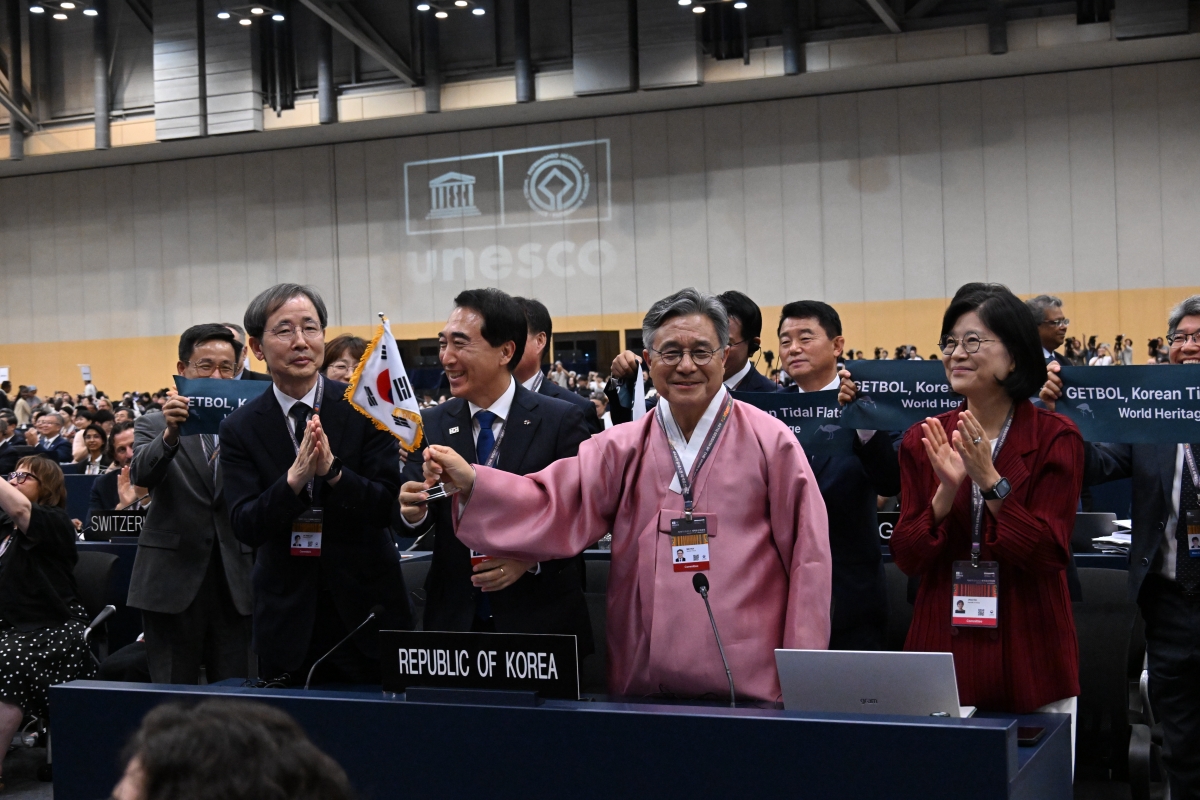
A government delegation with Korea Heritage Service (KHS) Administrator Huh Min (second from right) and Ambassador to UNESCO Kim Ji-hee (right) on July 25 celebrate news of the Phase II expansion of "Getbol, Korean Tidal Flats" at the convention center BEXCO in Busan's Haeundae-gu District. (KHS)
The committee said the gaetbol met the criterion of the World Heritage convention on the importance of biodiversity and conservation of endangered species.
The criterion stipulates that from a scientific or conservationist perspective, a site must contain the most important and significant natural habitats for the on-site conservation of biological diversity, including those for endangered species.
The committee lauded the tidal flats for their natural heritage value as a core habitat in the Yellow Sea ecosystem and the East Asian–Oceanian flyway, as well as their contributions to the conservation of globally important migratory waterbirds and marine species.
Korea Heritage Service (KHS) Administrator Huh Min spoke to reporters right after Phase II's approval.
"This result is highly meaningful as the culmination of long-term collaborative efforts by the central and local governments, local communities and experts," he said. "We hope that this registration is an opportunity to expand international cooperation for the conservation of the Yellow Sea ecosystem and the East Asian–Oceanian migratory bird flyway."
"Looking forward, we recognize that the gaetbol are not just our country's heritage but precious natural heritage that the world must jointly protect, and we'll keep doing our best for their systematic conservation, management and sustainable usage."

UNESCO, the Korean Tidal Flats World Heritage Promotion Foundation, World Coastal Forum and Yancheng Wetland Centre of China on July 25 hold a seminar on tidal flats at the convention center BEXCO in Busan's Haeundae-gu District. Afterward, a joint declaration was released on plans for cooperation in the conservation of the Yellow Sea's tidal flats and coastal wetlands. (Park Dae Jin)
The committee also approved the addition of 11 new World Heritage sites. The four natural heritage sites were Aqaba Marine Reserve in Jordan; Wadi Wurayah National Park in the United Arab Emirates; Okefenokee National Wildlife Refuge in the U.S. and the Bony Fish Fossils of the Western Limfjord – Evolution and Climate Adaptation in the Earliest Eocene in Denmark.
The seven cultural heritage sites were Jingdezhen Handicraft Porcelain Industry Sites in China; Medinas of the Historic Sultanates of the Comoros; Rock Mosques and Associated Sacred Sites of Mangystau in Kazakhstan; Cemetery Complexes of the Xiongnu Nobility in Mongolia; Nakhon Si Thammarat and Wat Phra Mahathat Woramahawihan in Thailand; Village de Sidi Bou Said in Tunisia; and Ancient Buddhist Site of Sarnath in India.
The decision expanded the boundaries of an inscribed World Heritage. Korea's number of designated sites stayed at 17 -- 15 cultural and two natural heritage.
July 26 also saw the inscription of 10 new World Heritage sites, with Boma-Badingilo Migratory Landscape in South Sudan being the only natural heritage selection of the bunch.
The eight cultural heritage sites were Ancient Capitals of Asuka and Fujiwara in Japan; Tashkent Modernist Architecture Modernity and Tradition in Central Asia in Uzbekistan; Rocas of Sao Tome and Principe: Colonial Agricultural System and Forced Migration in Sao Tome and Principe; and Alamut Castle and Related Fortifications in Iran; Aalto Works in Finland; Beaches of the D-Day Landings, Normandy, 1944 and Royal Capetian Fortresses of Languedoc in France; and the system of Italian-style condominio theaters of the 18th and 19th centuries in central Italy.
The lone mixed heritage site was the Mount Olympus Area in Greece.
margareth@korea.kr
![[World Heritage session in Busan] ① Enchanting K-Heritage House](/upload/content/image/f178972f05c043a8a5358eaffb78a8f4_20260723232819.jpg)