- 한국어
- English
- 日本語
- 中文
- العربية
- Español
- Français
- Deutsch
- Pусский
- Tiếng Việt
- Indonesian
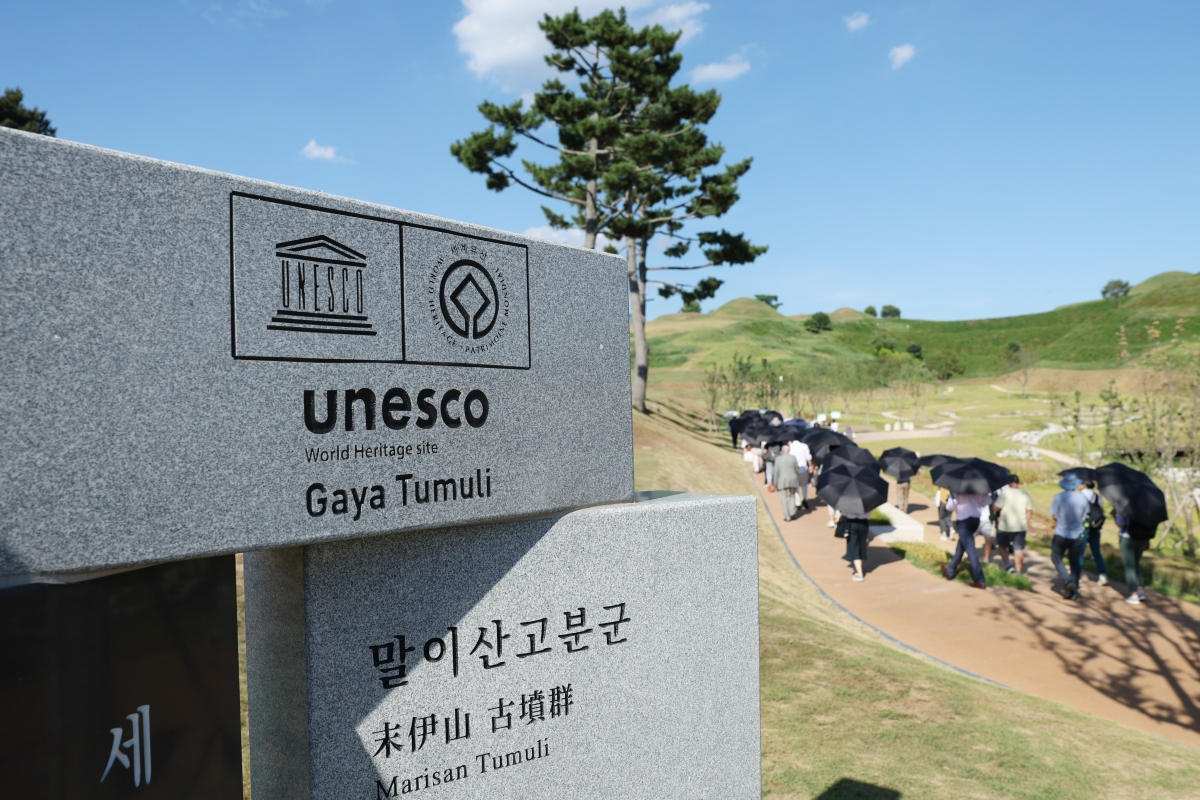
Participants in a tour of the Gaya Tumuli on July 27 look at the burial mounds of the ancient Gaya confederacy on Marisan Mountain in Haman-gun County, Gyeongsangnam-do Province.
By Margareth Theresia
Photos = Park Dae Jin
"Wow, this is amazing. I had no idea Korea had such a place like this."
Participants in a tour of the ancient tombs Marisan Tumuli in Haman-gun County, Gyeongsangnam-do Province, could not hide their amazement at the scenery in front of them.
As part of the annual session of the UNESCO World Heritage Committee in Busan, the 60 travelers on July 27 departed the convention center BEXCO, the venue of the event in the city's Haeundae-gu District, to see traces of the ancient Gaya confederacy.
Under the blazing sun with a heat wave warning in effect, the group first stopped at Haman Museum, which was opened in 2003. It displays artifacts excavated from the Marisan (Mountain) Tumuli to offer a comprehensive overview of the region's history and the significance of the tomb complex.
Afterward, they toured the tombs' exhibition hall, reflecting on the archaeological importance of the Gaya Tumuli, a UNESCO World Heritage site.
Tarisi Vunidilo, a native of Fiji who is an assistant professor at California State University in Los Angeles and attended the UNESCO session as an observer, marveled at the tombs and earthernware there.
"I also have a background in archaeology," she said, "So I really enjoyed learning about the burial mounds, especially the pottery. The pottery on display here reminded me of my home province in southern Fiji. I love how pottery can connect Fiji and Korea."
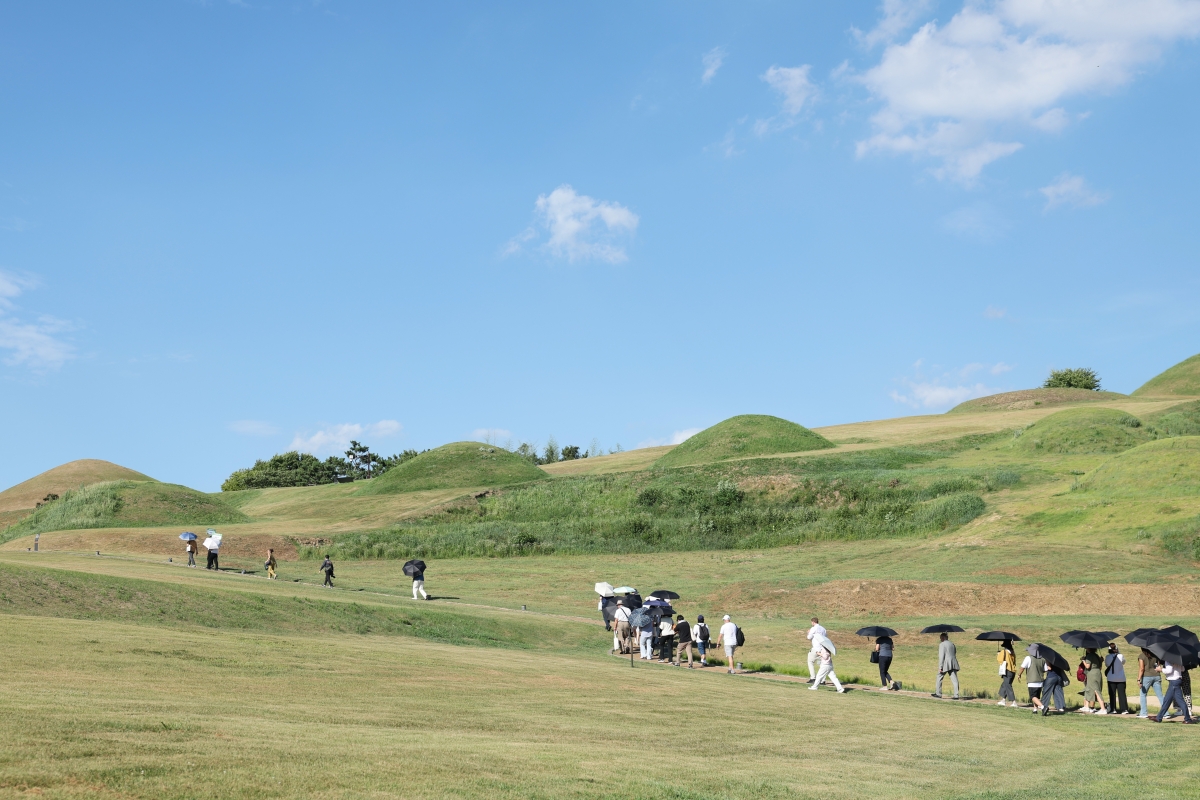
The tour of the Gaya Tumuli on July 27 goes along the ridge of the Marisan Tumuli in Haman-gun County, Gyeongsangnam-do Province.
The Gaya Tumuli is a serial property of seven groups of burial mounds built by political groups of the Gaya confederacy (42–532), which ruled the southern part of the Korean Peninsula from the first to mid-sixth century. Recognized for their enduring historical value, the tombs were designated UNESCO World Heritage in 2023.
Among them, the Haman Marisan Tumuli is considered an iconic landmark of Ara Gaya, a city-state of the confederacy based in Haman-gun, comprising a cluster of tombs for the royal family and aristocracy. The spectacular view is of low hills ranging from 40 to 70 m above sea level gently stretch for approximately 2 km from north to south.
After finishing a tour of the exhibition, the group moved to Tombs Nos. 2 and 3 at the Marisan site. Standing before these final resting places of kings with their history preserved intact, participants expressed awe and admiration.
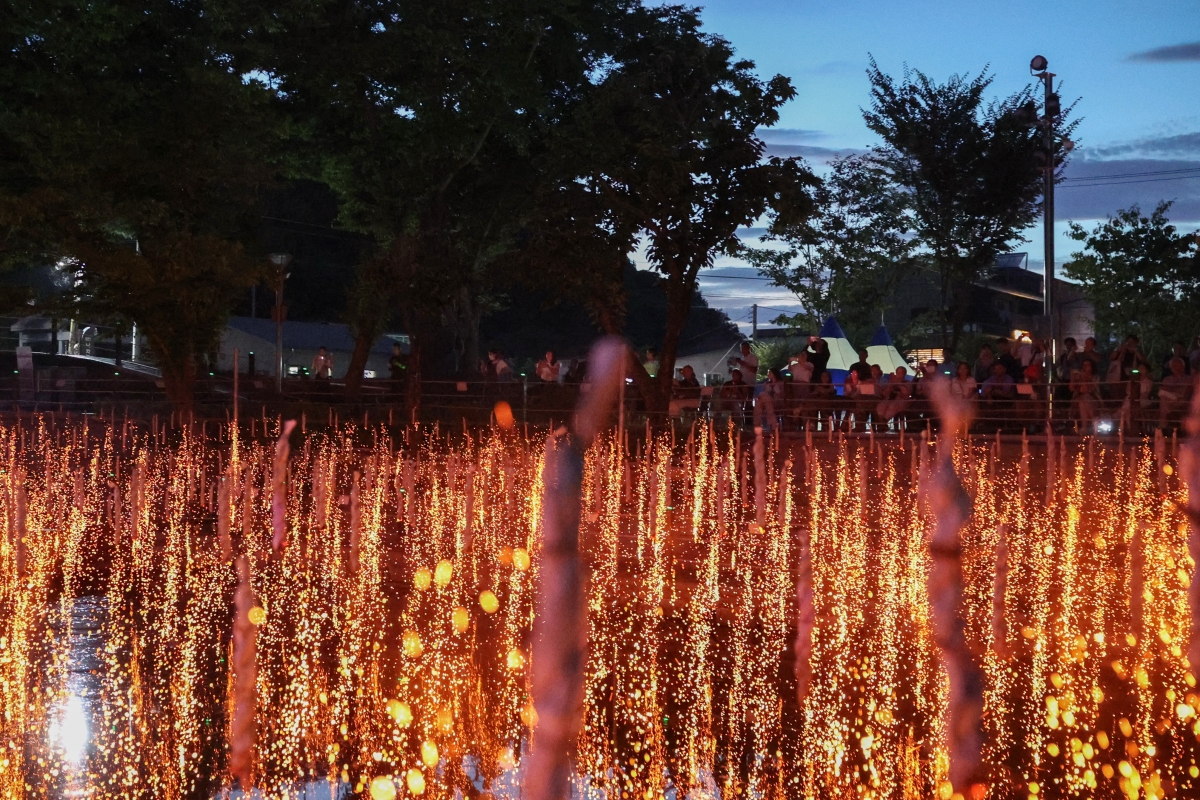
The Haman Nakhwa Nori, a traditional fire art festival, is held on July 27 at Mujinjeong Pavilion in Haman-gun County, Gyeongsangnam-do Province.
After finishing the tour of the complex, participants headed to Nakhwa Nori Training Center to experience another tradition of Haman-gun: the fire art festival Nakhwa Nori. Their first activity was to make nakhwabong (fire flower sticks), carefully twisting Hanji (traditional paper) filled with charcoal powder to craft the sticks, write their wishes on them and hang them from the lines.
As dusk fell, the group moved to the banks of Mujinjeong Pond. When the Haman Nakhwa Nori Preservation Society lit the sticks, a crimson glow began to dance.
Thousands of sparks rained like a shower over the pond. This fireworks spectacle bathed the pitch-black night sky and the water's surface in a sea of red, serving as a breathtaking finale to the tour.
margareth@korea.kr
![[World Heritage session in Busan] ③ Photo essay of related events](/upload/content/image/8afd6581d01148138736d45fa9906d0b_20260727104912.jpg)
![[World Heritage session in Busan] ② Four coastal tidal flats added](/upload/content/image/c63e2920d30c483ba40b3d70f724b5c8_20260726123202.jpg)
![[World Heritage session in Busan] ① Enchanting K-Heritage House](/upload/content/image/f178972f05c043a8a5358eaffb78a8f4_20260723232819.jpg)