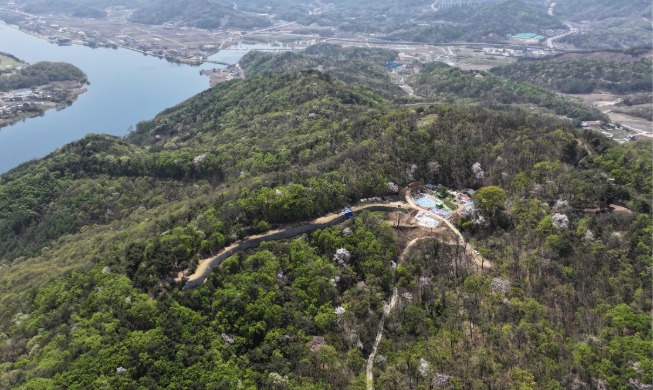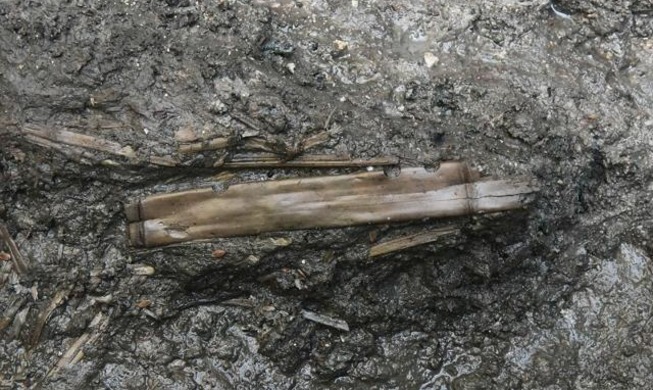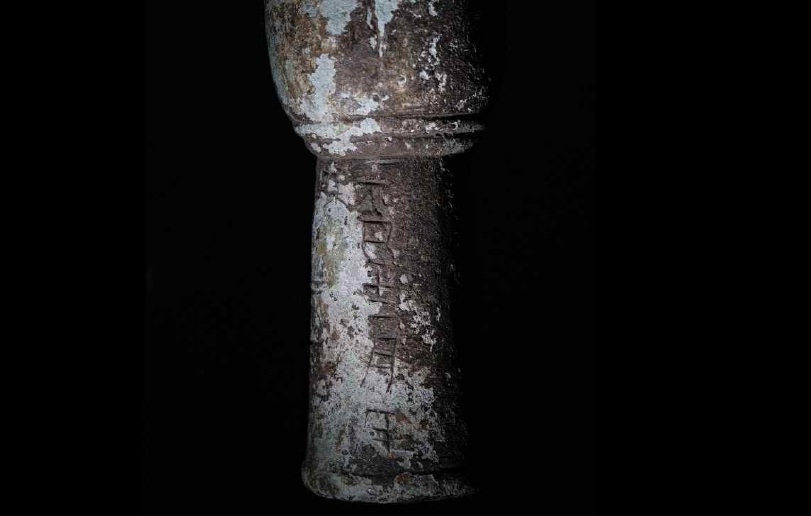
The country's oldest known gunpowder weapon has been unearthed in Naju, Jeollanam-do Province, a key military location in the Yeongsangang River basin. Shown is the inscription "Jeongsa-nyeon 12-wol-il," meaning December in the Jeongsa year, engraved on the discovered Hwangja Hwatong.
By Oh Jung Eun
Photos = Naju National Research Institute of Cultural Heritage
A weapon discovered in 2023 in Naju, Jeollanam-do Province, a key military location along the Yeongsangang River, has been confirmed as the country's oldest known gunpowder armament.
The Naju National Research Institute of Cultural Heritage on Sept. 21 announced the findings of its study on the Hwangja Hwatong, which was found on Geumseongsan Mountain.
The weapon used gunpowder to fire arrows or projectiles with a far greater range and destructive power than the bow, which was the primary weapon at that time.
It was discovered in November 2023 during a landmine sweep to pave a hiking trail on the mountain. Measuring 23.75 cm long with a caliber of 1.66 cm and weighing 1,032 g, the device bears inscriptions detailing its date of manufacture, name, weight, the official title and name of the production supervisor, and name of the maker.
The Jeongsa year of its manufacture date is believed to refer to 1377 or 1437. Regardless of the exact date, the weapon is considered a cultural heritage item of high academic value as the oldest gunpowder weapon in the country from between the late Goryeo and early Joseon Dynasty period, an era from which few such arms survive.
From Sept. 23 to Nov. 22, the institute will exhibit the Hwangja Hwatong at the National Palace Museum of Korea in Seoul.
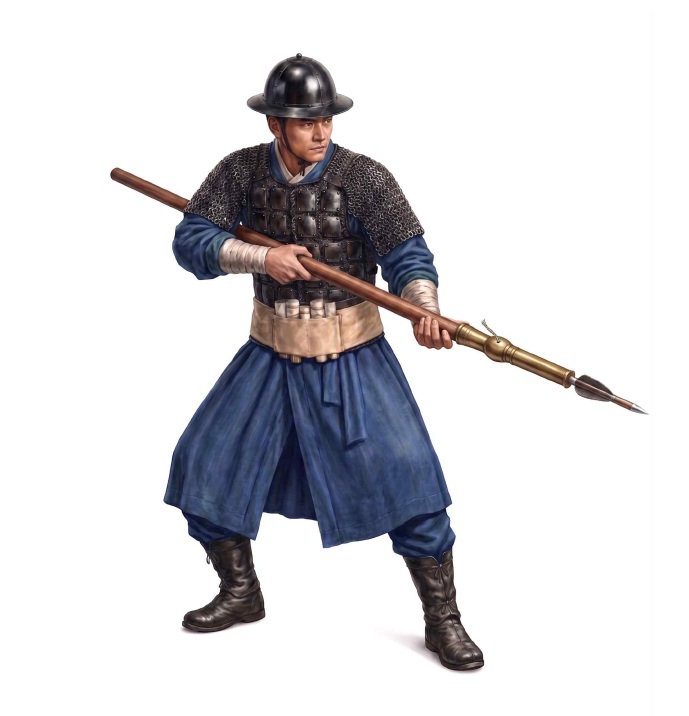
This artificial intelligence-generated image shows a soldier holding a Hwangjah Hwatong, which dates back from the late Goryeo to early Joseon Dynasty period.
cloveroh@korea.kr