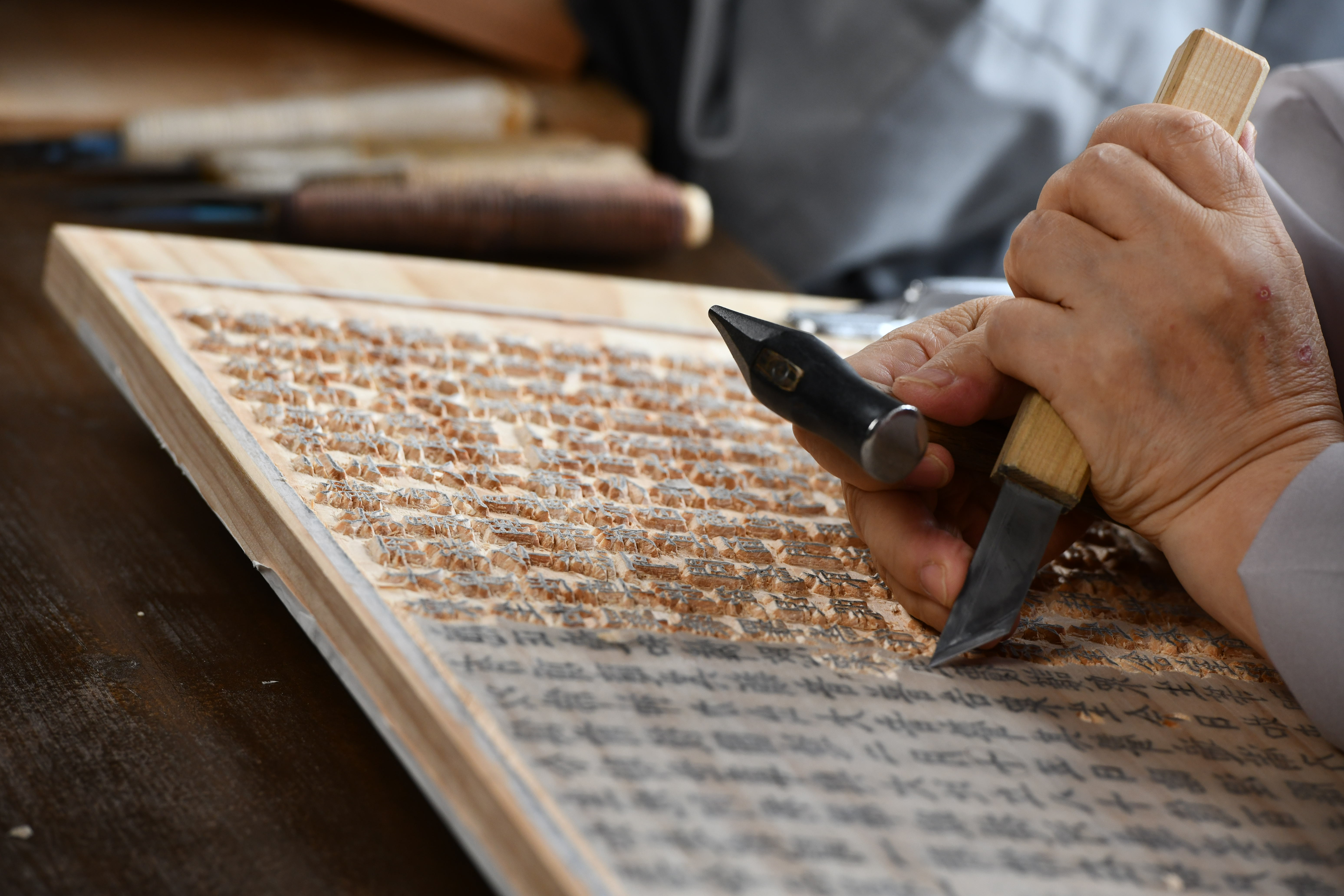
Demonstration of woodblock carving for Tripitaka Koreana (Haeinsa Temple)
By Oh Jung Eun
Three prostrations are done for each character carved into a woodblock. This deep devotion of the country's ancestors 800 years ago has seen a revival at Haeinsa Temple in Hapcheon-gun County, Gyeongsangnam-do Province.
On Oct. 29, Haeinsa hosted a gobulsik, or a ceremony to inform Buddha, was held to launch a woodblock-carving project for the Tripitaka Koreana, aka the Palman Daejanggyeong in Korean, a comprehensive collection of scriptures containing Buddha's teachings, precepts and commentaries.
The woodblocks at the temple were produced in the 13th century during the Goryeo Dynasty (918-1392) to overcome Mongol invasions through the power of Buddhism. Despite comprising 81,352 woodblocks, the collection contains few errors and is renowned for its exquisite font and artistic value.
In recognition of its significance, UNESCO in 2007 inscribed the set to its Memory of the World Register, while the Janggyeong Panjeon, the depositories where the woodblocks are kept, were earlier designated UNESCO World Heritage in 1995.
The initiative to recreate a celebrated relic stems from a desire to overcome the challenges facing humanity like climate change, conflict and the rapid development of artificial intelligence with the same devotion that inspired the creation of the original set 800 years ago.
At a news briefing, Ven. Haeil, the temple's juji (head monk), stressed the importance of preserving the spirit behind the project.
"3-D printing technology can produce woodblocks with over 95% precision and aesthetically beauty, but what is the point of making 80,000 or even 80 million woodblocks if they lack sincerity?" he said. "The original Tripitaka Koreana was carved during the Mongol invasions out of a profound sense of dedication and a genuine desire to protect the future of the nation and its people. Carrying on that same spirit of devotion today is crucial."
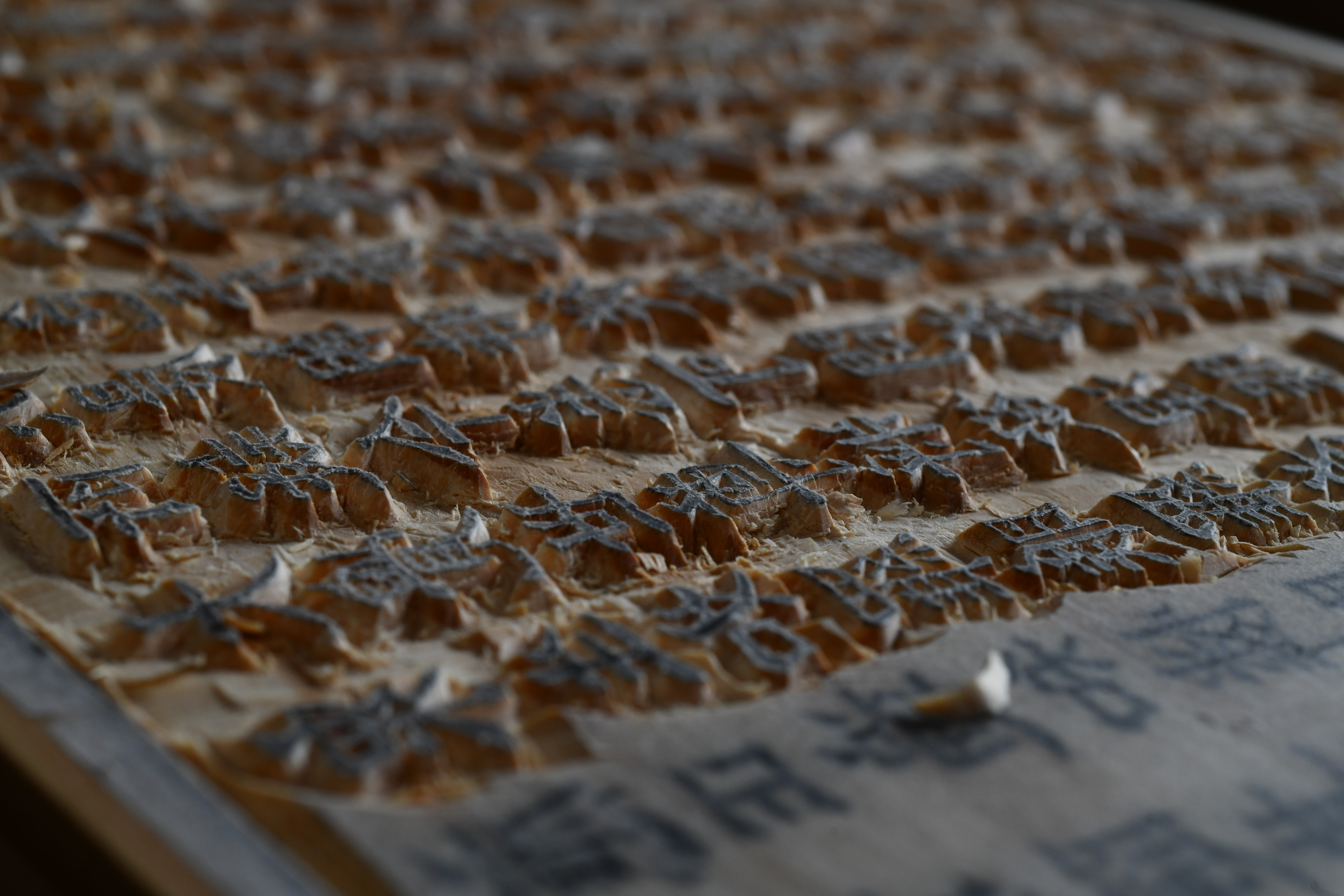
These are knife-carved characters in the Tripitaka Koreana. (Haeinsa Temple)
The carving process strictly adheres to traditional methods. Analyses of fragments that broke off from the original woodblocks found that approximately 75% were made of wild cherry wood and 15% of wild pear wood.
The temple has received donations of 320 tons of wild cherry wood. For the other wood, 2,000 saplings were planted last year with support from the Korea Forest Service, with an additional 1,000 to 2,000 trees to be planted annually.
In the past, logs underwent a treatment process of being submerged in seawater for three years to prevent insect damage and prevent warping or cracking. Haeinsa is fully reviving this tradition.
The temple will build a saltwater reservoir of about 660 square m near the coast and submerge around 50 tons of raw timber for three years. A freshwater reservoir of about 330 square m will be built beside a nearby valley to compare and test the effects of saltwater versus freshwater treatment.
Modern techniques like infrared drying will also seek to improve the durability and preservation of the woodblocks.
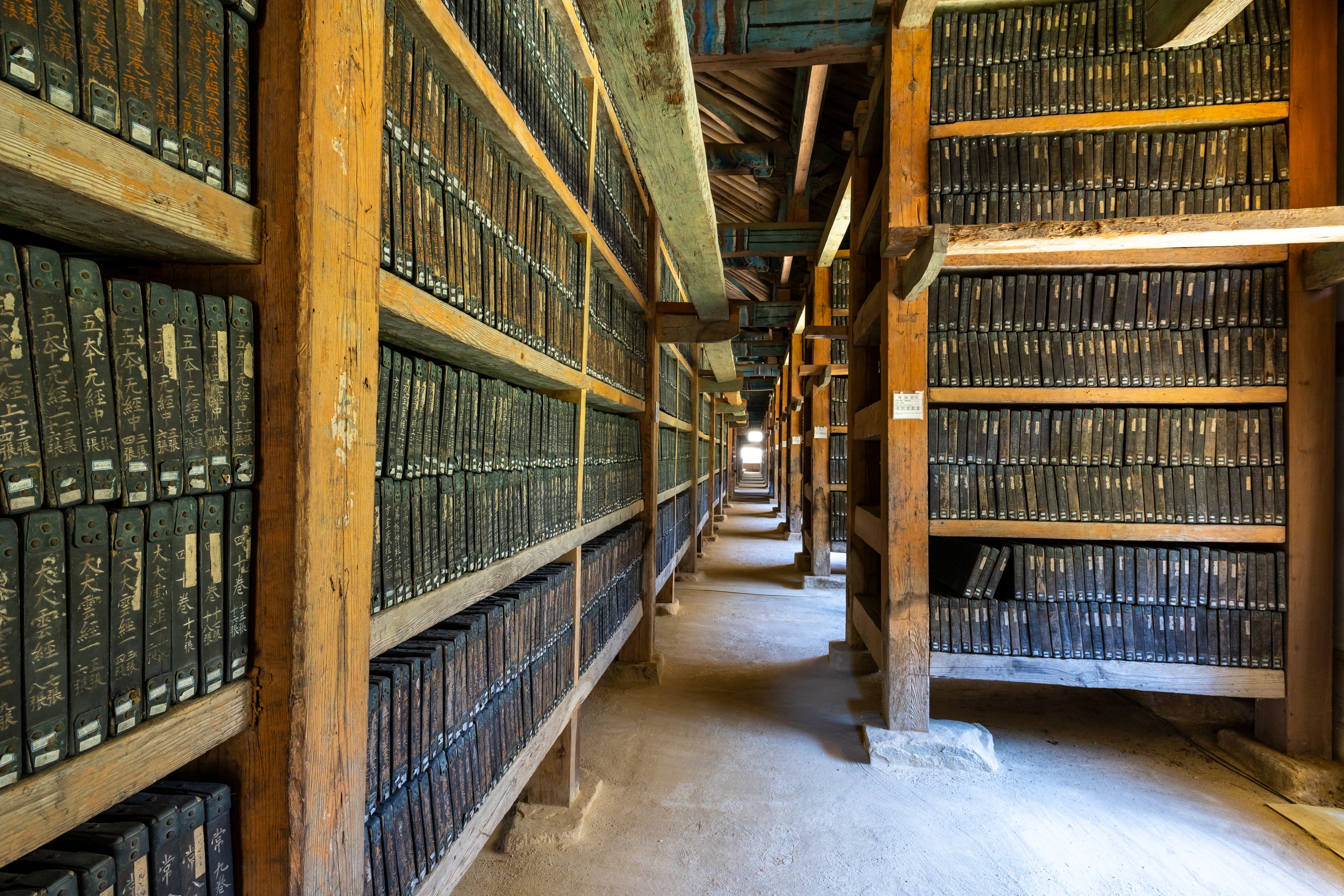
Woodblocks on shelves of Janggyeong Panjeon at Haeinsa Temple in Hapcheon-gun County, Gyeongsangnam-do Province (Haeinsa Temple)
Training skilled carvers is a priority for preserving the Tripitaka Koreana tradition. In 2024, Haeinsa launched a related school and has since admitted its fifth class. Around 670 monks and laypeople are learning traditional techniques from masters who hold national or regional intangible cultural heritage designations in the craft.
The five-year program charges no tuition.
Foreign monks are among the students as the school is open to foreign laypeople interested in the craft. The goal is to train 300 skilled carvers, around 100 of whom are expected to join the woodblock carving project.
To ensure the continuation of traditional carving practice and output of new woodblocks, Haeinsa will build a "Tripitaka Town" on some 330,000 square m of temple-owned land. The complex will provide accommodation and dining spaces for an estimated 300 people, allowing them to live on-site and dedicate themselves to learning the craft.
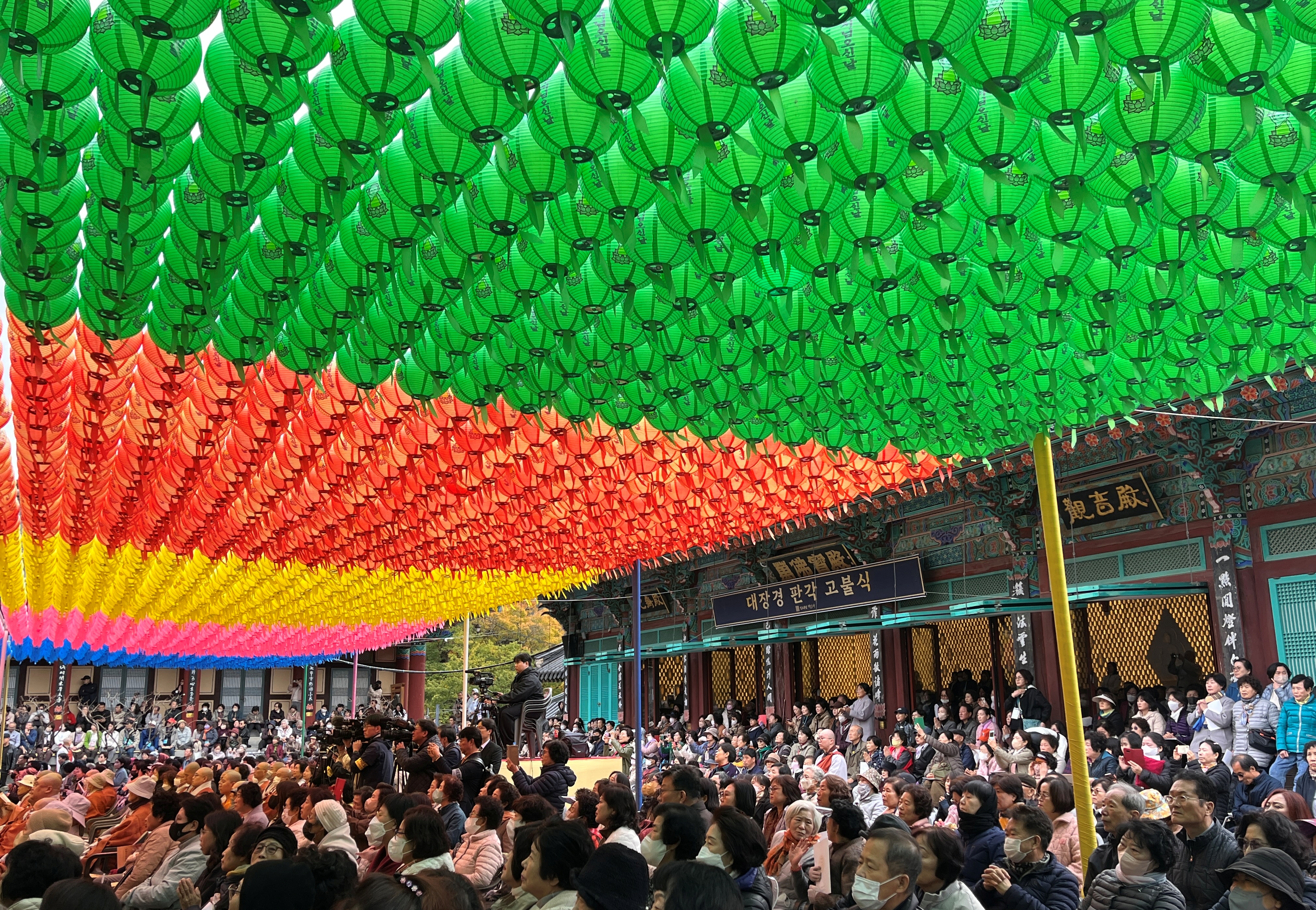
Buddhist devotees and visitors on Oct. 29 attend the ceremony marking the start of the project to carve a new edition of the Tripitaka Koreana at Haeinsa Temple in Hapcheon-gun County, Gyeongsangnam-do Province. (Oh Jung Eun)
Woo Cho-hyun, a student at the school and the principal of an elementary school in Changwon, Gyeongsangnam-do Province, said he learned about the project while considering his plans after retirement.
"I think it'll be a very meaningful way to spend my retirement, so I'm devoting myself to the program and learning the skills," he said. "It takes me about a month to carve a single woodblock."
At an estimated cost of KRW 3 trillion to KRW 5 trillion borne entirely by Haeinsa, the monumental task of recreating the Tripitaka Koreana is expected to take 50-100 years.
Taking its first step, the project has reaffirmed the value of devotion in uncertain times by preserving the country's heritage of woodblock printing to future generations and the craft's underlying spirit.
cloveroh@korea.kr

