By Lim Munyeong
Vice chairman of Presidential Council on National Artificial Intelligence Strategy
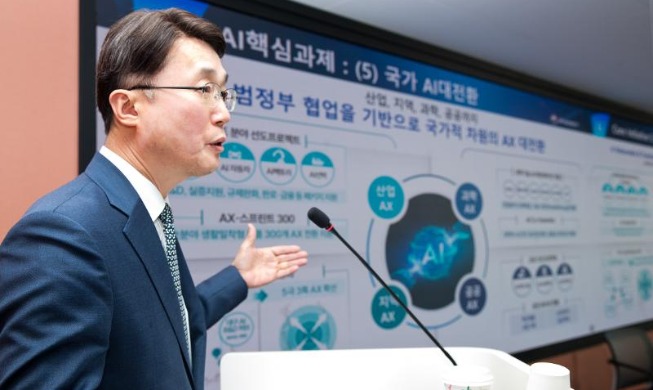
The Presidential Council on National Artificial Intelligence Strategy has fully launched its role as a control tower for the country's artificial intelligence (AI) policy. Since devising the draft of the AI Action Plan in December last year, the council is gathering input from all walks of life. The draft is not just a declaration but a concrete set of action guidelines to remove barriers between government ministries and make the entire government move as a unified organism. It has two core principles.
The first is the "funnel strategy." A ministry responsible for each policy must consult other ministries and complete an agreement within a specified period. This structure converges the divided capacities of each ministry into one action plan to expedite implementation. It enforces action by clearly assigning responsibilities and deadlines.
The second is a "router strategy" to rapidly deliver these collected public results and infrastructure to where they are needed -- industrial sites, regional communities and even the daily lives of the people. The council is responsible for coordinating data flow to spread the AI transformation to all industrial sectors including manufacturing, defense, medical care and finance.
A turning point is coming soon. The Basic Act on the Development of Artificial Intelligence and Creation of a Foundation for Trust (AI Basic Act) takes effect on Jan. 22. As a statutory body whose authority and responsibility are guaranteed under law, the council will serve as the de facto central axis of AI policy in both name and reality. This will jointly provide the legal and institutional basis and governance for Korea to take a major step toward becoming a top three power in AI.
Skeptics fear the regulatory consequences of the law's enactment. The nation's transition toward, AI, however, remains in its infancy with insufficient infrastructure and systems. Thus acceleration of AI innovation is needed to explore an unknown era that the nation has never experienced before. This means emphasis on growth over regulation. The government will accordingly suspend regulation, monitor the situation and respond appropriately.
The world has taken notice of the country's AI potential. Global tech titans are fiercely competing to woo Korea as a strategic partner. The reason is clear: Korea is the world's only "AI full-stack" nation with semiconductor manufacturing capability including high bandwidth memory (HBM), a brisk manufacturing base, and high public acceptance of AI. Such unrivaled competitiveness was the main driver of the adoption of the APEC (Asia-Pacific Economic Cooperation) AI Initiative in November last year at the APEC forum in Gyeongju, Gyeongsangbuk-do Province. Furthermore, this was a crucial moment to show Korea as the "standard-bearer of AI democracy," leading the way in setting AI norms and standards.
We now face a new crossroad. Just like the Kim Dae-jung administration 30 years ago transformed the country's foundation through the simultaneous pursuit of digitalization and democratization, the incumbent Lee administration needs to create an AI-based society to give the country the basis to join the world's top three AI powers. In the past, the Gyeongbu Expressway was considered the lifeline of industrialization. Today, what is needed is construction of an "AI highway" to allow anyone to easily and quickly access computing resources and data.
Only by building on this foundation and achieving a major transformation in public service and industry can Korea truly enter the era of a basic AI society. Just like the invention of Hangeul (Korean alphabet) by King Sejong the Great brought knowledge equality, a basic AI society aims to create a world where all people enjoy the intellectual benefits of AI to raise quality of life, with nobody left behind or isolated.
The country has started the engine for emerging as an AI power and needs unwavering implementation. Korea can achieve its dream of becoming an AI power through strong government commitment, dynamic innovation from the private sector and the people's trust. The Presidential Council on National Artificial Intelligence Strategy will vigorously embark on this grand journey by using the AI Basic Act and the AI Action Plan as its compass.
Lim Munyeong is vice chairman in charge of policy at the Presidential Council on National Artificial Intelligence Strategy chaired by President Lee Jae Myung. Lim is an expert on media and new media who formerly served as head of the iMBC Media Center, editor-in-chief of the National Assembly News ON at the National Assembly Secretariat, and director of future growth policy and informatization policy at the Gyeonggi-do Provincial Government.
arete@korea.kr