- 한국어
- English
- 日本語
- 中文
- العربية
- Español
- Français
- Deutsch
- Pусский
- Tiếng Việt
- Indonesian
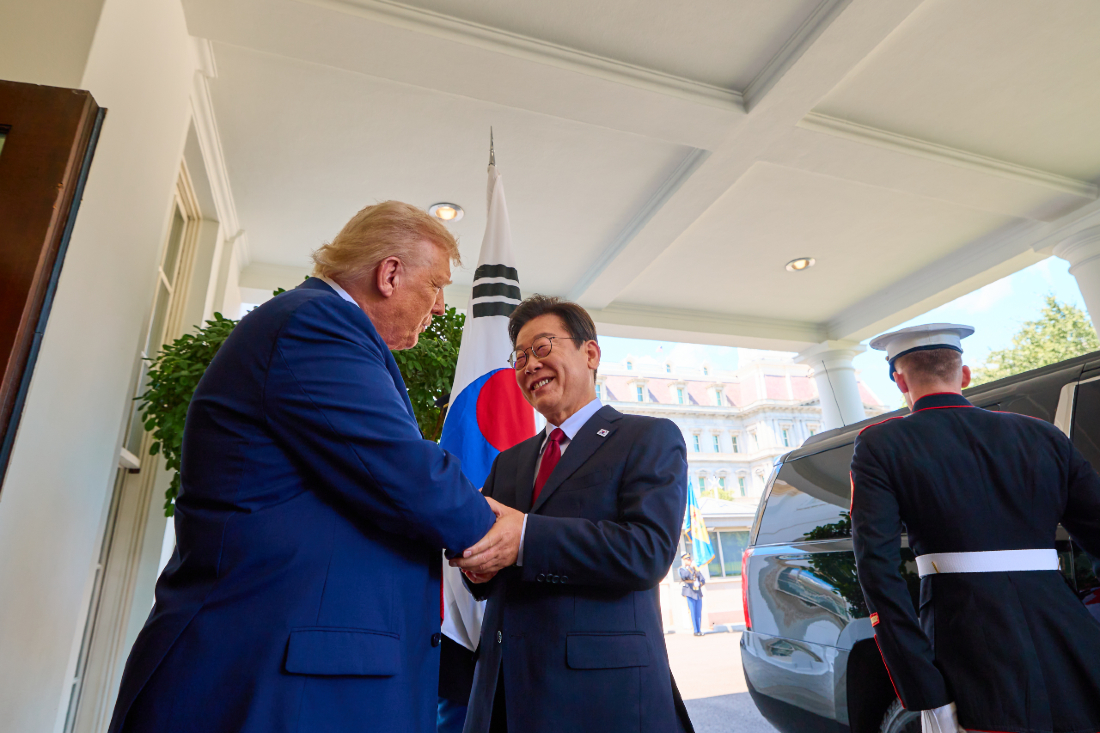
President Lee Jae Myung on Aug. 19 expressed his support for U.S. President Donald Trump's proposal to hold a bilateral summit with North Korea, saying on social media, "I will do my utmost to play the role of a 'pacemaker' who promotes and contributes to President Trump's efforts as a 'peacemaker.'" Shown is President Lee (second from left) on Aug. 25, 2025, receiving a welcome from President Trump after arriving at the White House in Washington. (Yonhap News)

By Jun Bong-Geun
Visiting research fellow at Sejong Institute and
president of Korea Nuclear Policy Society
U.S. President Donald Trump recently signaled his intent to resume summit diplomacy with North Korea by sending conciliatory messages to the North's leader Kim Jong Un. In response, experts and the media have engaged in heated debate over the potential adverse effects of such talks if they happen. Skeptics have warned of a "Seoul-passing," or the exclusion of South Korea from the negotiations or process, de facto U.S. recognition of North Korea as a nuclear-armed state, abandonment of the drive toward denuclearization, and the potential for dialogue on nuclear disarmament between Washington and Pyeongyang.
Maintaining the status quo of the North Korean nuclear issue does mean a freeze. This would be the worst-case scenario for Seoul and Washington. If the policy of turning a blind eye to the North's nuclear program continues, Pyeongyang will keep boosting its nuclear and missile capacities and secure second-strike capability as an even more powerful nuclear state. President Lee Jae Myung has said the North is producing enough material to make 15-20 nuclear weapons every year and will further develop its ICBM technology.
If left unchecked, the North within a decade will join the ranks of the world's top five countries in the number of nuclear weapons. Some experts even predict that Pyeongyang will rank fourth in this category after Russia, the U.S. and China. Moreover, if the North's nuclear armament is long term, the perception of the country as an "illegal nuclear-armed state" will fade to make way for recognition as a "de facto nuclear state" much like India or Pakistan, both of which possess nuclear weapons despite not being part of the Nuclear Non-Proliferation Treaty (NPT). Though negotiations on the North's nuclear program entail risks, the risk of keeping the status quo -- namely leaving the problem unaddressed -- is a far greater threat.
If the North's nuclear know-how keeps its growth trajectory and its nuclear threat and coercion targeting South Korea and Japan intensify, voices in the latter two countries will grow louder on going nuclear or deploying U.S. tactical nuclear weapons on their soil.
The NPT-centered global regime for nuclear non-proliferation will face an even greater crisis, amplifying the risks associated with nuclear security and the North's transfer of nuclear weapons, technology and materials abroad. The ensuing fierce arms race between the two Koreas amid their high-tension military standoff could incur the risk of a minor military clash escalating into a full-scale war, or if worse, triggering the risk of unintentional nuclear use.
The best answer for Seoul is complete, verifiable and irreversible denuclearization by Pyeongyang. The feasibility of this option over the short to medium term, however, has plummeted since 2017, when the North conducted its sixth nuclear test and ICBM test launch, declaring the "completion of the state nuclear force."
The post-Cold War era saw the emergence of a bloc-based dynamic in Northeast Asia, with Seoul, Washington and Tokyo forming one group and Pyeongyang, Beijing and Moscow the other, with security cooperation and economic ties among the latter growing. Thus sanctions and pressure on the North have gradually weakened in effectiveness. North Korea consequently lost interest even in the "second-best" scenario of corresponding political and economic concessions through negotiations in exchange for phased denuclearization.
Ultimately, the most realistic path toward denuclearization for Seoul is to gradually restart the process of denuclearizing the Korean Peninsula and building peace through the resumption of the North's dialogue with the U.S. The best starting point for this is to reaffirm the joint statement signed in 2018 in Singapore by President Trump and Kim at their first summit. The declaration includes all measures sought by Seoul and Washington like the normalization of the latter's relations with Pyeongyang, launch of a permanent peace regime and achievement of a nuclear-free peninsula.
The problem is that North Korea has far less of an incentive to talk to the U.S. now. Having advanced its nuclear know-how and bolstered cooperation with China and Russia, the North no longer needs U.S. security guarantees or South Korean economic aid as urgently as it once did. For this reason, new negotiations will require carrots and approaches different from those in the past.
The uncomfortable reality is that South Korea must coexist with a nuclear-armed North for the foreseeable future, but the priority should be on suspending nuclear activity as the initial step under a new approach toward denuclearization. If necessary, Seoul must also offer corresponding political, diplomatic and economic measures.
Given the grave security realities on the peninsula and in Northeast Asia, South Korea's long-standing approach of "denuclearization first, peace regime later" should make way for a parallel method or even a "peace regime first, denuclearization later" strategy that offers greater feasibility despite its uncomfortable nature. The Lee administration has stepped back from playing a leading role as seen in the "Korean Peninsula driver theory" to adopt a "pacemaker" role, something that backs President Trump's leading part as a "peacemaker."
As Pyeongyang's nuclear know-how has steadily grown over the past three decades, the diplomatic and economic costs Seoul must bear to achieve denuclearization of the peninsula are expected to keep rising. Furthermore, defense spending to counter the nuclear threat is also surging. In the end, the cost of denuclearization will always be lower today than tomorrow.
Now is not the time to fret over the risks or potential downsides of a North Korea-U.S. summit. Instead, South Korea must pool its wisdom -- both domestically and in coordination with the U.S. -- to determine how to effectively leverage the talks to maintain a nuclear-free peninsula and peaceful coexistence while managing these risks.
Jun Bong-Geun is a lifelong scholar of the Korean Peninsula, North Korea's nuclear program and nuclear non-proliferation. He has served as presidential secretary for international security, policy adviser to the Ministry of Unification and professor at the Korea National Diplomatic Academy. He is now a visiting research fellow at the Sejong Institute and president of the Korea Nuclear Policy Society.
arete@korea.kr