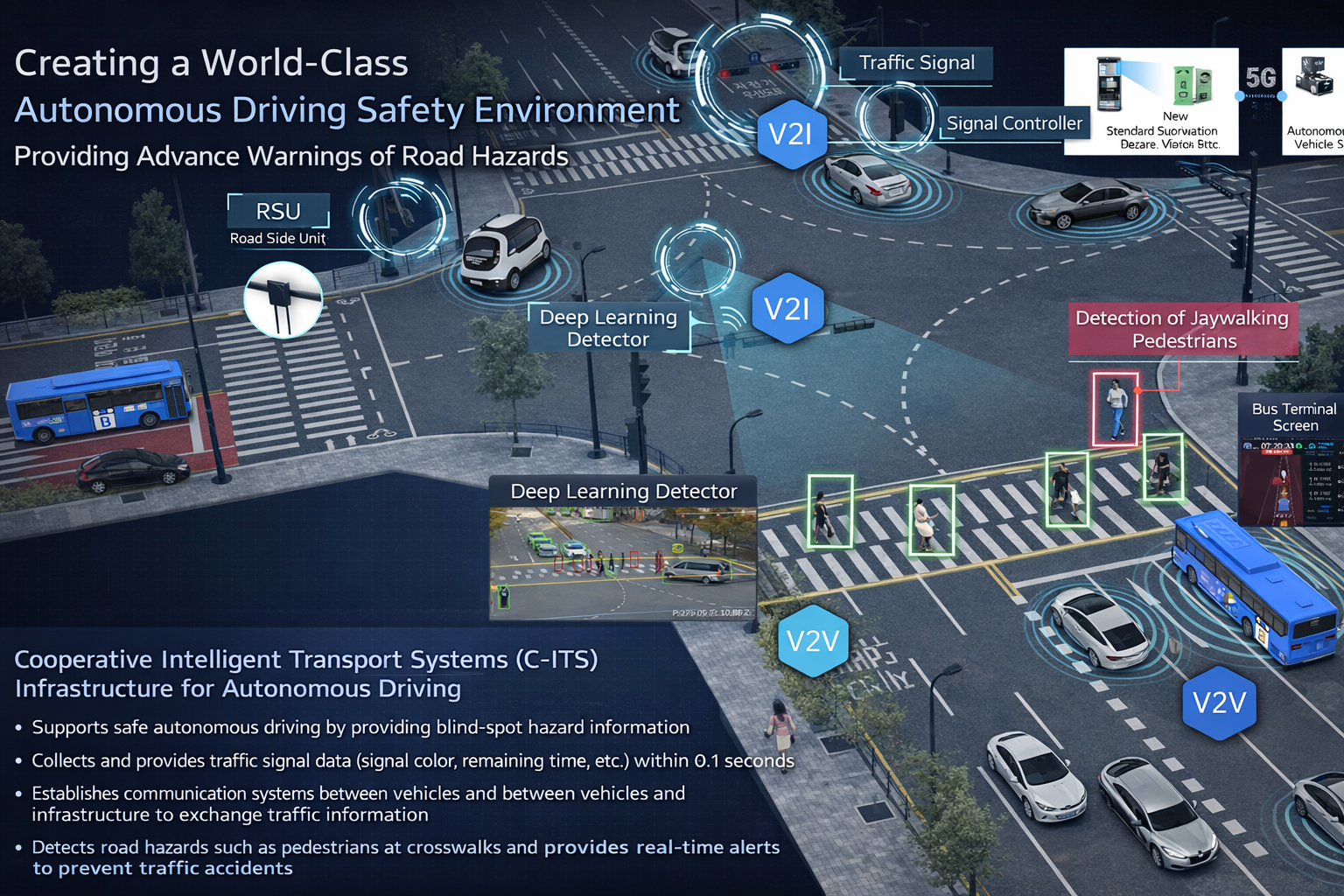
The K-City Network Global Cooperation Program of the Ministry of Land, Infrastructure and Transport has selected six projects in five countries to apply and confirm Korean models of AI-based smart cities abroad. Shown is part of a presentation on a Korean AI-based platform for smart traffic management in Bacolod, Philippines. (Ministry of Land, Infrastructure and Transport)
By Lee Dasom
Domestic models for a smart city based on artificial intelligence (AI) will see pilot operations in five Southeast Asian countries.
The Ministry of Land, Infrastructure and Transport on April 13 said its K-City Network Global Cooperation Program has selected six projects in five countries to apply and test such models globally.
The K-City Network is a government-to-government project that demonstrates Korea's advanced smart city know-how to assess their suitability in target cities overseas. The ultimate goal is to apply such models abroad.
Of 34 projects submitted this year, six from Brunei; Bacoor, the Philippines; Ho Chi Minh City and Can Tho, Vietnam; Surin, Thailand; and Penang, Malaysia, were selected after a comprehensive assessment of technical innovation, commercial viability and potential impact on overseas expansion.
Brunei will have a pilot model of building and running an integrative AI-based platform for smart city solutions to improve water management and disaster response.
In Bacoor, an AI-based platform for smart traffic management will seek to ease congestion and raise operational efficiency to show how Korean smart city solutions can resolve real-life problems.
Through the pilot programs, the ministry plans to demonstrate the technologies' efficiency and will collaborate with local governments and companies to expedite the expansion of projects and entry into global markets.
dlektha0319@korea.kr


![[Public admire-stration] ② AI-based disaster response system](/upload/content/image/800fef48140642be8710278532ffb865_20260312082356.jpg)