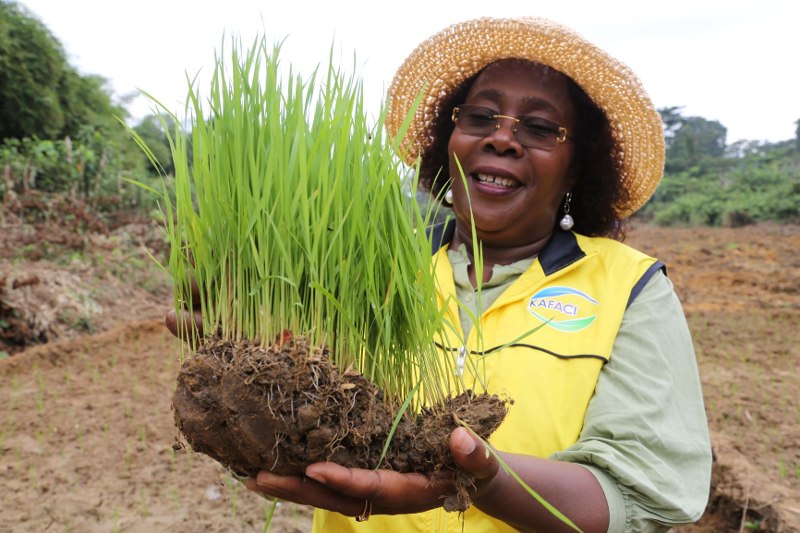
An official from the Korea-Africa Food and Agriculture Cooperation Initiative holds seedlings of Shei, a high-yielding rice variety developed in Gabon using a unified variety. (Rural Development Administration)
By Kim Seon Ah
Korean-developed rice varieties are changing the food landscape in Africa.
The Rural Development Administration (RDA) of Korea on June 11 said the project Africa Rice Development Partnership led by the Korea-Africa Food and Agriculture Cooperation Initiative (KAFACI) has seen major results over the past decade, including the development and designation of 71 rice varieties in 15 African countries and the training of 44 rice breeders in 23 countries.
The RDA completed Phase 1 (2016–25) of the partnership, a joint project with the international organization AfricaRice.
Rice is the No. 2 food crop after corn in Africa but its yield is just 2.4 metric tons per hectare, less than half the Asian level of 5 tons. The RDA is thus poised to greatly reduce the dependence of most African countries on rice imports.
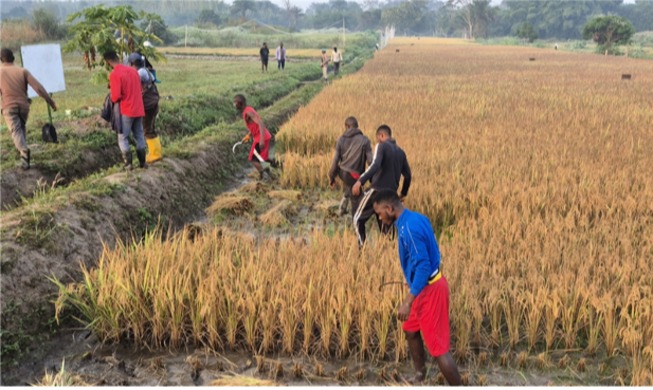
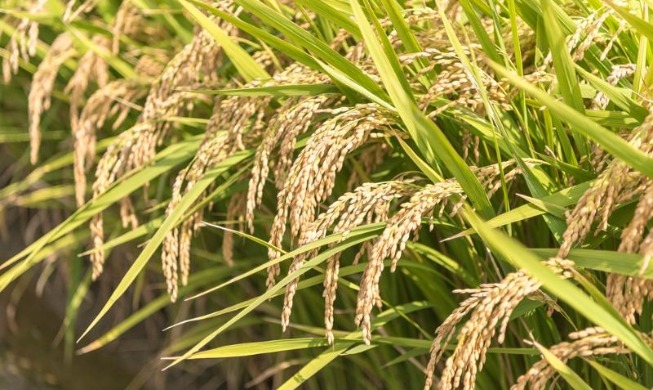
The RDA developed 71 rice varieties in 15 countries using tissue culture technology and standardized rice varieties. The yield of such varieties is 6.6 to 6.8 tons per hectare, nearly three times higher than existing types, with higher quality and taste hailed by locals.
In Gabon, three varieties -- Cheyi, Mbomba and Moukafaci-1 -- were registered as the country's first rice varieties, and six from the Isriz series were developed and distributed in Senegal. Certain types showed yields more than double those of leading varieties.
The transfer of source technology also produced results. Forty-four rice breeders trained in 23 countries are boosting domestic breeding capacity and leading the standardization of cultivation techniques.
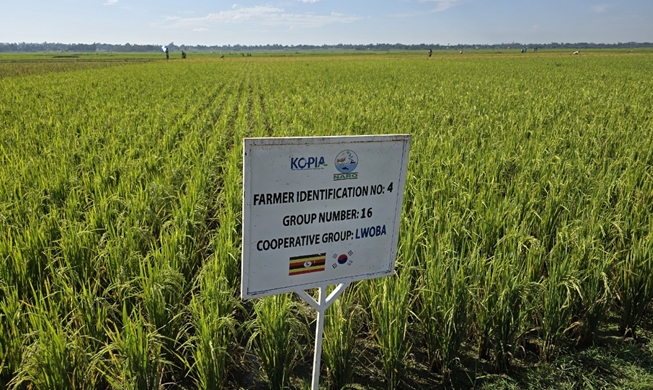
The Africa K-Rice Belt, a joint project with the Ministry of Agriculture, Food and Rural Affairs of Korea, has gained momentum through the launch of a strong system for the production and distribution of high-quality seeds. This approach nearly tripled seed output from 2,321 tons in 2023 to 6,365 last year.
Another plan is to set up a stable system next year to produce an annual 10,000 tons of such seeds.
From this year, the RDA will begin Phase 2 of the partnership, which aims to develop rice varieties growable even under adverse circumstances such as drought and damage from frost and salt.
sofiakim218@korea.kr