
A domestic study has found that the breeding method of violets could help advance the next generation of flexible robots. (Yonhap News)
By Koh Hyunjeong
Violets, which are commonly seen in the country in spring, has a unique reproductive strategy in flinging their seeds one by one instead of scattering them in all directions at once like most plants.
A domestic research team has uncovered the underlying principles of this reproductive strategy for potential application to the development of next-generation flexible robots.
The team identified the principles behind how violet seed pods launch their seeds, the Ministry of Science and ICT said on June 19.
The researchers included professors Hyun Youbong at the School of Biological Sciences and Kim Ho-Young at the Department of Mechanical Engineering of Seoul National University, as well as Jung Sohyun at the Department of Robotics and Mechatronics Engineering of Daegu Gyeongbuk Institute of Science and Technology.
The findings were published in the June 18 edition of the international journal Science.
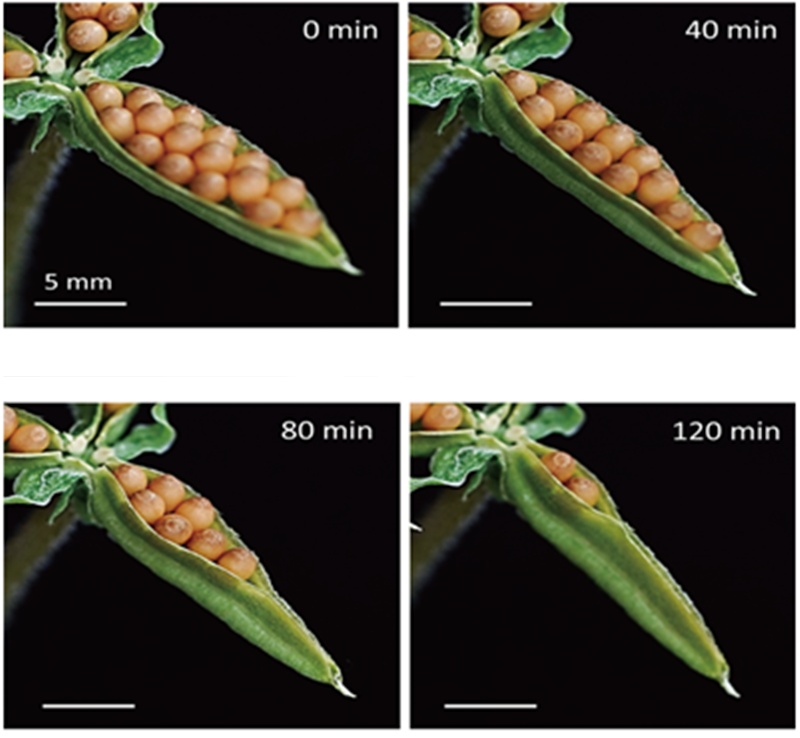
These photos show the "zippering" action of a violet seed pod. (Ministry of Science and ICT)
Normally, plants release their seeds all at once when their fruits burst open. Violets, however, use the power generated as their pouch-like seed pods dry and fold inward to eject seeds one after another.
To identify the operating principle behind this method, a precise analysis of the pod's structure found that as pods dry, they fold sequentially like a closing zipper. In the process, the point of force application shifts slightly forward along the line of seeds, causing them to spring out one by one from the front.
In robotics, sequentially shifting the point of force application requires sophisticated control technology. Violets, however, can achieve this only through their pod structure without the need for motors or control devices.
Moreover, a violet pod has a semicircular structure that enables the efficient transmission of force.
The team said, "This structure prevents the force generated during folding from dissipating; instead, it concentrates the energy on the seeds, allowing for their sequential launch."
The science community is paying close attention to this research because it proposes the potential for developing next-generation flexible robots that operate only through structural mechanics without the need for complex motors, batteries or wires.
This could create innovation in fields across biomedical engineering like medical soft devices that navigate narrow blood vessels, wound-closing patches that automatically and accurately suture related sites, and artificial muscles that move as smoothly as human ones.
"Violets have evolved to convey force efficiently using minimal resources," the team said. "This study is an example of how sophisticated movement is possible through natural structures alone."
hjkoh@korea.kr