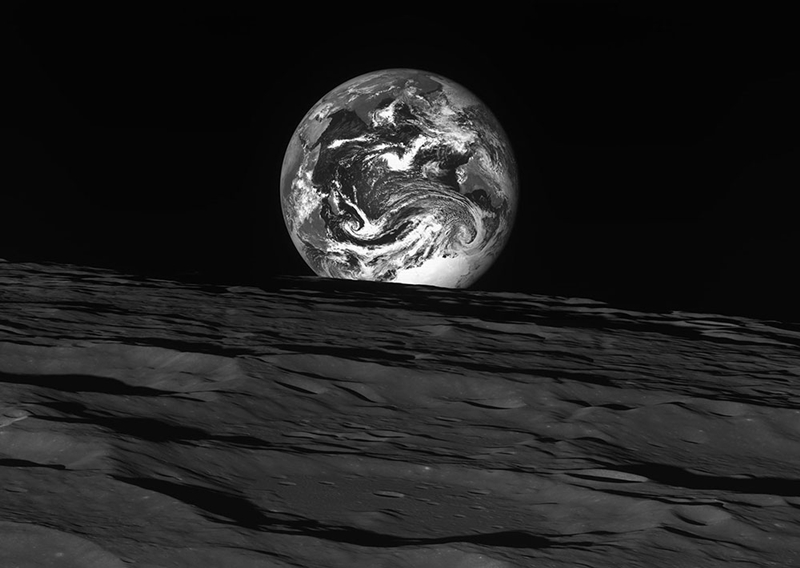
The Korea AeroSpace Administration on Aug. 4 said it will present the country's heliophysics exploration plan and proposals for global cooperation at this year's Committee on Space Research Scientific Assembly, which runs from Aug. 1-9 at the convention center Fortezza da Basso in Florence, Italy. Shown is the lunar surface and Earth taken by Korea's first lunar probe Danuri. (Korea Aerospace Research Institute)
By Lee Dasom
A domestic scientific probe by 2031 will be launched into the space between Earth and its moon to expand the range of the country's observation of solar activity.
The Korea AeroSpace Administration (KASA) on Aug. 4 said it will present its heliophysics exploration plan at this year's Scientific Assembly of the Committee on Space Research, which runs from Aug. 1-9 at the convention center Fortezza da Basso in Florence, Italy.
The international event shares the latest research results in space science and exploration and discusses cooperation on space exploration among the world's leading space agencies.
At the assembly, KASA introduced its plan to develop the Korean Space Situational Awareness System, which was launched on Aug. 3. On Aug. 7, the agency will present the country's phased heliophysics exploration strategy and proposals for international cooperation.
The planned scientific probe will conduct extensive observations of the effects of solar wind and Earth's magnetic field in the space between Earth and the moon, where long-term observational data is limited compared with Earth's low orbit and other regions.
In addition, KASA at the assembly will hold talks with major space agencies including NASA of the U.S. and the European Space Agency on expanding cooperation across the entire spectrum of space science and exploration like heliophysics and lunar exploration and space telescopes.
dlektha0319@korea.kr