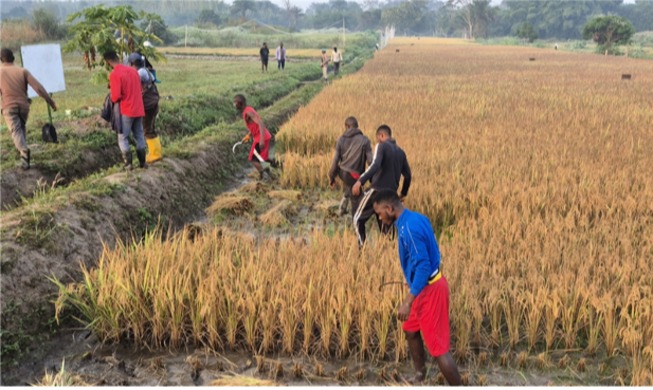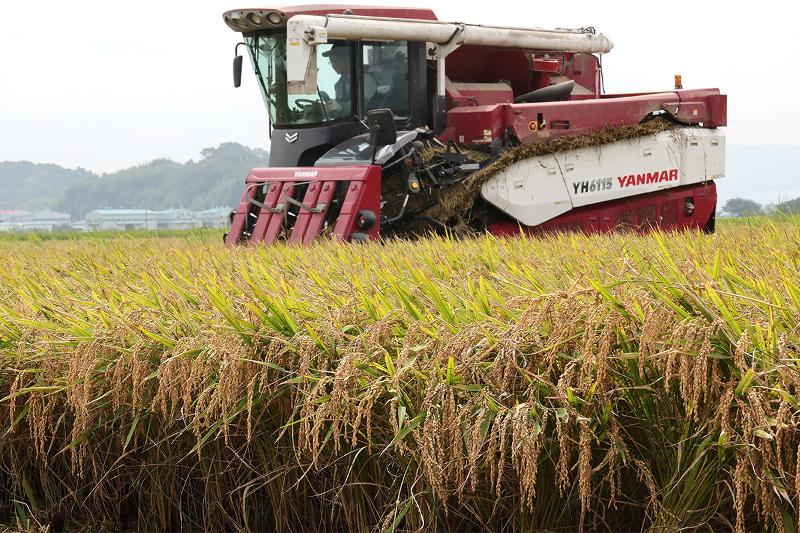
A farmer on Sept. 3 harvests rice in a paddy in Busan's Gangseo-gu District. (Yonhap News)
By Hong Angie
A newly developed artificial intelligence (AI) software can accurately predict the optimal time to harvest rice seeds amid the rise in heat waves and torrential rains caused by climate change.
The Korea Seed and Variety Service (KSVS) on Oct. 14 said it jointly developed the high-tech program with the Jeollabuk-do Province branch of the Korea Electronics Technology Institute. The software is being sent free to government-distrbuted seed production sites, local governments and private seed companies.
Harvesting rice intended for seed production too early can result in unripe grains while doing so too late causes pregermination due to exposure to autumn rain, leading to quality and germination rate plummeting.
The traditional methods of reliance on farmers' experience and visual inspections are inadequate given the higher frequency of extreme weather. The new program thus enables proactive coordination of harvest schedules to mitigate risks from adverse conditions.
When a farmer enters basic information such as region of cultivation and heading date, AI studies 46 years of recorded temperature data from 1980 to 2025, along with this year's statistics to calculate the optimal harvest time for each field in a graph.
A pilot test conducted this year on 9,565 plots planted with 24 government-supplied rice varieties showed the high accuracy of the program, with harvest times having a margin of error of plus or minus three days.
Use of a standardized criterion, which is expected to boost the nationwide system of seed quality management, will help accurately forecast the harvest periods for not only government-distributed seeds, but also advanced models from local governments and private companies.
Further improvement of prediction accuracy will also come through additionally incorporating field harvest data with that from agricultural satellites.
"This will serve as valuable assistance to farms struggling with estimating their seed harvest times based solely on past experience due to climate change," KSVS Director General Yang Joopil said. "We offer the program and its user manual free of charge and hope that rice and other grain producing organizations and institutions can actively use them."
shong9412@korea.kr