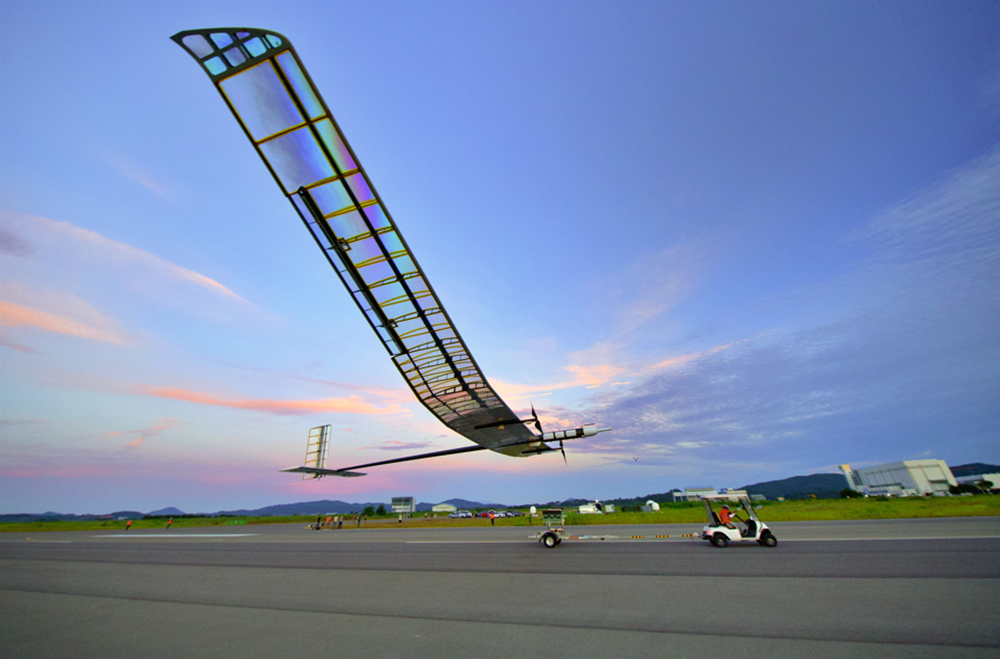
The stratospheric solar-powered unmanned aerial vehicle EAV-4 takes off. (Korea AeroSpace Administration)
By Jeong Euiseok
A domestically developed solar-powered unmanned aerial vehicle (UAV) has completed seven consecutive days of flight.
The Korea AeroSpace Administration (KASA) on Nov. 11 said its EAV-4, a stratospheric solar-powered UAV, completed a continuous flight of 170 hours and five minutes spanning a week during flight tests from August 18-25.
This was than triple the previous domestic record of 53 hours set in 2020 by the EAV-3 and the second best in the world of its kind behind only Airbus' Zephyr.
During flight testing, the EAV-4 confirmed its wildfire detection capacity through electro-optical and infrared cameras to pinpoint the source of a fire within seconds. It also tracked the spread of smoke and predicted the fire's path, demonstrating its ability in early detection and response.
Beyond real-time disaster monitoring, this UAV can also act as an aerial base station for communication with remote islands and mountainous areas, thus generating far-reaching applications in national security and the economy.
Stratospheric UAVs are considered next-generation infrastructure but their commercial application remains in an early stage worldwide. KASA said this is a prime opportunity for Korea to take the lead in the emerging market for such drones, adding that it plans by 2030 to work with private companies on initiatives like disaster monitoring and surveillance, telecommunications relay and testing of homegrown solar cells.
KASA is also working on hybrid vertical takeoff and landing (VTOL) aircraft to promote interregional air travel.
A hybrid VTOL model can take off and land vertically without a runway. Unlike battery-powered urban air mobility aircraft, a VTOL craft uses both an engine and batteries to carry more passengers and cargo and travel longer distances.
Once development is complete, the VTOL models are expected to be used for a range of purposes like the urgent delivery of emergency supplies to remote islands and mountainous areas, transfer of emergency patients and air taxi service between regions.
Another plan is the localization of the production of key components like engines, batteries and motors. A five-year research and development program from 2028-32 will pursue phased validation to demonstrate capabilities ranging from core technologies like hybrid propulsion to aircraft development.
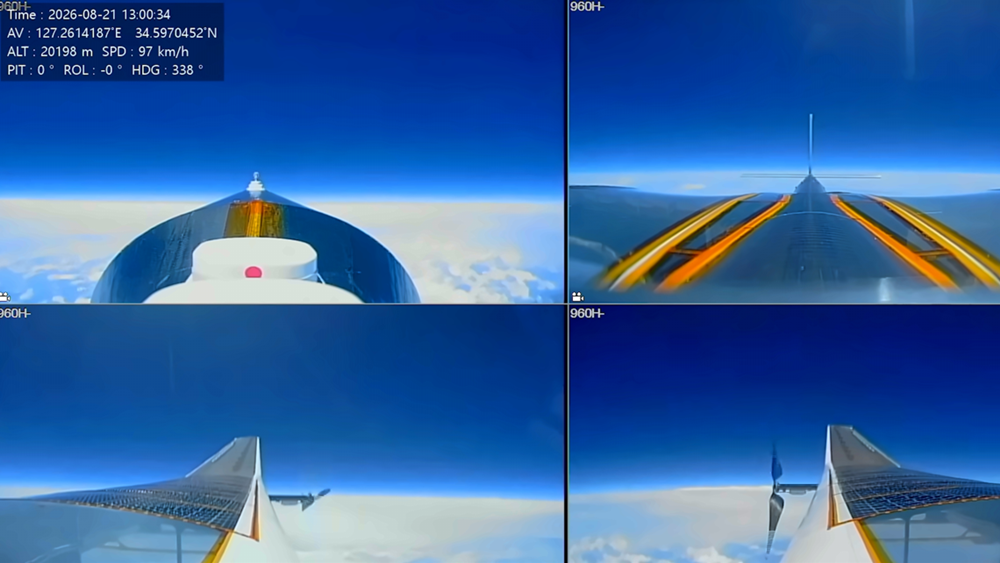
Stratospheric solar-powered unmanned aerial vehicle EAV-4 in flight (KASA)
innocence@korea.kr