The public perception of animals in Korea is fundamentally changing. The surge in the number of pet owners and rising awareness of animal welfare have led to related changes in policy and daily life. This series covers societal shifts surrounding the relationship between animals and humans by examining the legal status of animals, sanctuaries to protect them and animal-friendly policies by local governments.
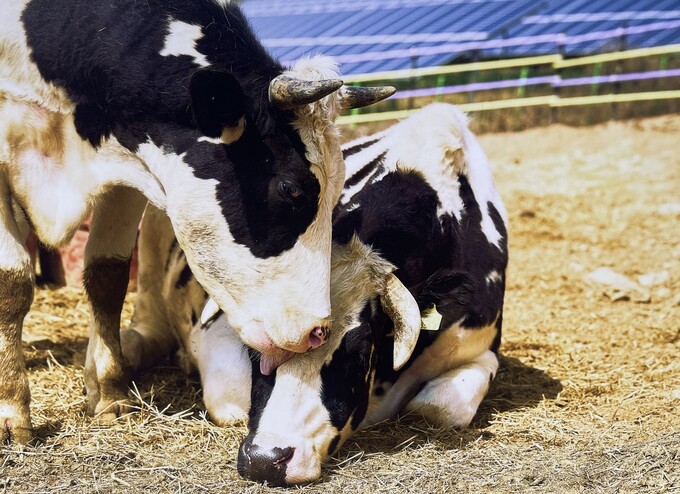
These rescued cows live at New Moon Sanctuary in the village of Sinwol-ri in Inje-gun County, Gangwon-do Province. (Donghaemul)
By Kim Hyelin
Video = Project Moon Bear's official YouTube channel
An animal sanctuary offers refuge to rescued creatures for the remainder of their lives. What differentiates it from conventional shelters and zoos is its priority on animal welfare above all else without commercial exhibition or breeding.
The launch of Farm Sanctuary in 1986 in the U.S. helped ignite the spread of the sanctuary movement worldwide. In 2007, the Global Federation of Animal Sanctuaries was founded to promote international standards for such facilities.
Today, the world has over 200 such sanctuaries. Certain countries such as Spain and Austria recognize them under a separate legal category.
Korea is in the early stage of this process. Sanctuaries led by the private sector caring for livestock like cows and pigs as well as bears have opened. After the enforcement this year of the Wildlife Protection and Management Act, which prohibits the ownership of farmed bears and extraction of bear bile, the government has also started to take action.
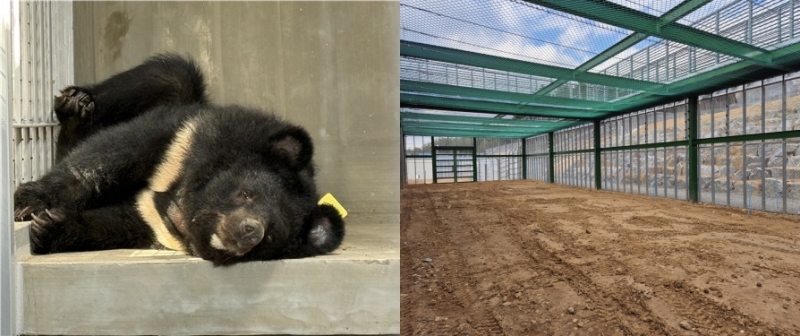
This bear lives at the Gurye Bear Protection Facility in Gurye-gun County, Jeollanam-do Province, and on the right shows the interior of the sanctuary. (Ministry of Climate, Energy and Environment)
Founded by the Ministry of Climate, Energy and Environment, the Gurye Bear Protection Facility in the township of Masan-myeon in Gurye-gun County, Jeollabuk-do Province, can house up to 49 bears. The shelter has been home to 21 furry residents since its opening on Sept. 30 last year.
A sanctuary with a capacity of 70 bears is also under construction in Seocheon-gun County, Chungcheongnam-do Province. Flooding has delayed work but the facility is slated for completion in the second half of next year.
The private sector is proactive in this area. Project Moon Bear began rescuing bears from farms by buying them even before the law took effect. In 2021, it took over a bear farm in Hwacheon-gun County, Gangwon-do Province, and now cares for the bears, gradually expanding outdoor enclosures to improve the environment.
Thirteen Asiatic black bears that had been caged their entire lives are now living outdoors, walking on dirt and engaging in their natural behavior.
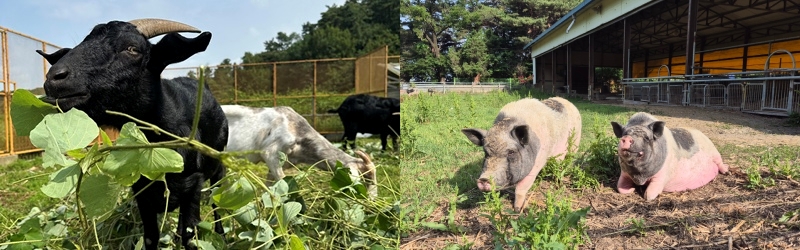
These goats and pigs live at KARA (Korea Animal Rights Advocates) Farm Sanctuary in Eumseong-gun County, Chungcheongbuk-do Province. (KARA)
Sanctuaries are also expanding their scope from wild animals to those on farms. In August 2021, the civic group Donghaemul (Animal Liberation Wave) saved five male Holstein cows at risk of slaughter at an unlicensed livestock facility in Incheon's Gyeyang-gu District.
The group opened New Moon Sanctuary in Inje-gun County, Gangwon-do, in October last year to care for them. Families of the activists live on-site to tend to the cows.
Dawn Sanctuary, which opened in April 2020 as the first facility of its kind in Korea, is home to pigs rescued from industrial breeding farms and laboratories. In 2022, Korea Animal Rights Advocates (KARA) also opened KARA Farm Sanctuary in Gyeonggi-do Province, caring for pigs, goats and chickens rescued from dog breeding farms and slaughterhouses.
The sanctuary was eventually relocated to a farm in Eumseong-gun County, Chungcheongbuk-do Province.
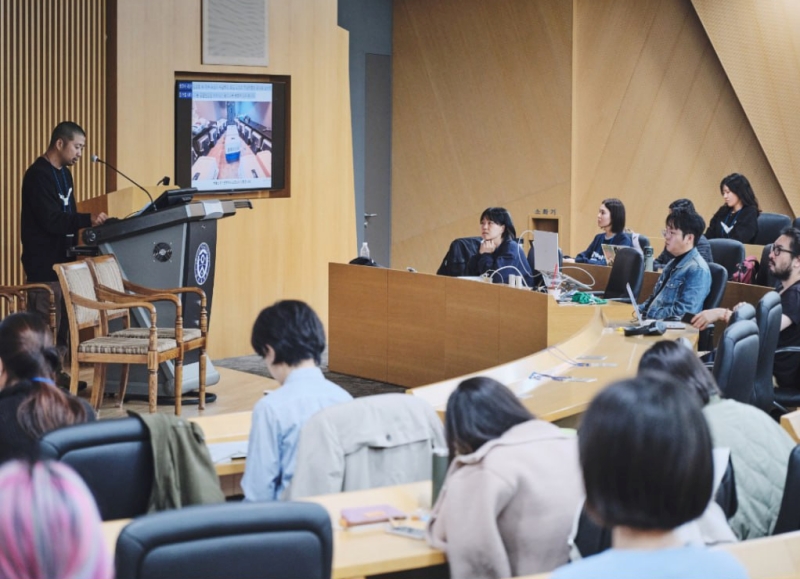
A forum on animal sanctuaries is held on Nov. 8, 2025, at Yonsei University in Seoul's Seodaemun-gu District. (Donghaemul)
The institutionalization of the sanctuaries has spurred debate. In November last year, a forum discussed at Yonsei University in Seoul discussed the need for legal recognition of the facilities, adoption of an accreditation system, site use exemptions and tax incentives.
Also that month, heated talks erupted at the National Assembly over amending the Wildlife Protection and Management Act and the Animal Protection Act to introduce the concept of sanctuaries.
Thus animal sanctuaries in Korea have begun taking their first steps toward widespread adoption like facility expansion and setup of a legal framework.
kimhyelin211@korea.kr
![[Animal kin-stinct] ① Legislative shift from 'use' to 'coexistence'](/upload/content/image/1b8daebeb60b4081b9b3a6970762382a_20260226164147.jpg)