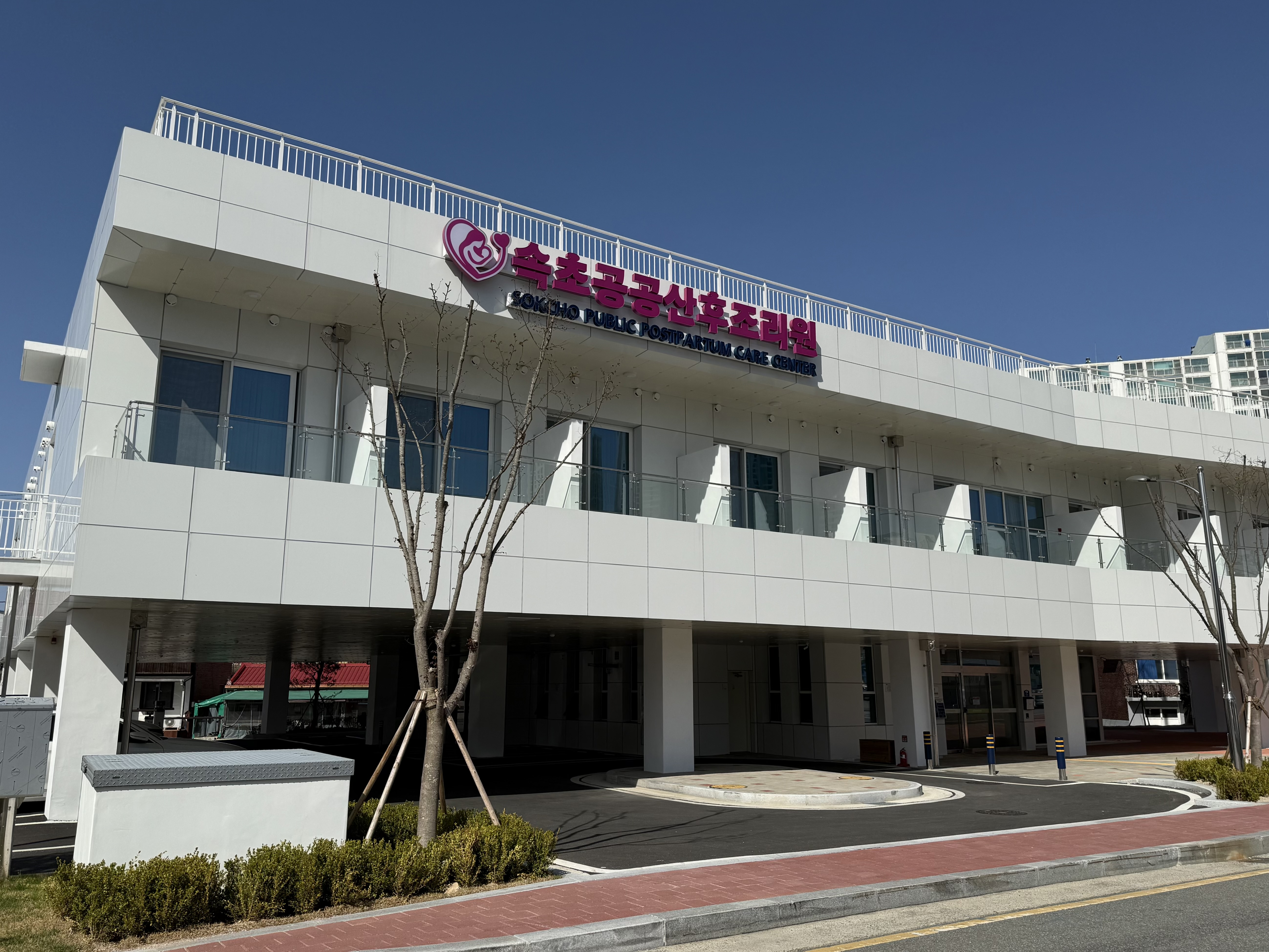
Sokcho Public Postpartum Care Center in Sokcho, Gangwon-do Province, caters not only to the residents of Sokcho but also those of regions near Seoraksan Mountain. (Hong Angie)
By Hong Angie
For generations, geumjul (sacred straw rope) hanging on a home's main gate was considered protection for a mother and her newborn through prevention of strangers from entering.
Today, this role is played by postpartum care centers, shared parenting facilities, culture centers and kids cafes. These places carry on the wisdom of geumjul in a far more modern and scientific manner.
Public postpartum care centers: lower cost, better care
Traditional postpartum care has been replaced by commercial systems. Postpartum care centers are a common and accessible choice for new mothers, who usually spend two weeks there to receive in-depth care from experts around the clock.
Balanced nutritious meals and professional baby care have earned such facilities respect as "heaven" for these mothers.
More than just resting places, they are also "parenting academies" that teach parents practical skills like proper methods of changing diapers, bathing babies and breastfeeding. The systematic education offered there is a reliable stepping stone that turns a sense of helplessness felt by adults new to parenthood into excitement.
Given the growing of the centers, local governments have quickly stepped up. Facilities with state-of-the-art equipment comparable to private ones have opened, with their strengths being high-quality services at prices about half of that in the private sector.
Since their launch in 2013, the centers will be increased in number to 23-25 nationwide. Those in Seoul, the provinces of Gyeonggi-do, Gangwon-do, Jeollanam-do and Gyeongsangnam-do, and Jeju Island have received favorable responses and are often fully booked daily.
Thus such facilities are part of the national model of public maternity care heavily funded by the government to raise the low birth rate.
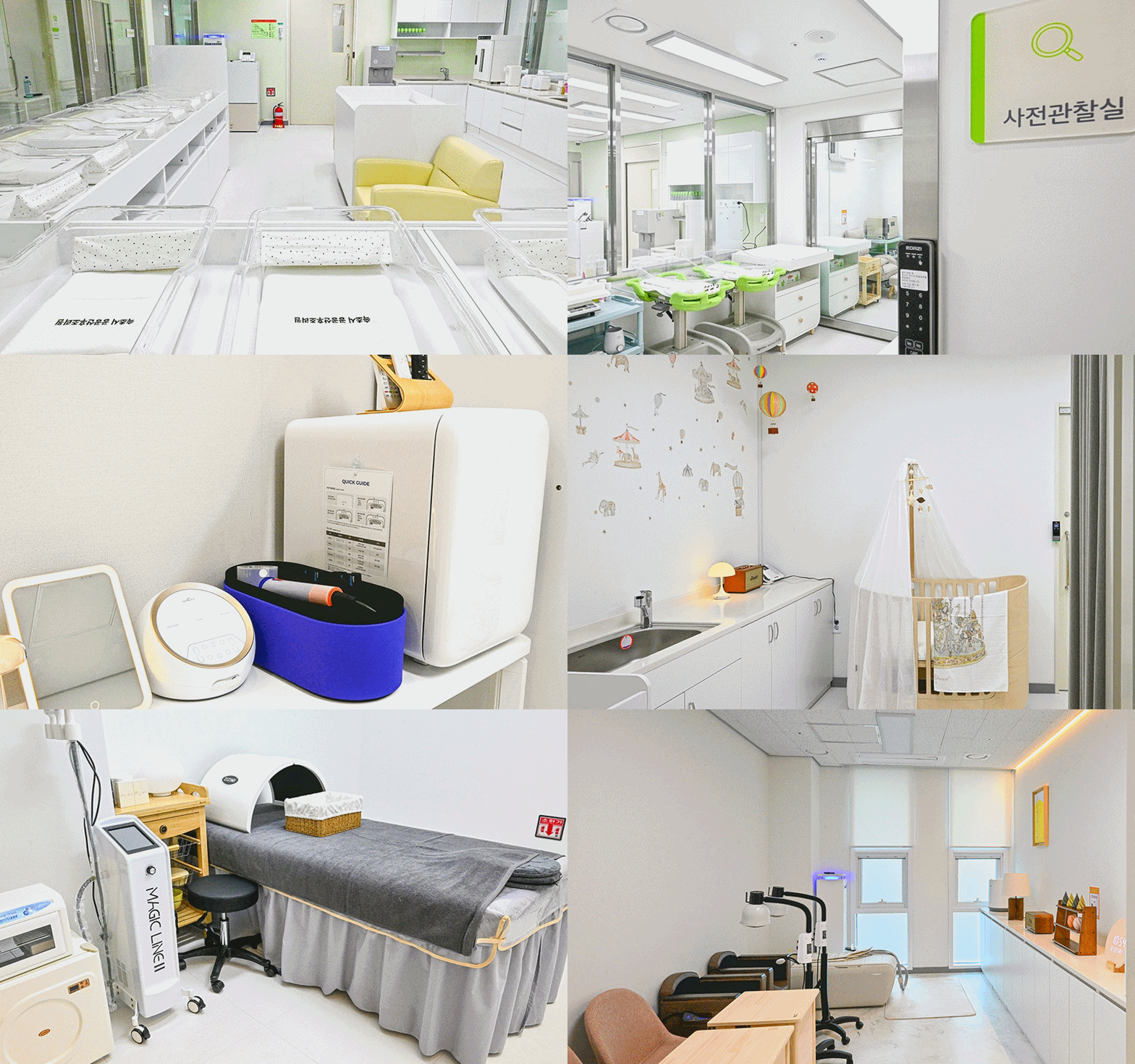
Facilities inside Sokcho Public Postpartum Care Center in Sokcho, Gangwon-do Province
Shared parenting centers
Shared parenting centers nationwide create a community-based, child-friendly environment. Supporting caregiving among neighbors, these facilities not only reinforce the bond between parents and children but also encourage fathers to take a more active role in child care.
This year, the number of centers has risen from 68 to 77 thanks to support from the Ministry of Gender Equality and Family and the Gyeonggi-do government. This preemptive move is a response to growing demand for public child care.
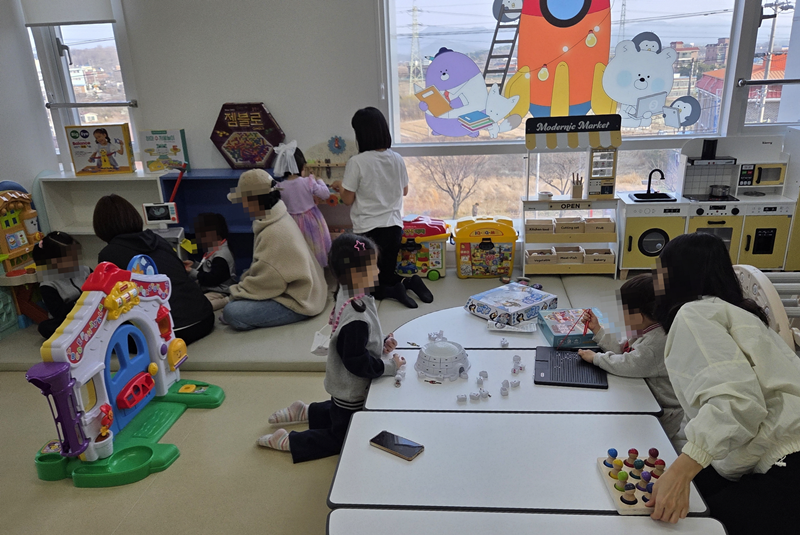
Parents and children play together at a public shared parenting center in Nonsan, Chungcheongnam-do Province. (Nonsan City Hall)
Culture center: sharing information and solidarity
With chat rooms dominating information sharing in cyberspace, cultural centers are the main players in the offline world for spreading know-how in child care. Parents share their concerns with one another in alleviating the exhaustion of parenting, while their babies just a few months old learn about the world by using their five senses via tactile play.
Culture centers at department stores or large supermarkets are valued community spaces, much like modern-day "village pavilions," where parents and children start to form ties with society.
Kids cafes: evolution into safe play spaces
A kids cafe epitomizes the meaning of the proverb "It takes a village to raise a child."
More like the extended living room of a modern home, this facility has seen its number increase thanks to local governments as part of child care infrastructure that lowers the economic burden of child-rearing but raises safety.
Moving beyond commercial and convenience spaces, these four types of child care facilities form a systematic, community-based network deemed reliable by parents. Backed by the central and local governments, these venues constitute a strong safety net of social welfare that helps Korean society navigate the era of the low birth rate.
shong9412@korea.kr
![[Fertility fix] ② Expanded support seeks to ease parenting burden](/upload/content/image/0e930efa3d3b4e37811fa804c9961929_20260410141231.png)
![[Fertility fix] ① Exhibition of traditional childbirth culture](/upload/content/image/dd2642f75545427fbd1bae09cb68b7e5_20260408092054.jpg)