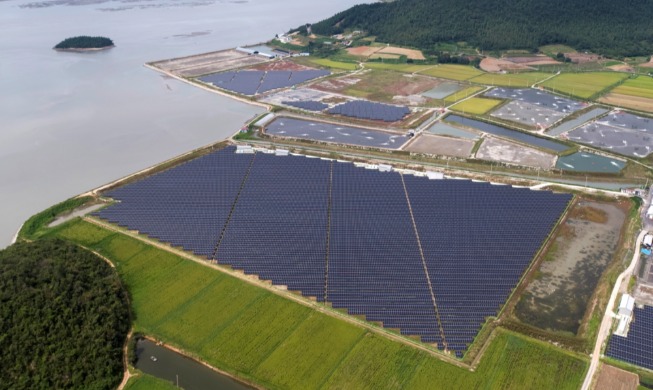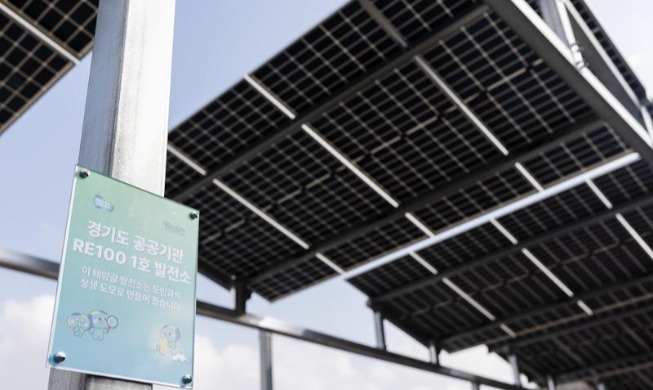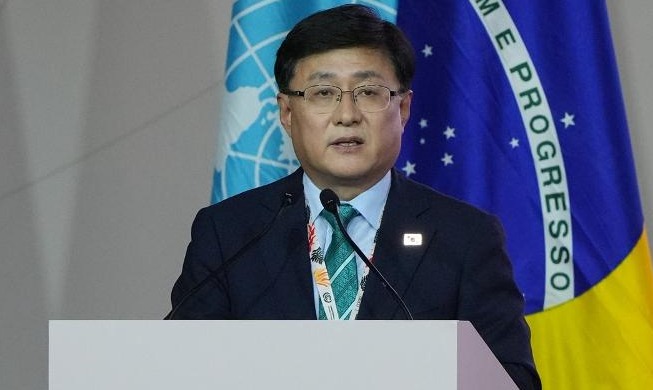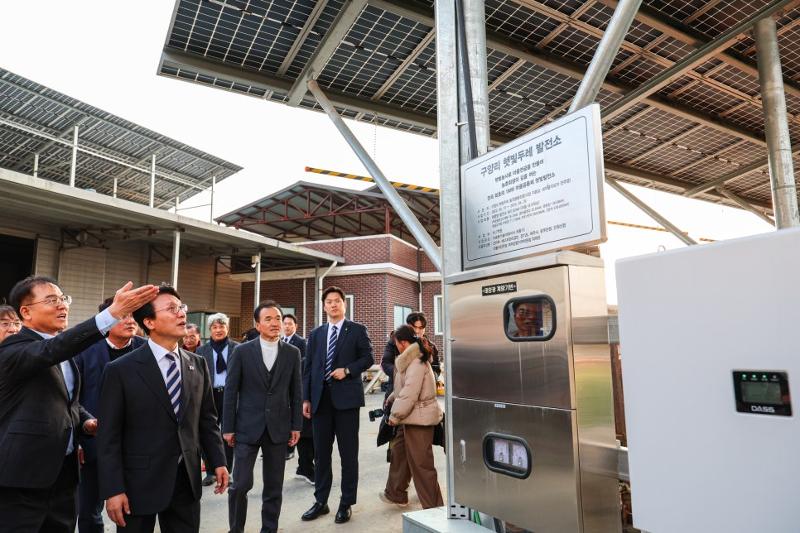
Prime Minister Kim Min-seok (second from left) on Nov. 22 receives a briefing on a solar power plant in the village of Guyang-ri in Yeoju, Gyeonggi-do Province. This community-led project seeks to install solar power facilities in the village and share the resulting profits with residents. (Official blog of Office of the Prime Minister)
By Yoon Sojung
The international journal Science in December last year named the surge in renewable energy activity as "Breakthrough of the Year" for 2025.
This was highly unusual for the Washington-based publication to select an industrial and economic phenomenon for the honor given its focus on purely scientific results. Thus renewable energy has gone beyond being a simple energy transition and toward serving as a practical solution to the climate crisis and a game changer for the economy.
In line with this trend, the Lee administration is pursuing a massive energy transformation centered on renewable energy as a major policy task. In a briefing on its 2026 business plan to the president in December last year, the Ministry of Climate, Energy and Environment presented a blueprint for a "decarbonized Republic of Korea" through the supply of 100 gigawatts (GW) of renewable energy by 2030.
Local governments are leaders in this initiative. By using natural resources like wind and solar power to generate income for residents, they can simultaneously achieve two goals: promotion of regional coexistence and expansion of green energy.
Two model cases of solar power that advances social welfare are the "sunlight pension" of Sinan-gun County, Jeollanam-do Province, and Solar Dure Power Cooperative in the village of Guyang-ri in Yeoju, Gyeonggi-do Province.
A sunlight pension is a profit-sharing system that produces and sells electricity made from solar power and regularly distributes the profits to residents like a pension.
Facing extinction since 2014 due to a rapidly declining population, Sinan-gun turned things around after the system's adoption, with the number of residents restored to growth of 179 in 2023 and 139 in 2024. As a result, the county in May last year received the gold prize for green energy at the Green World Awards, one of the world's top four honors for the environment.
The solar power plant in Guyang-ri is a community welfare model. Since 2024, the village has run a 1 megawatt (MW) facility as a community asset whose profits are shared with the community, with free bus fare and lunch provided. To spread this model nationwide, the plan is to set up more than 2,500 "sunlight income villages" by 2030.
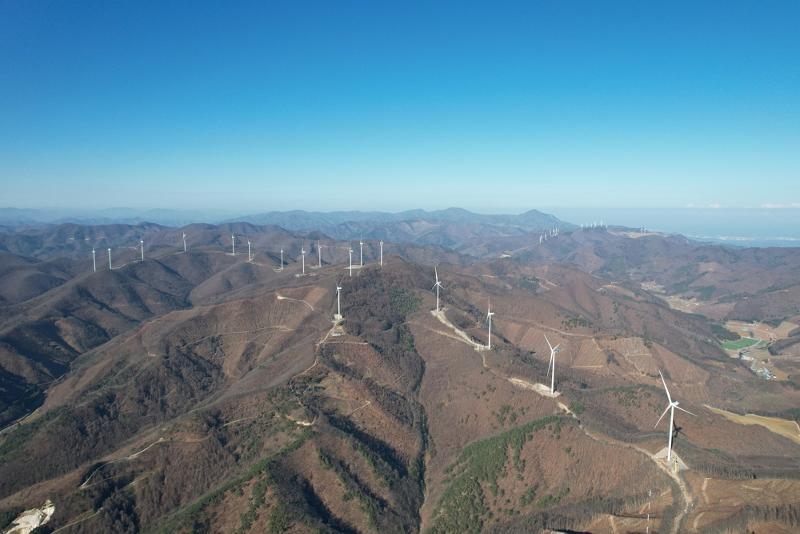
Since going online in February 2022, Taebaek Gadeoksan Wind Power Complex has produced 160,000 MW of electricity every year to power 43,000 households. (Korea East-West Power)
The spread of the "wind pension" is also accelerating. Run by the city government of Taebaek, Gangwon-do Province, and Sinan-gun, this program shares the profits from wind power generated by Taebaek Gadeoksan Wind Power Complex with residents.
As of late last year, such facilities produced 160,000 MW of electricity to power up to 43,000 households a year, more than enough for the city's population of under 40,000. Late last year, this model earned the Prime Minister's Award at the annual Korea Energy Awards for its contributions to profit sharing and job creation.
Offshore wind power is another major tool in the acceleration of the country's energy transition. Passed in March last year, the Special Act on the Promotion of Offshore Wind Power Distribution and Industry Development will take effect next month to set up the institutional framework. The ministry also seeks institutional improvements to aggressively expand from 2030 the commercial scale of offshore wind power, now at 0.35 GW per year.
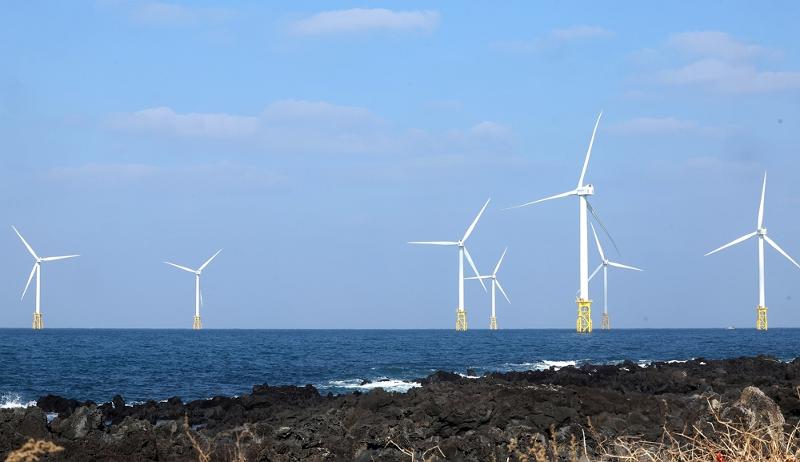
Completed on Dec. 15, 2025, the Hanlim Offshore Wind Power Project on Jeju Island can produce 234 GW of electricity a year to power 65,000 households. (KEPCO)
Completed in December last year, the Hanlim Offshore Wind Power Project on Jeju Island is the culmination of domestic technical excellence. As the country's largest offshore wind farm, the facility generates 234 GW of electricity a year to easily meet the annual needs of 65,000 households on the island.
What stands out about this project is civic participation in renewable energy. Some 1,000 residents of three nearby areas including the village of Suwon-ri in the town of Hamlim-eup of Jeju City are partially sharing the profits from the proceeds in contributing to the regional economy.
Construction of large-scale offshore wind power facilities is also gaining momentum. Jeollabuk-do Province on Jan. 6 selected the Southwest Wind Power Consortium as the project developer for the 0.2 GW offshore area off Gochang-gun County, the first phase of building a 2.4 GW offshore wind farm off the coast of the province's southwestern region.
Another eight to nine regions of the country are speeding up development of offshore wind power by applying to set up related clusters including Incheon; Taean-gun County, Chungcheongnam-do Province; Gunsan, Jeollabuk-do; and Sinan-gun.
arete@korea.kr