- 한국어
- English
- 日本語
- 中文
- العربية
- Español
- Français
- Deutsch
- Pусский
- Tiếng Việt
- Indonesian
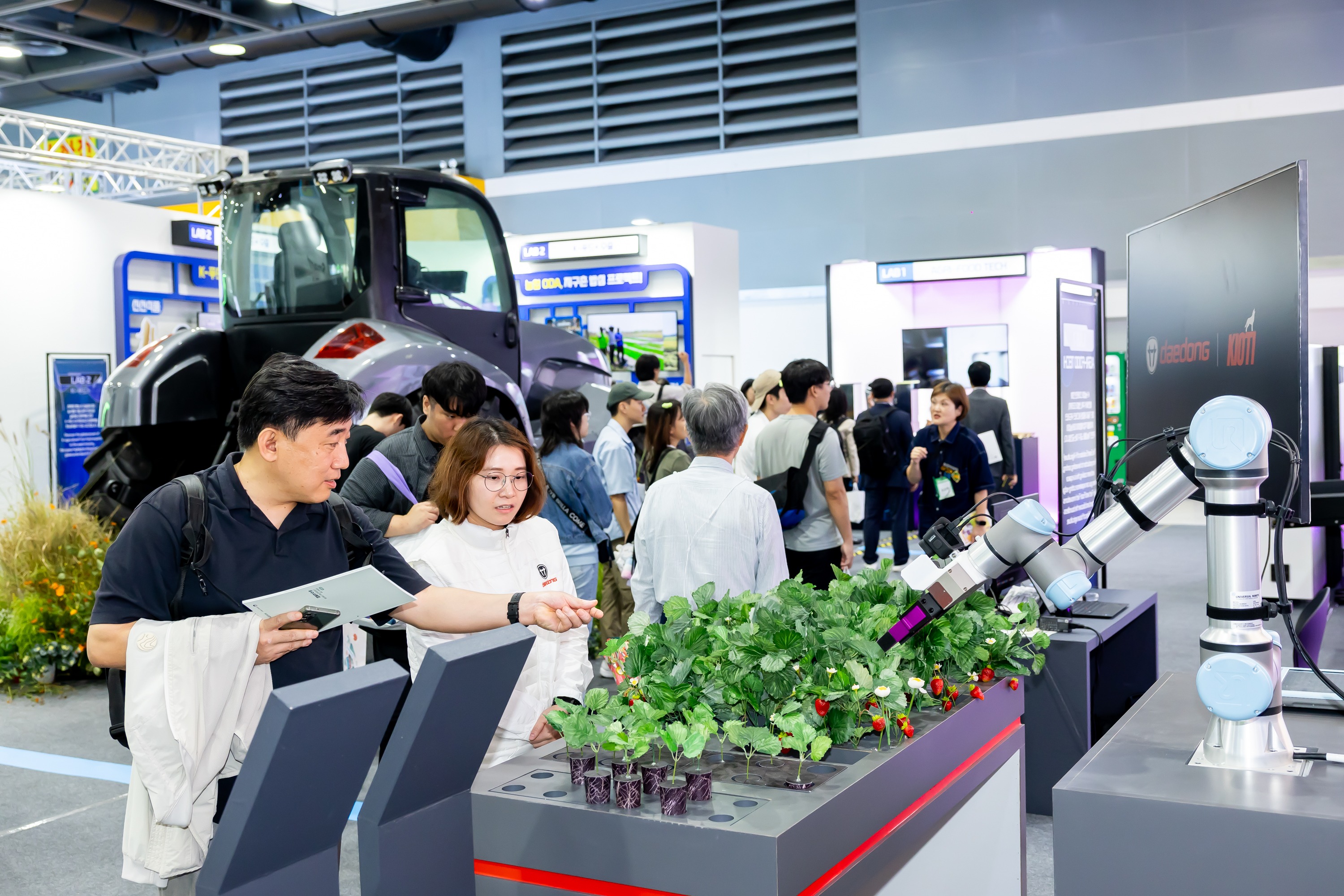
An artificial intelligence-based robot of domestic robotics company Daedong on Sept. 25, 2025, demonstrates harvesting and transportation at the K-Agricultural Innovation Pavilion of Agri Expo Korea at the aT Center in Seoul's Seocho-gu District. (Korea Agricultural Expo)
By Charles Audouin
A government initiative seeks a "major transformation of agriculture and rural artificial intelligence (AI)" to boost farm productivity 30% and cut labor 10% by 2030.
The plan is to integrate AI across all aspects of rural life, from farming to distribution, to alleviate chronic worker shortages and secure future competitiveness.
The Ministry of Agriculture, Food and Rural Affairs and the Ministry of Science and ICT on March 11 announced this as part of a joint strategy for a transformation in agricultural and rural AI.
First in agricultural production, AI and related infrastructure will be supported for open-field farming. This year, irrigation management and monitoring technologies for pests and disease will be applied to some 500 hectares in five cultivation sites for key crops like kimchi cabbage and green onions.
A more affordable model will be devised for small or mid-size farms of half a hectare or smaller.
The development of unmanned farming technologies will use drones and smart agricultural machinery for application to major crops such as soybeans grown in rice paddies and wheat, and will be expanded to a wider range of crops. From June, AI-powered disinfection drones will assess the density of migratory bird habitats and pilot the automation of disinfection facilities at key locations.
A forthcoming AI-based disaster risk map will be based on analyses of weather and disaster data. In addition, a crisis response system will use AI to predict the availability of agricultural groundwater and proactively manage it.
Agriculture and food distribution will also benefit from AI by streamlining processes such as receiving, sorting and shipping at agricultural product processing centers (APCs) and using AI in livestock product grading to raise accuracy and reliability. The goal is to launch 55 "smart APCs" by year's end.
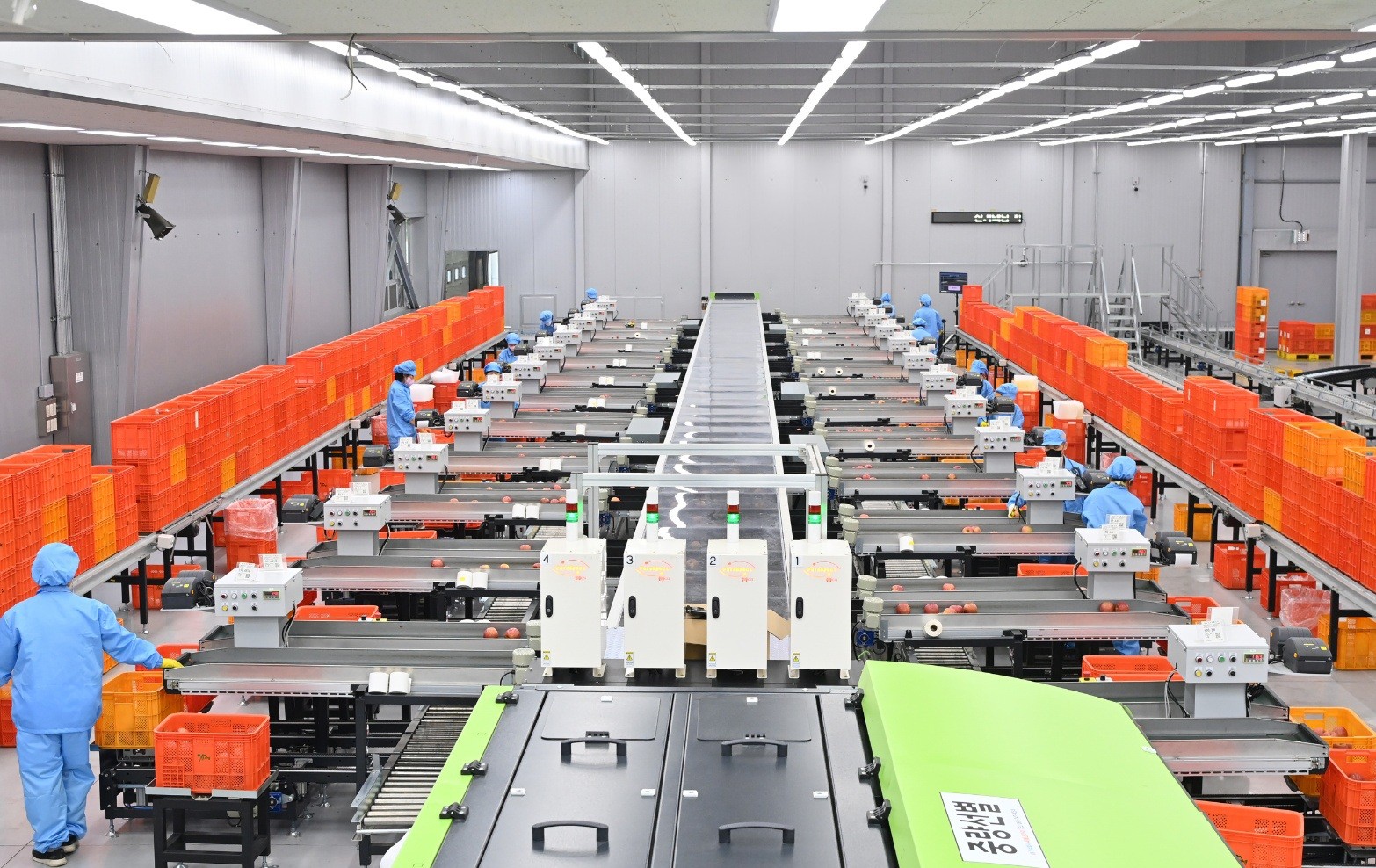
Gyeongsangbuk-do Province since 2023 has promoted the expansion and smartification of 16 of the province's 133 agricultural product distribution centers. (Gyeongsangbuk-do Province)
For example, an APC handling chamoe (Korean melons) in Seongju-gun County, Gyeongsangbuk-do Province, adopted an AI sorting system using high-performance cameras and sensors to automatically detect quality, size and peel defects for classification by grade. This setup raised hourly sorting volume 20%-30% and more than halved labor.
In the second half of the year, a satellite will be launched to determine areas cultivating rice and horticultural and livestock products to improve the system for forecasting farm supply and demand. A pilot program in five regions will also allow consumers to compare agricultural product prices.
To raise the quality of life for rural residents, AI will be adopted in non-contact telemedicine, administrative kiosks, waste sorting and bus stops. Over 100 "smart rural living zones" will be installed by 2030 to provide AI services to improve the rural environment.
For the sustainability of the industrial ecosystem, public support will go toward 3,000 promising startups by 2030 and a utilization system for agricultural data will firm up the foundation of related industries.
"AI is a core basis for determining the survival and future competitiveness of agriculture and rural areas," Minister of Agriculture, Food and Rural Affairs Song Mi-ryung said. "We will make changes to allow people to experience AI in agriculture and rural communities."
"We will actively support the AI transformation in agriculture and rural areas," Deputy Prime Minister and Minister of Science and ICT Bae Kyunghoon added. "We will actively cooperate with the Ministry of Agriculture, Food and Rural Affairs and the Rural Development Administration in a variety of tasks like improvement of agricultural AI capacity and systematic data use."
caudouin@korea.kr