Korea's model of public administration is seeing rising global prominence. The Ministry of the Interior and Safety last month presented benchmarks of public sector advancement to diplomatic delegations from 93 countries, promoting the potential of Hallyu (Korean Wave) in public administration. This series covers five innovative examples like disaster management, smart agriculture, forest restoration and construction of administrative cities.
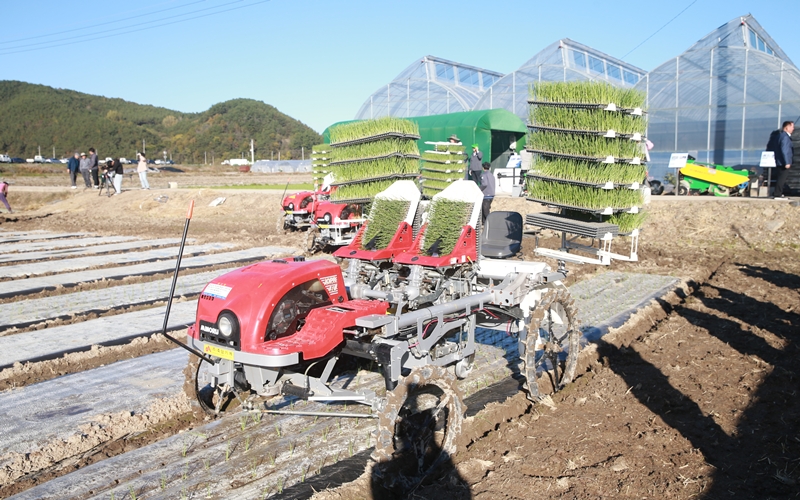
This self-driving tractor is being used at a smart machinery cultivation site. (National Institute of Agricultural Sciences)
By Margareth Theresia
Domestic agriculture faces a severe labor shortage due to rapid depopulation in provincial areas and the aging society. A national census on agriculture, forestry and fisheries found that the agricultural population as a percentage of the national population plunged from 44.7% in 1971 to 4.3% in 2021.
More than half of workers in the field are age 65 or older, thus the super-aged structure undermines the fundamental sustainability of rural areas.
To resolve this demographic crisis and turn agriculture into a future cutting-edge industry, the Rural Development Administration (RDA) is speeding up the adoption of robotics and smart farm machinery in agriculture. Its development of robots for pest control, weeding and transportation and artificial intelligence (AI)-based autonomous tractors and attachable steering systems are greatly raising the efficiency and safety of agricultural operations.
Driverless tractors and rice transplanters outperform even the most skilled farmers. The precision margin of error in conventional manual labor is ± 21 cm but that of self-operating technology is ± 7 cm. The major economic benefits include lower fatigue of workers from repetitive tasks and 25% reduction of overall working hours, and higher productivity thanks to such machines running day and night and even in bad weather.
The use of robotics in farming is a game changer that not only ensures safety on-site but also slashes the financial burden on farms. Pesticide-spraying robots greatly lower the risk of worker exposure to such chemicals, and precision spraying also cuts annual pesticide use 20%-40% compared to conventional methods, saving an estimated KRW 261.9 billion a year.
Weeding and transportation robots can also prevent rollover accidents and musculoskeletal disorders during work.
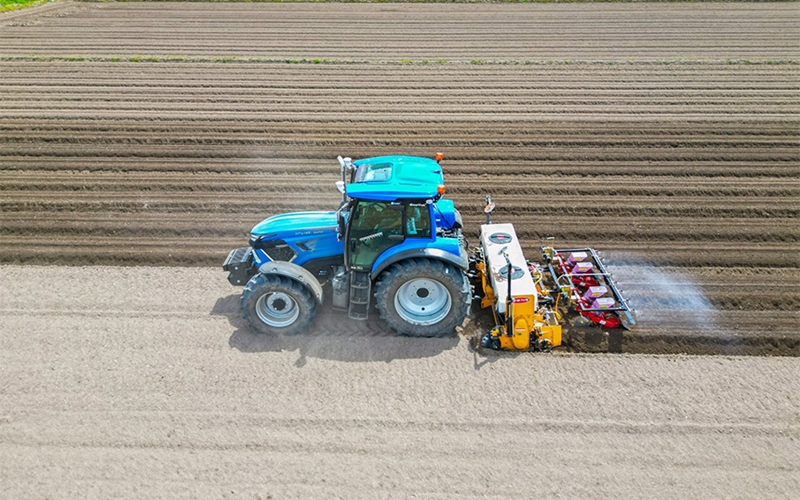
A driverless tractor plants soybeans. (LS Tractor)
The RDA is preparing for an autonomous farming era by combining AI-based recognition and self-driving technologies to automate the entire process from sowing to harvesting. The plan is to devise AI smart agricultural machinery and an integrated control system by 2029 and develop physical AI-based robots to perform tasks requiring high-level skills.
To this end, the organization is collaborating with institutions such as Jeonbuk National University to make intelligent agricultural machinery part of major national projects such as the creation of physical AI-based software platforms.
"Robots are no longer mere auxiliary tools at farms but a practical solution to save rural areas facing extinction," an RDA source said. "AI will surmount the physical limits of rural areas to serve as pivotal driver that opens up new possibilities."
margareth@korea.kr
![[Public admire-stration] ② AI-based disaster response system](/upload/content/image/800fef48140642be8710278532ffb865_20260312082356.jpg)
![[Public admire-stration] ① Detecting potential, hidden disasters](/upload/content/image/38ceae8af2704a64b95c13822897ed16_20251210100934.jpg)