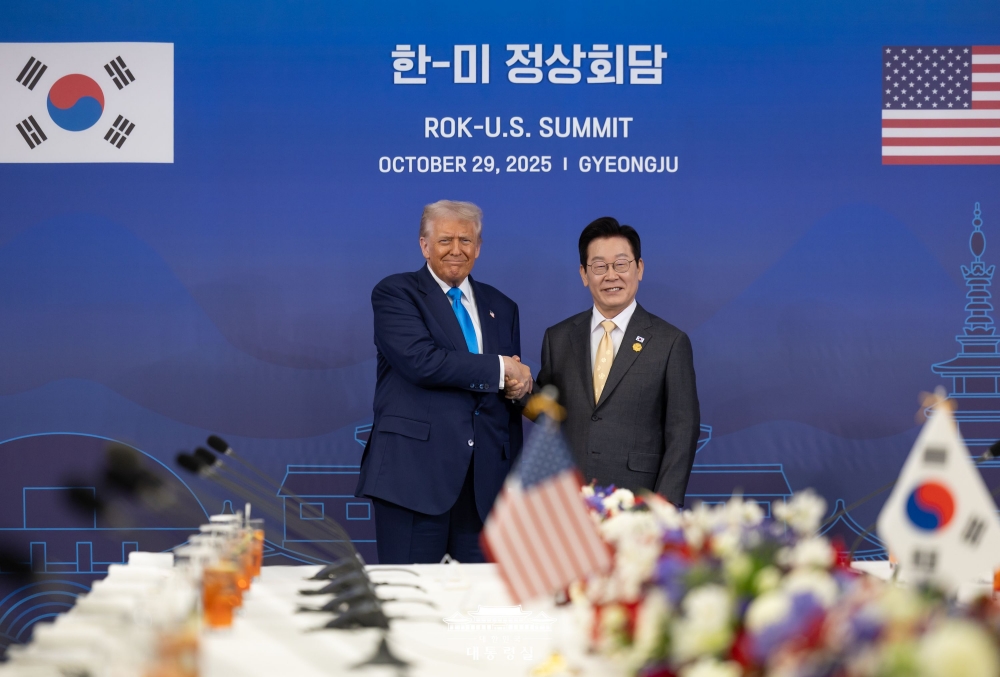
President Lee Jae Myung (right) on Oct. 29, 2025, shakes hands with U.S. President Donald Trump at their bilateral summit in Gyeongju, Gyeongsangbuk-do Province.
By Aisylu Akhmetzianova
Photos = Cheong Wa Dae
Foreign media have called Korea after the first year of the Lee Jae Myung administration a "middle power with pragmatic diplomacy," a "key nation in the artificial intelligence and semiconductor supply chains," and a "powerhouse in the cultural industry."
The Ministry of Culture, Sports and Tourism on June 11 said it found this in an analysis of 64,827 articles on Korea by 67 major media outlets from 19 countries between the launch of the administration on June 4 last year to May 4 this year.
The field most covered by global media was politics and diplomacy (54.3%), followed by business and industry (43.1%), economy (40.4%), culture (27.8%), and technology and information and communications technology (23.9%).
The most frequently used description in foreign affairs was a "pragmatic diplomatic approach."
The Washington Post called Seoul's diplomacy a "delicate balancing act" while the Financial Times of the U.K. said President Lee's diplomatic approach "signalled restraint and pragmatism." The Economist reported the Lee administration's pursuit of "strategic pragmatism."
Bilateral relations with India and member states of the Association of Southeast Asian Nations stayed strong throughout the year, and those with the U.S., China and Japan were also well received.
At the Asia-Pacific Economic Cooperation (APEC) forum in October last year in Gyeongju, Gyeongsangbuk-do Province, the volume of global media coverage surged over 50% compared to the average. At the time, Korea commanded the spotlight as a major battleground for the strategic competition between the U.S. and China and supply chain restructuring.
In the economy, the Korean stock boom driven by AI and semiconductors was cited as the strongest positive factor.
On Korea's status in AI in Asia, Fortune said, "Asia's stock markets have rebounded since the outbreak of the Iran war over two months ago, as the AI boom lifts the fortunes of manufacturing economies like China, South Korea, and Japan."
Reuters reported that Asian tech giants such as Samsung and SK Hynix are forming a new axis in the AI bull market.
The sector with the most favorable buzz was culture, particularly Hallyu (Korean Wave). In 10 of the administration's first 12 months, the most covered Korean topic by foreign media was Hallyu, including BTS and K-pop.
Deputy Minister of Culture, Sports and Tourism Kong Hyungsik said, "This analysis shows how Korea is moving beyond its image of a mere economic power or the homeland of Hallyu in gaining recognition as an important 'global strategic nation.'"
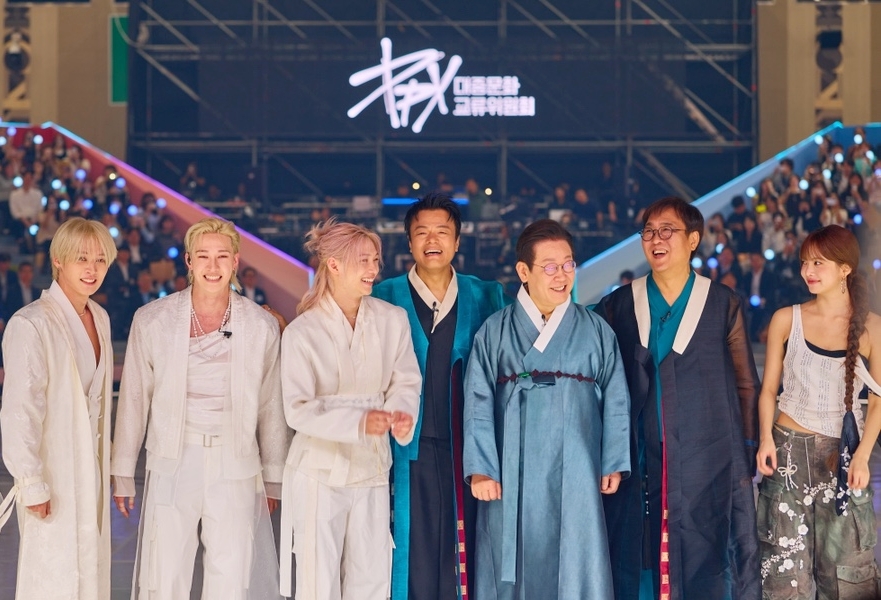
President Lee Jae Myung (fifth from left) on Oct. 1, 2025, poses for photos at the appointment ceremony for the Presidential Committee on Popular Culture Exchange at the convention center KINTEX in Goyang, Gyeonggi-do Province. From left to right are three members of the K-pop boy band Stray Kids; the committee's co-chair Park Jin-young, CEO of JYP Entertainment; President Lee; Minister of Culture, Sports and Tourism Chae Hwi-young; and Huh Yunjin of the K-pop girl group LE SSERAFIM.
aisylu@korea.kr
![[President Lee: Year 1] ① Nat'l interests over ideology in diplomacy, security](/upload/content/image/789fb9184e1c4a5096d9e74f23feb58b_20260520132603.jpg)