- 한국어
- English
- 日本語
- 中文
- العربية
- Español
- Français
- Deutsch
- Pусский
- Tiếng Việt
- Indonesian
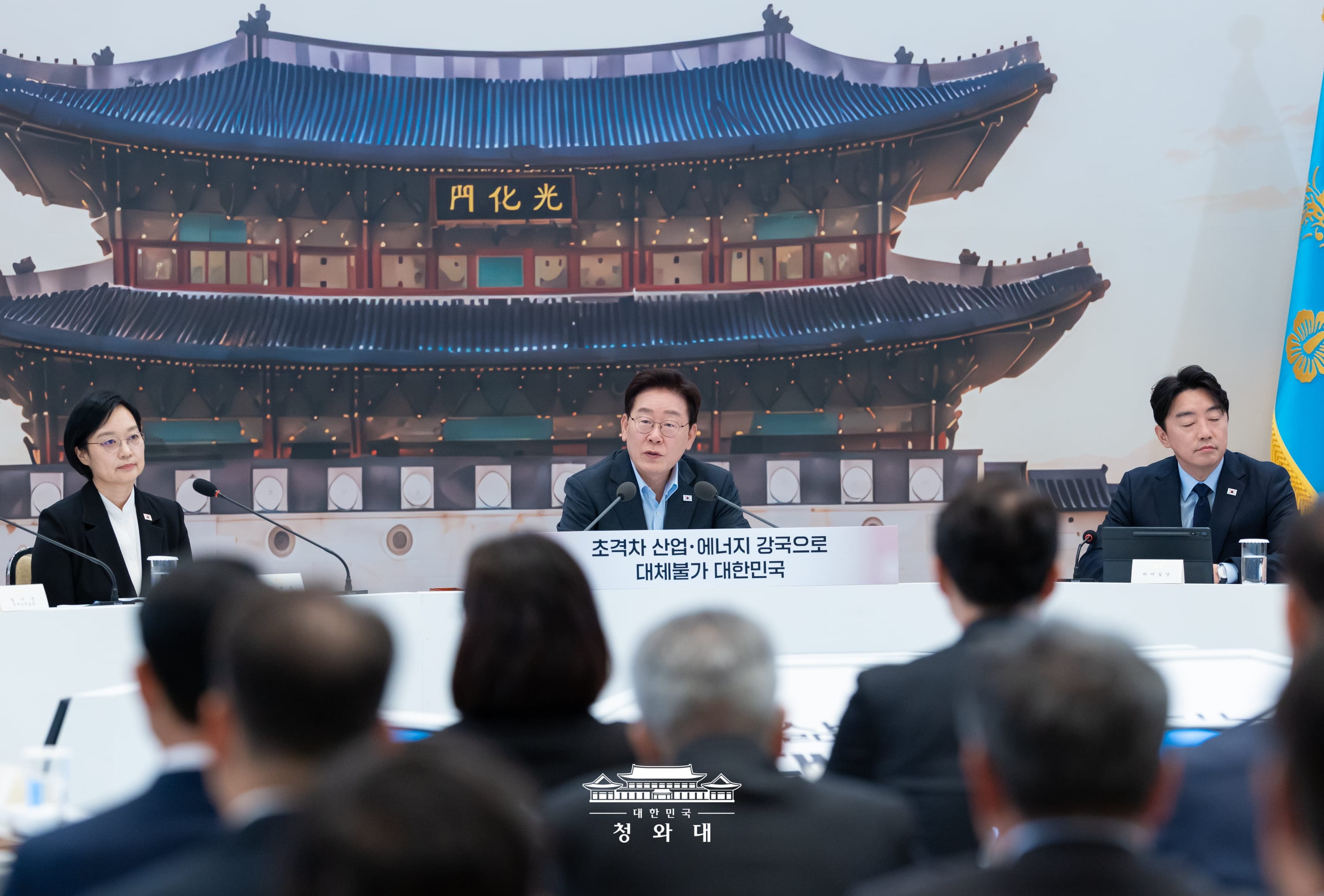
President Lee Jae Myung (center) on Aug. 4 speaks at a joint policy briefing by the Ministry of Trade, Industry and Resources, Ministry of Climate, Energy and Environment, Korean Intellectual Property Office, Nuclear Safety and Security Commission and Korea Meteorological Administration at the official guesthouse Yeongbingwan of Cheong Wa Dae in Seoul's Jongno-gu District. (Cheong Wa Dae)
By Lee Ji Yae
The acceleration of the three national megaprojects focused on semiconductors and artificial intelligence (AI) will seek to make Korea one of the world's top five exporters through incorporating AI in manufacturing and launching of a fund for industrial resource security.
The Ministry of Trade, Industry and Resources on Aug. 4 unveiled this plan at a briefing on industrial and trade policies at the official guesthouse Yeongbingwan of Cheong Wa Dae in Seoul's Jongno-gu District.
The first task is to speed up the development of the three megaprojects. Completion of the general complex of a chip cluster in Yongin, Gyeonggi-do Province, will come 12 years ahead of schedule and that of the national complex will be moved up eight years.
To meet the goal of opening the Yongin complex by 2029, the plan is to complete land compensation by year's end and rapidly build the infrastructure for power and water supply in line with the revised project schedule.
The proposed enactment of laws on mega special zones and RE100 (Renewable Energy 100%) industrial complexes will seek institutional support for investment in provincial growth growth engines and the three megaprojects.
The ministry is also expediting efforts to make Korea one of the world's top five exporters and lay the basis for exports worth USD 1 trillion. In distribution, it will support the simultaneous overseas expansion of domestic products and platforms, while helping companies develop market-specific sales strategies and expand the domestic issuance of globally recognized certifications.
To support strategic sectors such as the defense industry, nuclear power and electricity, trade finance worth KRW 18 trillion will be allocated this year and a combined KRW 127 trillion by 2030. Planned amendments to laws on the Korea Trade-Investment Promotion Agency and trade insurance will seek to diversify export support programs and expand trade finance.
To accelerate AI transformation in manufacturing, the plan is to digitize the tacit knowledge of skilled workers at 30 work-related sites and develop AI models trained with the expertise and know-how of master craftsmen. Pilot operations of humanoid robots at 10 industrial sites including those of steel and semiconductors will perform hazardous and repetitive tasks.
To boost industrial resource security, a proposed fund will help procurement of critical minerals, expand strategic stockpiles of oil and minerals, and diversify import sources of crude oil. The aim is to shift the focus of the domestic energy and resource supply system from short-term efficiency to long-term resource security.
To see early results from key initiatives, the ministry's proposed Policy Performance Innovation Unit will directly report to the minister in monitoring implementation and performance outcomes.
ljyhwa@korea.kr