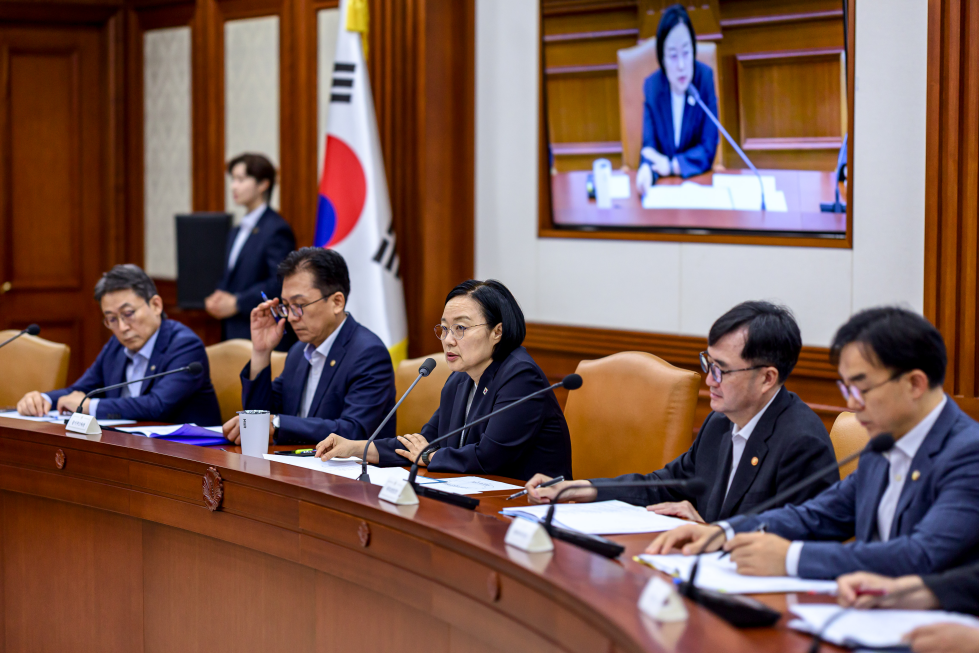
Prime Minister Han Seong-sook (third from left) on Aug. 6 chairs a policy coordination meeting that finalizes a basic strategy for artificial intelligence-based healthcare at Government Complex-Seoul in the capital's Jongno-gu District. (Office for Government Policy Coordination-Prime Minister's Secretariat)
By Xu Aiying
Neighborhood public health centers and primary care clinics in underprivileged areas will adopt medical support tools powered by artificial intelligence (AI).
This initiative aims to reduce gaps in regional, essential and public healthcare and expand the use of medical AI to make it tangible in daily life.
Finalized on Aug. 6 at a policy coordination meeting chaired by the prime minister, a basic strategy on AI healthcare comprises three major strategic areas and 12 key initiatives such as AI healthcare innovation tangible in daily life, launch of nationwide digital infrastructure for such innovation and creation of a sustainable AI healthcare ecosystem.
First, medical institutions such as public health centers and their branches nationwide will adopt AI-powered tools for primary care support, as well as primary care clinics in underserved areas. Such tools will assist in the interpretation of imaging tests such as X-rays, automatically record clinical notes and help chronic disease management.
Pilot operation of an integrated emergency AI platform to support the transfer of emergency patients to hospitals will start in Daegu in the second half of the year. From the ambulance transportation stage, AI will analyze a patient's condition and a hospital's capacity to help find the right medical institution and facilitate transfer.
The expansion of the platform PHR (Personal Health Record) will allow users to access their medical records from multiple healthcare providers in one place. The idea is to reduce the inconvenience of repeating the same tests when switching hospitals and improve continuity of medical care.
An AI highway for public healthcare will connect 72 designated medical institutions nationwide to a national AI platform for public medicine.
An AI-driven system of hospital information will help patients from the moment they arrive at a hospital until their discharge, as well as "AI-specialized" hospitals in each region that use AI transformation models in clinical settings.
Overall hospital services ranging from medical care and nursing to surgery are undergoing redesign using AI, with hospital visits to grow more convenient from registration to discharge.
"AI is a tool for filling gaps in regional, essential and public healthcare and protect the lives of the public," Minister of Health and Welfare Jeong Eun Kyeong said. "With the adoption of this basic strategy for AI healthcare as a starting point, we will work with relevant ministries including the Presidential Council on National Artificial Intelligence Strategy and the Ministry of Science and ICT to smoothly implement this strategy so that the entire nation can benefit from AI-driven healthcare innovation."
xuaiy@korea.kr