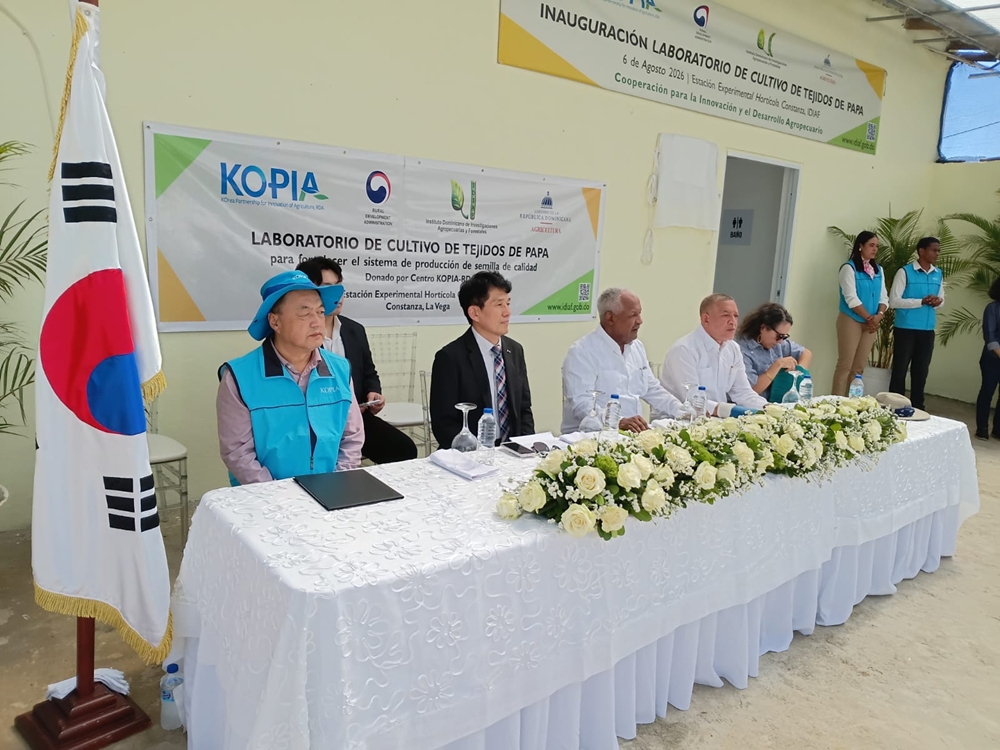
The completion ceremony of a laboratory to produce seed potato tissue culture free from disease is held on Aug. 6 in the town of Constanza in the Dominican Republic. (Rural Development Administration)
By Jeong Euiseok
The Rural Development Administration (RDA) has built a laboratory in the Dominican Republic to produce seed potato tissue culture free from disease to help the island country get self-sufficient in producing the vegetable.
The RDA on Aug. 6 said it held a completion ceremony for the lab at the horticulture branch of IDIAF, a public institution for agricultural and forestry research and development, in the Dominican town of Constanza. The event was organized by the office of the Korea Partnership for Innovation of Agriculture (KOPIA) on the island, and the facility has begun full-scale operations.
The lab is expected to raise the stability of the Caribbean country's domestic supply of disease-free seed potatoes.
Since 2017, the KOPIA office has developed phased technologies for seed potato production customized for the Dominican market and conducted field trials. In 2023, it launched a pilot program to develop villages that produce the vegetable.
From February to May this year, the office converted a warehouse into the lab capable of mass-producing the foundation stock of homegrown seed potatoes.
The facility is expected to independently churn out around 5,000 plants of disease-free seed potato foundation stock. This will enable the phased development of a domestic production based for general distribution stock potatoes capable of supplying some 1,000 hectares of cultivated land.
RDA Deputy Administrator Kim Sangkyung said, "Through technical support toward setting up a domestic system of seed potato production, we will upgrade this into a model of international development cooperation that promotes agricultural self-sufficiency and raises Korean agriculture's presence overseas."
innocence@korea.kr