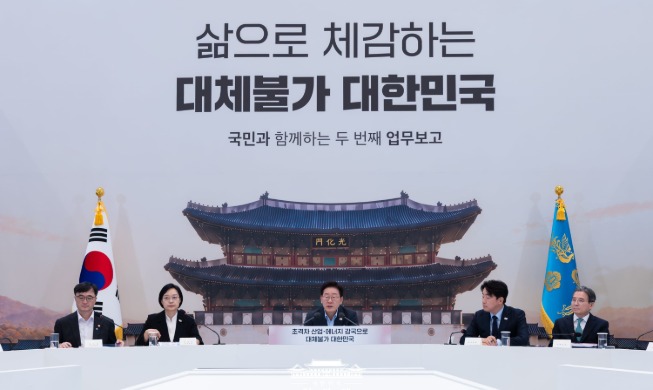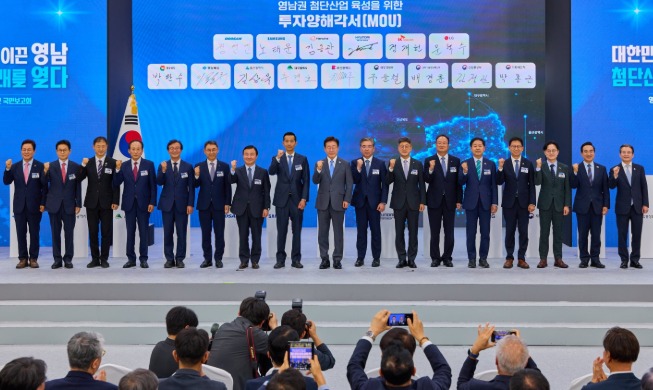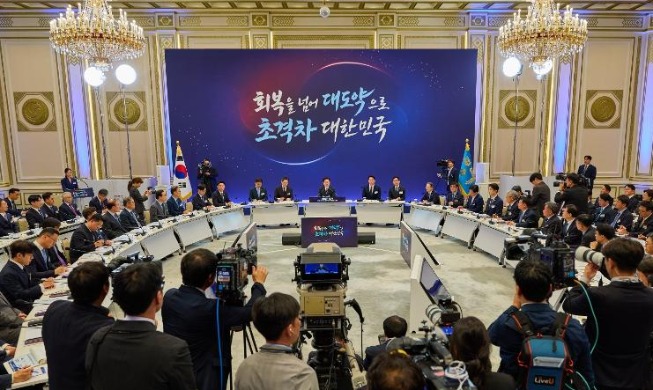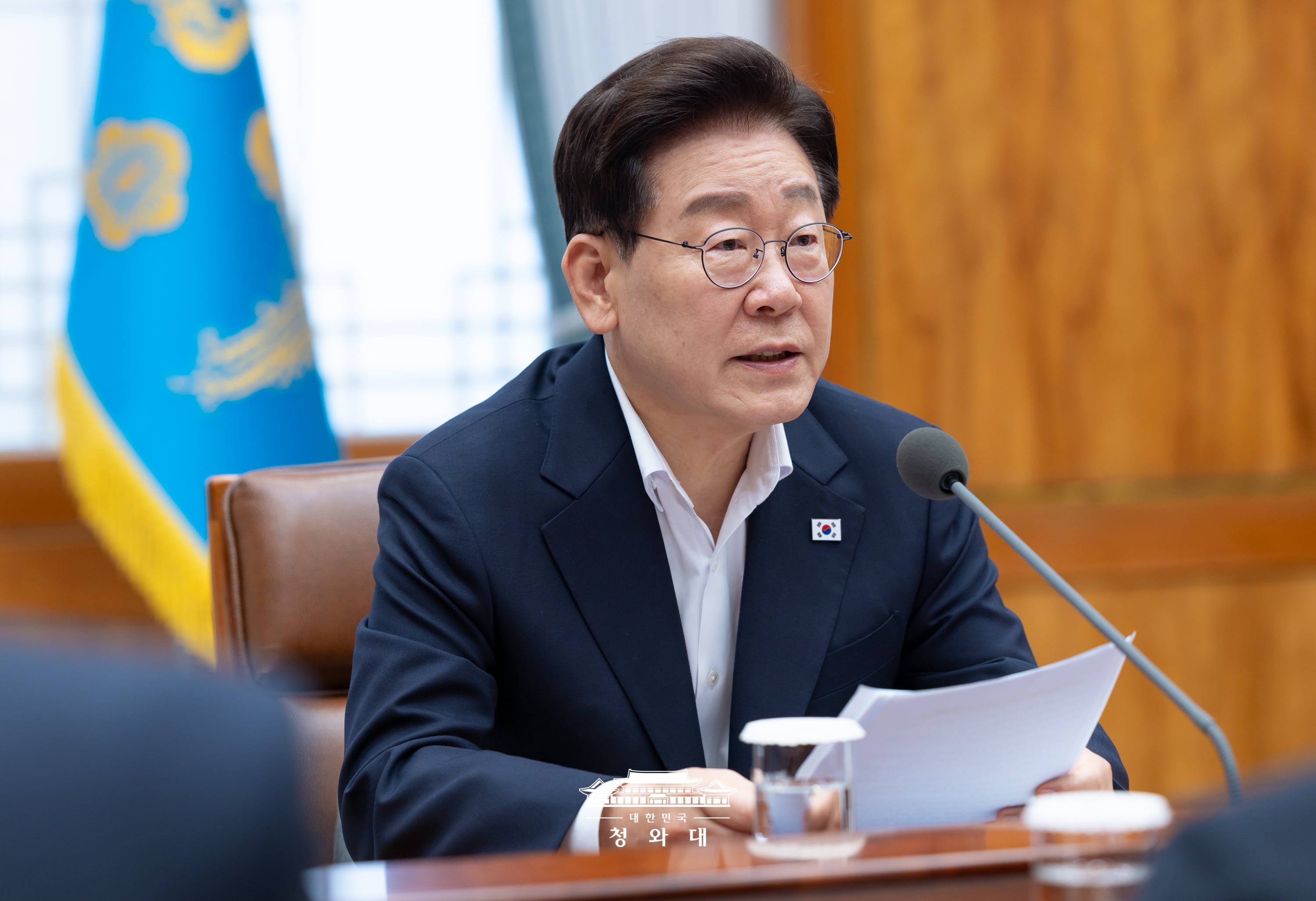
President Lee Jae Myung on Aug. 10 speaks at the second meeting of a joint inspection by the public and private sectors on his administration's three megaprojects at Cheong Wa Dae in Seoul's Jongno-gu District. (Cheong Wa Dae)
By Lee Ji Yae
The planned enactment of a special law on mega industrial zones this year seeks to accelerate the Lee administration's three major megaprojects.
The relocation of Gwangju Air Base in the country's No. 6 city will also be completed by the second half of 2028 to enable earlier construction of the Honam Semiconductor Industrial Complex in the country's southwestern region.
Presidential Chief of Staff Kang Hoon-sik on Aug. 10 announced this at a briefing following the second meeting of a joint inspection by the public and private sectors on the megaprojects. Participants reviewed the progress of the ventures announced on June 29 and discussed spreading the benefits of these investment projects across regions and the overall industrial ecosystem.
The proposed law on mega special zones will streamline licensing procedures and environmental impact assessments as well as accelerate the development of infrastructure such as electricity, water and transportation as well as living conditions like housing and educational facilities.
To this end, Cheong Wa Dae will launch an organization overseeing the megaprojects. A pan-government council to be set up under the Office of the Prime Minister will also boost inter-ministerial cooperation, and the use of a "proactive" administrative system will expedite the processing of related tasks.
Public investment will be sped up in the Honam chip cluster. The relocation and temporary transfer of air force operations from 8.26 square km of the air base, a candidate site for a national industrial complex, will be done by the second half of 2028 to allow early construction of the semiconductor zone.
Also announced were measures to ensure stable power supply. The Phase 1 power transmission line will undergo rapid construction to begin supplying electricity from late 2028 and the expansion of power generation capacity will use renewable energy, energy storage systems, and generation of power through combined heat and power and liquefied natural gas.
"We will meticulously monitor and back the implementation of corporate investment plans to ensure that these megaprojects proceed smoothly," Chief of Staff Kang said. "We will see to it that the industrial ecosystem grows together alongside these ventures."
ljyhwa@korea.kr