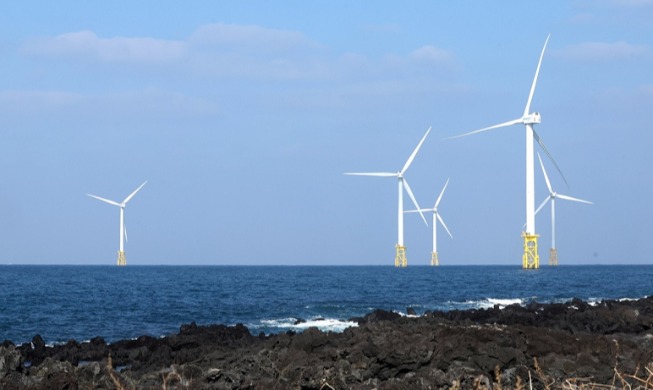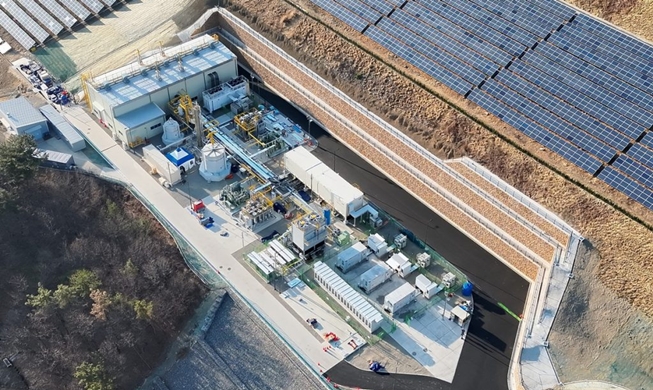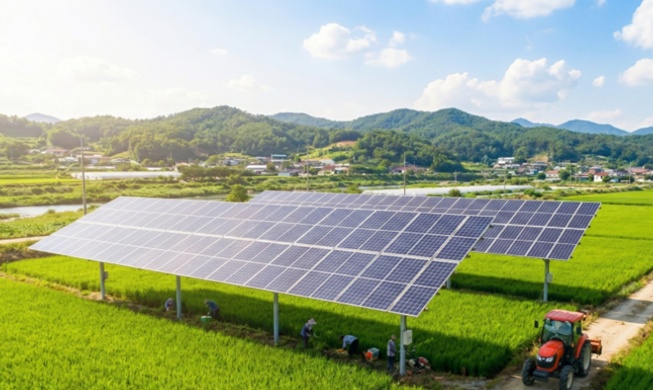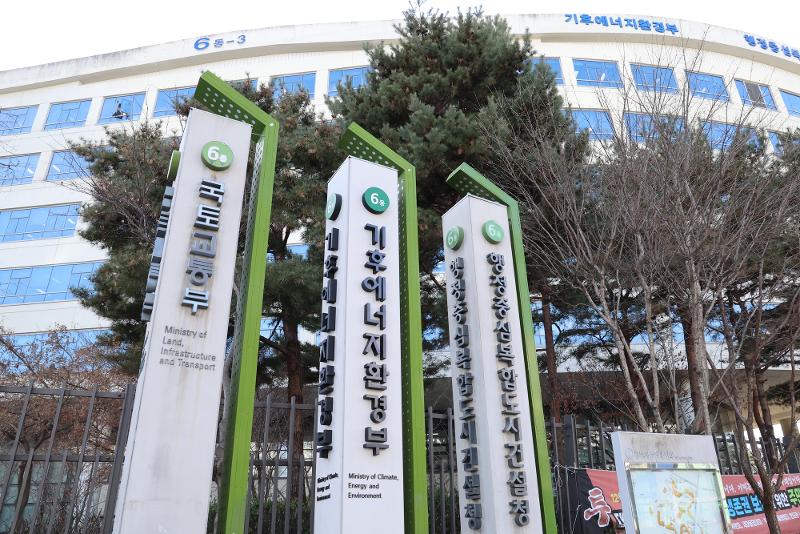
The National Assembly on Aug. 20 passed amendments to seven energy and environment-related laws including those for power grid expansion and renewable energy reform. Shown is a view of the Ministry of Climate, Energy and Environment at Government Complex-Sejong in Sejong. (Yonhap News)
By Koh Hyunjeong
The National Assembly on Aug. 20 passed amendments to seven energy and environment-related laws, including the Electric Utility Act and the Act on the Promotion of the Development, Use and Diffusion of New and Renewable Energy.
The revisions lay the groundwork for easing delays in connecting related facilities to the national power grid and expanding resident participation in energy projects.
Small-scale (one megawatt or less) and public-interest projects for renewable energy with community participation like those done near the national power grid will receive priority in connecting to the power system.
The renewable portfolio standard will also be restructured into a long-term contract market based on government-led competitive bidding. New facilities for renewable energy generation will be selected through the method, with the winners signing long-term power purchase deals with the Korea Electric Power Corp. (KEPCO) at fixed prices.
Private capital and expertise will also help resolve chronic delays in power grid construction. Once approved by the Power Grid Expansion Committee, private operators other than KEPCO can participate in national projects for power grid development.
The revisions also set the legal basis to support mitigation of the social and economic impact of the transition to carbon neutrality. The Special Act on Support for Development of Areas Affected by the Closure of Coal-Fired Power Plants specifies measures to ensure employment stability and assist regions affected by power plant closures.
In addition, Act on the Transboundary Movements of Hazardous Wastes and Their Disposal was amended to extend the validity period of permits and reports for the import of waste resources and revise export restriction standards for certain types of waste, thus raising the effectiveness of the resource circulation system.
hjkoh@korea.kr