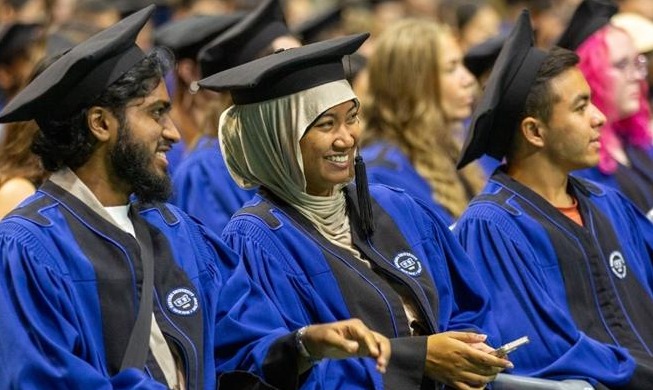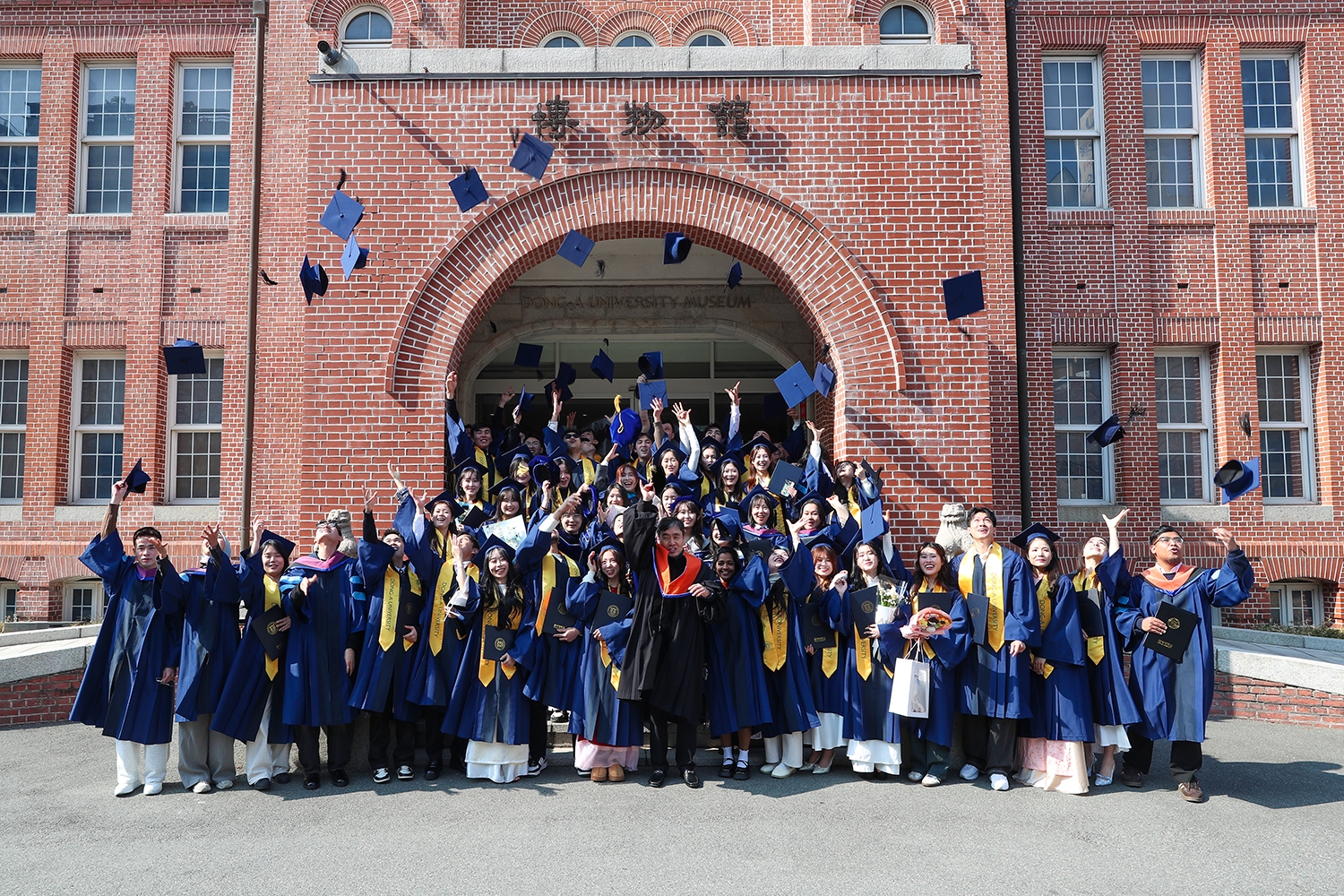
International students on Feb. 11 pose for a graduation photo at Dong-A University's Bumin campus in Busan's Seo-gu District. (Dong-A University)
By Charles Audouin
The region-specific visa program will undergo an overhaul to alleviate labor shortages in provincial industries and encourage foreign nationals to settle in regions outside of the Seoul metropolitan area.
The Ministry of Justice on Aug. 24 announced this after releasing the results of a comprehensive evaluation of the program. It also opened applications for the 2027–28 edition, which will start next year, with the deadline being Nov. 10.
The program allows the ministry and metropolitan-level local governments to attract foreign nationals to the provinces based on industrial and social needs by area.
The evaluation found that the program helped ease labor shortages in provincial industries, with little effect on jobs and wages for Korean workers.
The overhaul was in response to criticism that the system failed to reflect the specific needs of such industries by area and was limited in stimulating families to settle and consume in a region.
Under the revamp, the visa system will seek to select talent needed by regional industries and connect education, employment, family accompaniment, regional settlement and consumption.
First, the ministry will strengthen visa planning and management based on regional industrial demand. Previously, local governments could design a program using either an international student (D-2) or professional work (E-7) visa but can now offer and apply both categories.
To prevent indiscriminate recruiting, the number of visa slots will be cut for each metropolitan-level local government from 60–1,000 people to 50–200, while the cap on participants will be cut from 6,790 to around 3,000.
The visa selection process will also be strengthened. Expats in Korea will receive priority, while applicants abroad will be selected on a limited basis only after undergoing preliminary screening including preentry training and Korean-language proficiency testing.
Even at the recommendation stage, metropolitan-level local governments will comprehensively assess the Korean-language skills and willingness of applicants to settle in target regions.
Greater incentives will also seek to stimulate settlement in regions. Foreign students with the regional D-2 visa can switch to a regional E-7 if they find employment in the same region after graduation. Spouses of regional E-7 visa holders can also work within the region, a move seeking to encourage family-based settlement and consumption in target areas.
Justice Minister Jung Sung-ho said, "This reform is not just about expanding the pool of foreign workers, but instead seeks to refine the system to carefully select the talent needed by regional industries and responsibly facilitate a smooth transition, from study abroad to employment, family accompaniment, settlement in a region and contribution to the area economy."
caudouin@korea.kr