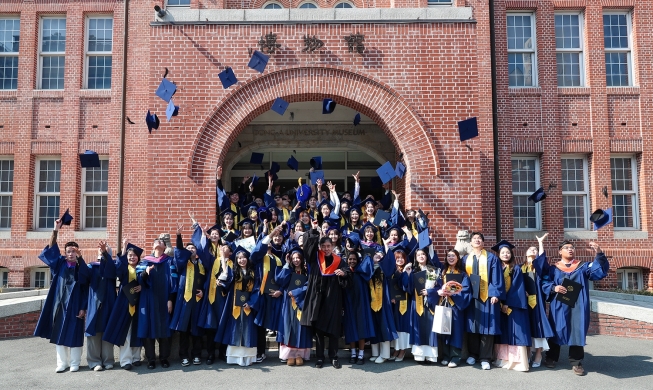
The Ministry of Education on Sept. 8 announced a strategy for developing international student talent through a qualitative-based policy shift. Shown is a welcoming party for foreign freshmen in the second semester of the 2026 academic year held on Aug. 27 at the Humanities and Social Sciences Campus of Sungkyunkwan University in Seoul's Jongno-gu District. (Sungkyunkwan University)
By Lee Da Som
Policy toward international students will shift from expanding enrollment to raising the quality of education and developing outstanding talent, with underperforming universities to face restrictions in recruiting such students.
With the number of foreign students this year surpassing the government's original target of 300,000, the Ministry of Education on Sept. 8 said this in announcing a strategy for developing the talent of such students.
The first step is to prepare a draft standard agreement between universities and study abroad agencies to ensure that the schools manage the entire recruitment process responsibly when using such agents to attract and admit international students.
Provisions to protect such students will be mandatory after relevant laws and regulations are amended.
The International Education Quality Assurance System (IEQAS), which evaluates a university's capacity to educate and manage international students and links the results to visa screening, will undergo revision. From 2029, universities must meet key metrics for the education and management of such students instead of being able to choose select evaluation criteria to obtain accreditation.
International student recruiting by universities that lack basic educational conditions will face strict regulation. Schools that fail to receive institutional accreditation or get tagged as facing a management crisis for two straight years under a financial assessment of private universities will be restricted from recruiting such students.
New policies will seek to attract and develop outstanding foreign talent needed by advanced industries and regional labor markets. The proportion of science and engineering students selected for the Global Korea Scholarship will be raised, and new benefits to woo top talent will include incentives for outstanding research results.
Next year, an accreditation system will be launched for departments that excel in attracting global talent. Departments with a proven track record of helping foreign students find jobs and settle in the regions of their schools will qualify for benefits such as financial support and scholarship allocation.
In the second half of the year, the ministry will finalize a basic plan for the fifth cycle of the IEQAS and sequentially pursue measures like amendments to laws and regulations, launch of an accreditation system for departments that have successfully recruited international talent and setup of a network for foreign students.
Minister of Education Choi Kyo Jin said, "Our focus will be attracting and developing outstanding talent to support international students and allowing them to contribute to our society and those worldwide based on their academic achievements and experiences they gain in Korea, while further enhancing the standing of K-education."
dlektha0319@korea.kr