- 한국어
- English
- 日本語
- 中文
- العربية
- Español
- Français
- Deutsch
- Pусский
- Tiếng Việt
- Indonesian
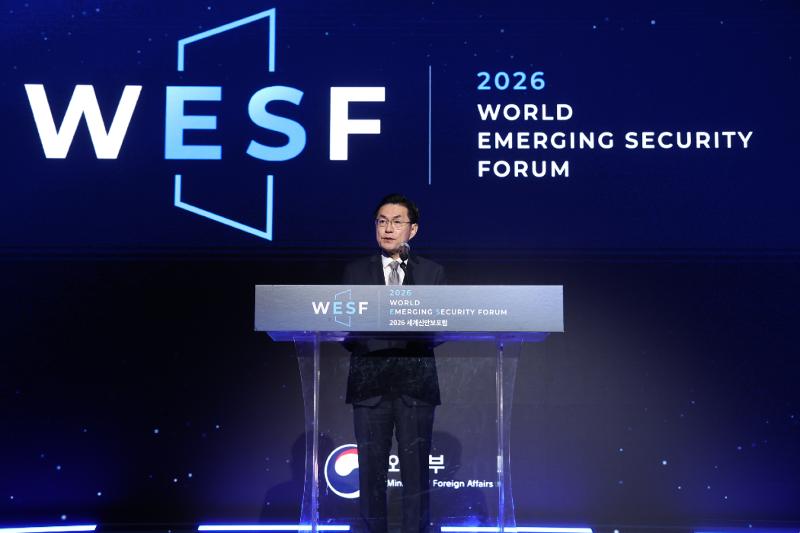
This year's World Emerging Security Forum on Sept. 9 was held under the theme "Emerging Technology: Risks and Opportunities" at the hotel Grand Hyatt Seoul in the capital's Yongsan-gu District. Shown is Vice Minister of Foreign Affairs for Strategy and Intelligence Jeong Yeondoo delivering the opening speech at the event.
By Yoon Sojung
Photos = Ministry of Foreign Affairs
Domestic and foreign scholars have gathered in Seoul to discuss security threats posed by emerging technologies such as artificial intelligence (AI) and drones.
The Ministry of Foreign Affairs on Sept. 9 hosted this year's World Emerging Security Forum under the theme "Emerging Technology: Risks and Opportunities" at the hotel Grand Hyatt Seoul in the capital's Yongsan-gu District. Participants also covered how to achieve coprosperity.
Marking its sixth year, the event attracted about 200 people and 20 speakers including representatives from the government, international organizations, the private sector and academia.
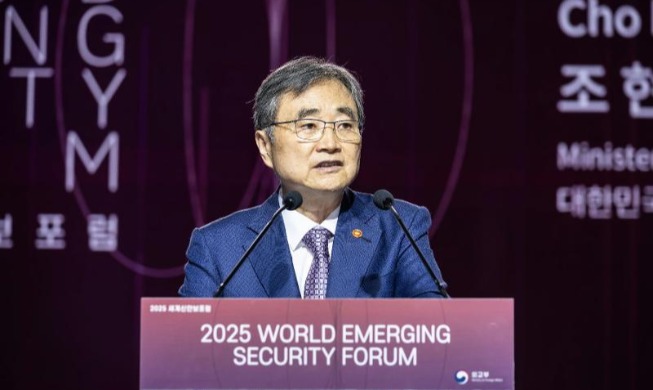
Vice Minister of Foreign Affairs for Strategy and Intelligence Jeong Yeondoo said in his opening speech, "Cooperation within the international community, efforts to set norms and responsible behavior by individual nations are essential for technological innovation to advance in a way that raises security."
He emphasized Korea's efforts to lead the international community, citing the high-level open debate on "AI and International Peace and Security" last year chaired by President Lee Jae Myung at the United Nations Security Council as an example. The vice minister then presented Seoul's "AI for All" vision and pledged to promote a human-centric and inclusive AI environment.
Kim Huy Kang, presidential secretary for cybersecurity, said in a congratulatory speech that emerging technologies such as AI are the most effective means of defense against threats in the modern cybersecurity environment, where attacks are accelerating and tactics are getting more sophisticated.
In line with Seoul's policy announced in June to foster innovative companies in sectors including AI, drones, cybersecurity and aerospace, he added, the administration will seek to link private sector innovation in cutting-edge technologies to national-level cyber resilience.
Panel discussions covered issues such as changes on the battlefield driven by low-cost drones and automation of weapons systems; risk of miscalculation arising from the interplay of AI, cyber and nuclear threats; and the competition for space security triggered by the commercialization of the military.
On the impactful effects of AI on defense and national security, Sami Khoury, a former senior cybersecurity official of the Canadian government, warned that AI has lowered the threshold for the time, cost and expertise needed to launch cyberattacks.
Guy Lalanne, senior economist at the Directorate for Science Technology and Innovation of the Organisation for Economic Co-operation and Development, highlighted the limitations stemming from the concentration of the global semiconductor supply chain.
"The most serious threat posed by AI is the undermining of democracy," said Oh Il Seok, director of emerging security studies at the Seoul-based Institute for National Security Strategy. "As a global leader in democratic resilience, Korea must actively confront the harm and impediments that AI poses to democracy."
On civilian defense against AI-driven cyberattacks, Khoury advised to simply adhere to "basic cyber hygiene" such as applying the latest security patches and enabling multi-factor authentication to effectively block attacks.
Peter Anstee, national security policy lead for global affairs at OpenAI, underscored the need to approach technology's role with great caution based on established principles when integrating AI into the defense sector.
"The greatest risk posed by AI is the eradication of critical thinking," Director Oh added. "Develop the habit of thinking for yourself to find answers rather than relying solely on AI-generated responses."
On how the government and the world can support AI in way that raises national security without stifling technological innovation, he said, "We need to pursue 'sovereign AI.'"
"Security regulations pose a major hurdle to sharing defense-related data with the private sector," he added. "It's important to break away from the Sino-U.S. duopoly for launching an independent normative framework that represents the interests of likeminded middle powers."
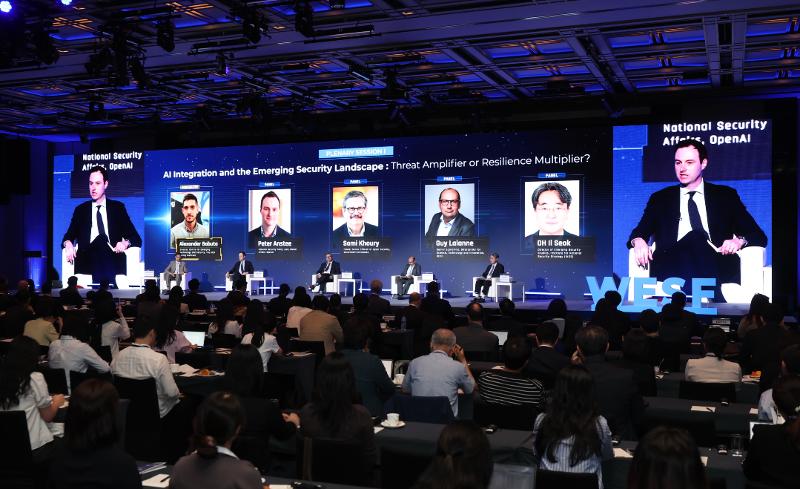
Panelists at the World Emerging Security Forum on Sept. 9 discuss integration with AI and the emerging security landscape at the hotel Grand Hyatt Seoul in the capital's Yongsan-gu District.
arete@korea.kr