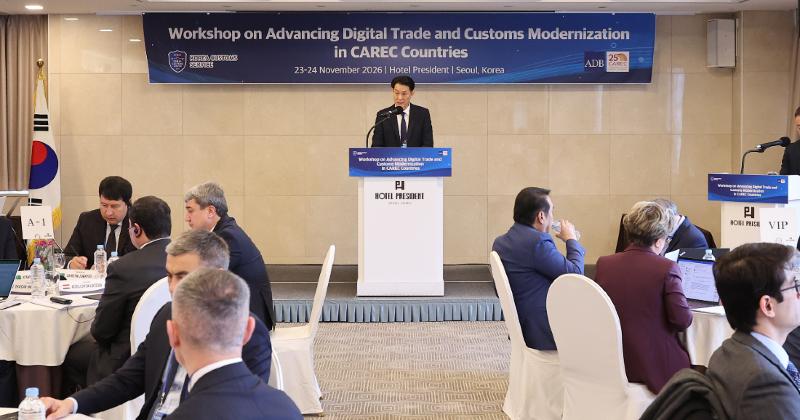
Han Min, director general of the International Affairs Bureau at the Korea Customs Service, on Nov. 23 delivers the opening speech at a workshop for member countries of the Central Asia Regional Economic Cooperation Program at Hotel President in Seoul's Jung-gu District. (Korea Customs Service)
By Yoon Sojung
The Korea Customs Service (KCS) has hosted a workshop for member countries of the Central Asia Regional Economic Cooperation (CAREC) Program to share the country's know-how and experiences customs administration like e-customs clearance systems, the use of artificial intelligence (AI) and initiatives driven by big data.
The watchdog from Nov. 23-24 hosted a workshop at Hotel President in Seoul's Jung-gu District jointly with the Asian Development Bank (ADB) on the theme "Advancing Digital Trade and Customs Modernization in CAREC Countries."
CAREC comprises five Central Asian states -- Kazakhstan, Uzbekistan, Kyrgyzstan, Tajikistan and Turkmenistan -- along with the six neighboring countries of China, Mongolia, Azerbaijan, Georgia, Pakistan and Afghanistan.
The workshop was part of a three-year cooperation project launched under a memorandum of understanding signed in 2023. The 26 attendees included officials from 10 CAREC member countries excluding Afghanistan, the ADB and the Asian Development Bank Institute, and the Paris-based International Chamber of Commerce.
The agenda focused on trade facilitation among member countries, digital trade, data interoperability and global standards, the legal recognition of e-trade documents and strategies for building cross-border trust.
The KCS provided a real-time demonstration of Uni-Pass, Korea's e-customs clearance system, and presented examples of innovation involving the use of AI in customs operations and risk management cases like the use of big data analysis to detect smuggling.
"Facilitating digital trade through the interconnection of systems and data exchange between customs authorities are a vital basis for lowering trade costs for businesses and expanding trade," said Han Min, director general of the KCS' International Affairs Bureau. "We will do our best to help the continued advancement of customs administration in Central Asia and boost cooperation to ensure that businesses can trade smoothly in a favorable environment."
arete@korea.kr